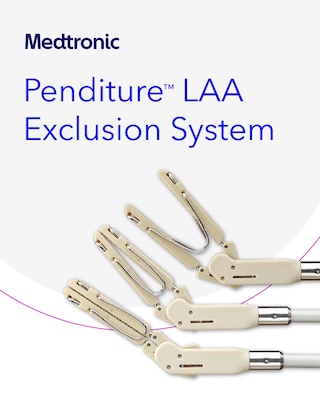
exClusion of the Left atrIal appendage with PendITure (CLIP-IT) post-market study

Objective and study design

The exClusion of the Left atrIal appendage with PendITure (CLIP-IT) post-market study is a clinical investigation designed to collect post-market clinical evidence on the performance and clinical outcomes of the Penditure™ device in patients undergoing concomitant cardiac surgery.

The study endpoints will further analyze the safety and efficacy of the device when used for surgical LAA management under direct visualization.

This is a prospective, multicenter, single-arm, nonrandomized, interventional post-market study generating data on performance and clinical outcomes of the Penditure™ LAA exclusion system following its commercial introduction in the United States.


Study results

  • 100% rate of successful exclusion of the LAA from the heart defined as the absence of residual communication (≤ 3 mm residual contrast communication) between the left atrium (LA) and the LAA2
  • 100% successful recapture and redeployment of the clip when the recapture feature was used2
  • 0% composite rate of device-related serious adverse cardiac events at 30 days post-procedure2
  • 100% electrical isolation, as observed in the evaluated subset†,2

† Subset is n = 25.


Study population

150 

subjects were implanted

15

clinical sites across
the United States

All subjects had 
clinical indication

for surgical LAA management


Follow-up schedule and endpoints

Participants will undergo a structured follow-up process:

  • Acute procedural assessment at the time of surgery
  • Safety evaluation at 30 days and all follow-ups
  • LAA exclusion assessment at three months
  • Long-term follow-up at 12, 24, and 36 months


The primary outcomes measured efficacy via successful LAA exclusion confirmed by multidetector CT (MDCT) scan at three months, and safety through device-related serious adverse cardiac events at 30 days.

The secondary outcomes evaluated technical success at the time of procedure, defined as proper placement verified by intraoperative transesophageal echocardiography (TEE) without tissue damage requiring intervention. Long-term safety will also be tracked via device-related adverse events at one, two, and three years post-procedure.


This timeline allows for evaluation of both short-term procedural success and long-term durability of LAA exclusion.

Subject requires surgical LAA management

Acute procedural evaluation

Endpoint evaluation

30-day safety evaluation

Three-month LAA exclusion assessment

12-month follow-up

Annual follow-ups at 24 and 36 months


Baseline characteristics and medical history

Demographics and medical history All (N = 150)
Age (years) 67.6 ± 9.9
Sex (%)
      Female
25.3% (38)
      Male 74.7% (112)
Body mass index (kg/m2) 30 ± 5.9
STS predicted risks of mortality (%) 1.7 ± 1.4


Medical history All (N = 150)
Hypertension 82.7% (124)
Prior cerebrovascular accident        14.0% (21)
CHA2DS2-VASc score 3.6 ± 1.6


Medical history All (N = 150)
History of atrial fibrillation 58.0% (87)
      Paroxysmal 66.7% (58/87)
      Persistent 16.1% (14/87)
      Long-standing persistent 17.2% (15/87)
Anticoagulants 45.3% (68)
Aspirin 65.3% (98)
Class I antiarrhythmics 4.7% (7)
Class III antiarrhythmics 10.0% (15)
Other antiplatelets 12.7% (19)


‡ Patients may have been taking > 1 medication.


Procedural characteristics

Procedure information All (N = 150)
Surgical approach
      Sternotomy 98.7% (148)
      Partial sternotomy 0.7% (1)
      Mini-thoracotomy 0.7% (1)
Primary procedure§
      Coronary artery bypass grafting 61.3% (92)
      Surgical treatment of atrial fibrillation 34.7% (52)
      Aortic valve replacement 28.0% (42)
      Ascending aortic aneurysm or dissection repair 13.3% (20)
      Mitral valve repair 11.3% (17)
      Other 10.0% (15)
      Mitral valve replacement 9.3% (14)
      Tricuspid valve repair 8.0% (12)
      Aortic root replacement 5.3% (8)
      PFO closure 3.3% (5)
      ASD closure 0.7% (1)


§ Patients may have had > 1 procedure.


Intraoperative device outcomes

LAA exclusion information All (N = 150)
Mean residual stump (mm) 1.8 ± 2.53
Residual stump < 10 mm 98.6% (145/147)
Mean distance of clip from circumflex artery (mm) 6.9 ± 8.4
LAA electrically isolated from LA 100% (25/25)
Full recapture 8.7% (13/150)
      Successful recapture and redeployment 100% (13/13)


◊ Based on site-reported TEE.
 

Device model All (N = 150)
LAAC35 16.0% (24)
LAAC40 34.0% (51)
LAAC45 32.7% (49)
LAAC50 17.3% (26)