
| Item number | Description |
|---|---|
| PMB4000 | BIS™ Advance monitor |
| PMB4000DOC | BIS™ Advance monitor docking station |
| PT00059589 | BIS™ Advance monitor power cord, 10A, 10 ft, black (NEMA 5-15P) |
| PMB4000PMT | BIS™ Advance monitor IV pole mount |
| PMAC71STAND | BIS™ Advance monitor desktop stand |
| PMC80CB | BIS™ Advance pEEG module with integrated host cable, sensor cable (PMCBSENSORCBLE), and BIS™ Advance pEEG module mount (PMAC80BR01) |
| PMCBSENSORCBLE | BIS™ Advance pEEG module sensor cable (spare part) |
| PMAC80BR01 | BIS™ Advance pEEG module mount (spare part) |
| PMB4000PEM | BIS™ Advance monitor power supply mount and BIS™ Advance pEEG module mount in one |
| PMAC80BR03 | BIS™ Advance pEEG module IV pole clamp |
| PMAC80BR02 | BIS™ Advance pEEG module data cable |
| 186-0106 | BIS™ quatro sensor (box of 25) |
| 186-0200 | BIS™ pediatric sensor (box of 25) |
| 186-0212 | BIS™ bilateral sensor (box of 10) |
| 186-0160 | BIS™ extend sensor (box of 25) |


Brain channel monitoring
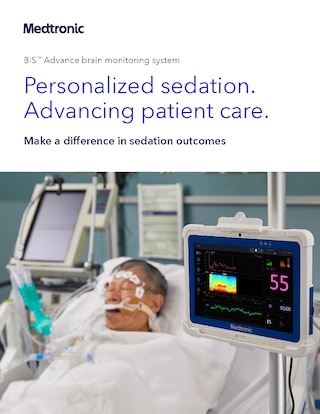
BIS™ Advance monitor
<p>The BIS™ Advance system is designed to monitor the hypnotic state of a patient's brain based on the acquisition and processing of EEG signals.</p>
BIS™ brain monitoring benefits at a glance
May provide up to 38% reduction in primary anesthetic delivery6, 7, 9-11
29% reduction in the risk of postoperative delirium12
27% to 53% faster wake-up times3, 7, 9, 13
Personalized anesthesia, now with cleaner EEG signal capture.†
Perfecting your art. Advancing patient care.
Built on a clinically proven foundation, the latest generation of BIS™ technology delivers a cleaner, more accurate EEG signal for clinical interpretation.
The BIS™ Advance pEEG module features enhanced artifact protection through improved ECG filtering and analog-to-digital signal conversion at the sensor to reduce signal interference. Integrated two- and four-channel monitoring within a single module, future-ready software upgrade capabilities, and an improved mechanical design provide a flexible platform built for today's clinical needs and tomorrow's innovations.†,14

BIS™ Advance pEEG module features

Enhanced ECG filtering helps reduce cardiac signal artifacts†

Converts EEG signal from analog to digital directly at the point of connection with the sensor, preserving a more accurate EEG signal†

Supports both two- and four- channel monitoring within a single device

Provides a next-generation hardware and software platform ready to support future parameter expansion and advanced monitoring capabilities

Expanded internal memory (from ~32 MB to ~50 GB) to store ~1,000 hours of raw EEG and processed variables‡
† Compared to legacy BIS™ modules.
‡ Data is automatically deleted when reaching the threshold. User discretion at downloading is required. Data may be deleted according to local procedures and regulations.
Frequently Asked Questions
What parameters are available on the BIS™ Advance system?
- Signal quality index (SQI)
- Electromyogram (EMG) shown in numerical form and as a bar
- BIS™ index value
- Suppression ratio (SR)
- Suppression time (ST)
- Median frequency (MF)
- Spectral edge frequency (SEF)
- Density spectral array (DSA)
- Electroencephalography (EEG) with adjustable amplitude scale and sweep speed
- EEG power asymmetry index (ASYM) with BIS™ bilateral sensor
- Burst count with BIS™ bilateral sensor and BIS™ extend sensor
What sensors function with the BIS™ Advance system?
- BIS™ quatro sensor: Measures brain activity in adult patients undergoing general anesthesia or sedation.
- BIS™ pediatric sensor: Measures brain activity in pediatric patients four and up for individualized anesthetic management.
- BIS™ extend sensor: Measures brain activity and burst count in adult patients who require longer periods of monitoring, including those in the ICU.
- BIS™ bilateral sensor: Measures the hemispheric differences in the brain with the Asymmetry Indicator (ASYM).
What is the BIS™ Advance pEEG module?
The BIS™ Advance pEEG module is the system component that processes the raw EEG signal and delivers the BIS™ index value and other parameters and trends when used with the BIS™ Advance monitor or integrated OEM monitoring platforms.
What does “two-channel and four-channel in one module” mean?
The BIS™ Advance pEEG module supports both unilateral (two-channel) and bilateral (four-channel) monitoring within a single hardware device, reducing SKUs and streamlining procurement workflows.

The BIS™ brain monitoring system should not be used as the sole basis for diagnosis or therapy and is intended only as an adjunct in patient assessment.
Webinars
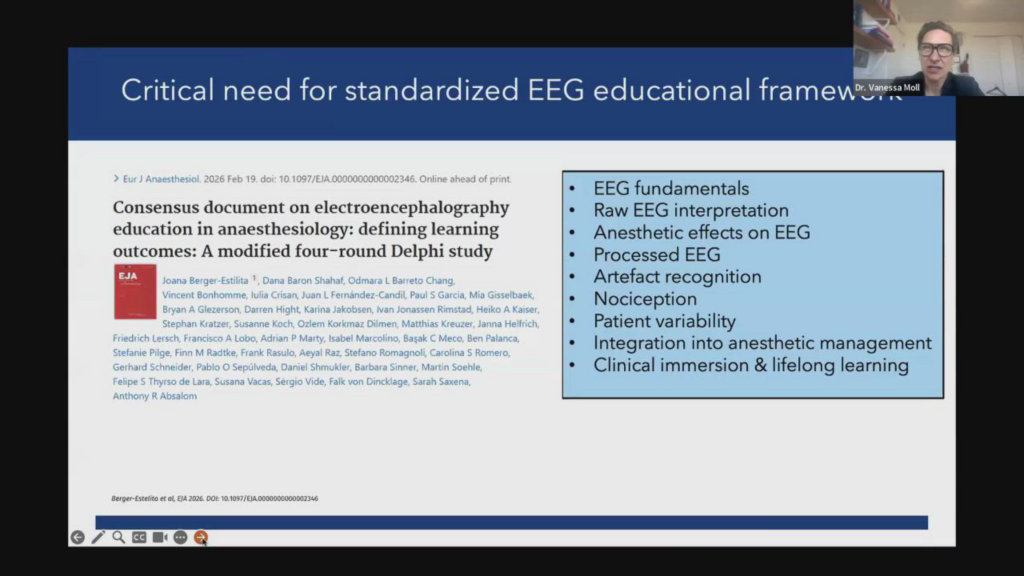
Reading between the lines: The good, the complex, and the untapped beyond the index
Vanessa Moll, MD, PhD, FASA, FCCM
37:01
Minds Matter: Brain ERAS for cognitive protection & age-friendly care
Carol Peden, MB ChB, MD MPH, FRCA FFICM, FACHE
Lis Evered, MBiostat, PhD, (Hon) FANZCA
58:05
On-demand training

BIS™ Advance on-demand training: Why BIS™ technology?

BIS™ Advance on-demand training: Overview of the BIS™ Advance monitor

BIS™ Advance on-demand training: Workflow and customizing trend data
Software Bill of Materials (SBOM)
To receive the Software Bill of Materials, please email us.
Ordering information
Resources







Related links
Related products
-
 BIS™ quatro sensorThe BIS™ quatro sensor captures EEG signals from the frontal brain cortex that are processed by the BIS™ algorithm and displayed on the BIS™ monitor.
-
 BIS™ pediatric sensor
The BIS™ pediatric sensor, intended for children age 4 and above, captures EEG signals from the frontal brain cortex to be displayed on the BIS™ monitor.
-
 BIS™ extend sensorThe BIS™ extend sensor captures EEG signals from the frontal brain cortex that are processed by the BIS™ algorithm and displayed on the BIS™ monitor.
-
 BIS™ brain monitoring system
The Bispectral Index™ (BIS™) monitoring system processes raw EEG information to provide a direct measurement of the patient’s level of consciousness.
-
 BIS™ bilateral sensorThe BIS™ bilateral sensor captures EEG signals from the left and right hemispheres of the brain's frontal cortex that are processed by the BIS™ algorithm.
† Compared to legacy BIS™ modules.
‡ Data is automatically deleted when reaching the threshold. User discretion at downloading is required. Data may be deleted according to local procedures and regulations.
The BIS™ brain monitoring system should not be used as the sole basis for diagnosis or therapy and is intended only as an adjunct in patient assessment.
- Nelson G, Altman AD, Nick A, et al. Guidelines for pre- and intra-operative care in gynecologic/oncology surgery: Enhanced recovery after surgery (ERAS®) society recommendations — part I. Gynecologic Oncology. 2016;140(2):313-322. doi:10.1016/j.ygyno.2015.11.015
- Zhang C, Xu L, Ma Y, et al. Bispectral index monitoring prevent awareness during total intravenous anesthesia: a prospective, randomized, double-blinded, multi-center controlled trial. Chinese Medical Journal. 2011;124(22):3664-3669. doi:10 .3760 /cma .j .issn .0366-6999 .2011 .22 .012
- Lewis SR, Pritchard MW, Fawcett LJ, Punjasawadwong Y. Bispectral index for improving intraoperative awareness and early postoperative recovery in adults. Cochrane Database Syst Rev. 2019; 26;9:CD003843.
- Myles P, Leslie K, McNeil J, Forbes A, Chan M. Bispectral index monitoring to prevent awareness during anaesthesia: The B-aware randomised controlled trial. The Lancet. 2004;363(9423):1757-1763. doi:10.1016/s0140-6736(04)16300-9
- Ekman A, Lindholm M, Lennmarken C, Sandin R. Reduction in the incidence of awareness using BIS monitoring. Acta Anaesthesiologica Scandinavica. 2003;48(1):20-26. doi:10.1111/j.1399-6576.2004.00260.x
- Punjasawadwong Y, Phongchiewboon A, Bunchungmongkol N. Bispectral index for improving anaesthetic delivery and postoperative recovery. Cochrane Database of Systematic Reviews. Published online June 17, 2014. doi:10.1002/14651858.cd003843.pub3
- Gan TJ, Glass PS, Windsor A, et al. Bispectral index monitoring allows faster emergence and improved recovery. Anesthesiology. 1997;87(4):808-815. doi:10.1097/00000542-199710000-00014
- White PF, Ma H, Tang J, Wender RH, Sloninsky A, Kariger R. Does the use of electroencephalographic Bispectral index or auditory evoked potential index monitoring facilitate recovery after anesthesia in the ambulatory setting? Anesthesiology. 2004;100(4):811-817. doi:10.1097/00000542-200404000-00010
- Song D, Joshi GP, White PF. Titration of volatile anesthetics using bispectral index facilitates recovery after ambulatory anesthesia. Anesthesiology. 1997;87 (4):842‐8.
- Luginbühl M, Wüthrich S, Petersen‐Felix S, Zbinden AM, Schnider TW. Different benefit of bispectal index (BIS™) in anesthesia. Acta Anaesthesiologica Scandinavica. 2003;47(2):165-173. doi:10.1034/j.1399-6576.2003.00041.x
- Chan MTV, Cheng BCP, Lee TMC, Gin T. BIS-guided anesthesia decreases postoperative delirium and cognitive decline. Journal of Neurosurgical Anesthesiology. 2013;25(1):33-42. doi:10.1097/ana.0b013e3182712fba
- Punjasawadwong Y, Chau-In W, Laopaiboon M, Punjasawadwong S, Pin-On P. Processed electroencephalogram and evoked potential techniques for amelioration of postoperative delirium and cognitive dysfunction following non-cardiac and non-neurosurgical procedures in adults. Cochrane Database Syst Rev. 2018;5:CD01128
- Wong J, Song D, Blanshard H, Grady D, Chung F. Anesthesia titration using BIS index improves early recovery of elderly patients undergoing orthopedic surgeries. Can J Anaesth. 2002;49 (1):13‐8.
- Internal V&V data on file.