Long before modern medicine, some of the earliest wound-closure techniques relied on live ants. Their powerful mandibles clamped tissue together, and once the bodies were removed, the heads remained, acting as tiny, biological staples.
It sounds primitive, but the idea was surprisingly sophisticated: bring tissue together so it can heal.

That same goal still defines one of the most common tools in surgery today: the surgical stapler.
Modern mechanical staplers began to take shape in the early 1900s, when innovators like Hümér Hültl translated the ancient idea into metal and mechanics, said Dwight Bronson, a senior principal hardware engineer in the Surgical business at Medtronic. For decades, advances came slowly and deliberately.
One of the biggest early breakthroughs wasn’t changing how staplers worked, but instead making them easier and more reliable for surgeons to use.
As surgery evolved, staplers evolved with it. The rise of laparoscopic surgery — a minimally invasive technique that uses small incisions instead of one large opening — demanded smaller, more adaptable devices. Powered staplers followed, helping deliver more consistent results across different users and clinical applications.†,‡,1-3
And then came the next leap: intelligence.
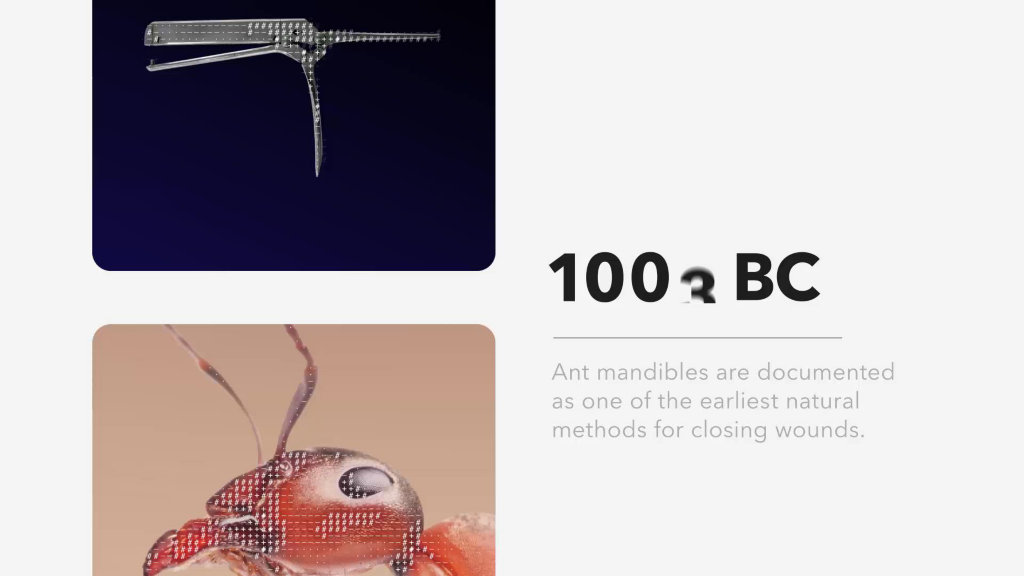
Today’s innovations, such as the Signia™ stapling system by Medtronic, can sense the tissue’s response to the stapling process and automatically adjusts the firing speed in real time based on the force measured.‡,1,3 The stapler responds to what it’s touching, much like a surgeon’s hand would. A far cry from insects.
“It’s not artificial intelligence,” Bronson said. “But it’s designed to mimic the haptic feedback and surgeon response as closely as possible.” §,4
As surgery moves further into robotic-assisted procedures, the surgical stapler itself isn’t going away, Bronson said. What may change is how surgeons use it via a robotic platform rather than by hand.
“At the end of the day,” he said, “it’s still placing titanium staples to appose while simultaneously transecting the target tissue.”
He jokingly added: “Not as exciting as an ant head though.”

Risks may include, but are not limited to: acute/chronic pain, bleeding, infection, and tissue damage.
This material should not be considered the exclusive source of information, it does not replace or supersede information contained in the device manual(s). Please note that the intended use of a product may vary depending on geographical approvals. See the device manual(s) for detailed information regarding the intended use, the (implant) procedure, indications, contraindications, warnings, precautions, and potential adverse events. For a MRI compatible device(s), consult the MRI information in the device manual(s) before performing a MRI. If a device is eligible for eIFU usage, instructions for use can be found at Medtronic's website manuals.medtronic.com. Manuals can be viewed using a current version of any major internet browser. For best results, use Adobe Acrobat® Reader with the browser. Medtronic products placed on markets comply with legislation (if applicable) on medical devices. For any further information, contact your local Medtronic representative and/or consult Medtronic's websites.
† Compared to manual and fixed speed powered staplers
‡ Preclinical results may not correlate with clinical performance in humans.
§ P < 0.001. Bench test results may not necessarily be indicative of clinical performance.
- Based on internal test report #RE00009440, Powered Stapling Firing Speed DOE analysis & ASA parameters. Mar 2015.
- Based on internal test report #RE00218740 Internal R&D Report Signia Adaptive Firing Technology. Aug 2019.
- Based on internal test report #RE00026741 ASA Verification Testing with Slow Speed Force Limit Evaluation. Oct 2015.
- Based on internal test report #RE00055515 SAGES lab Report. Aug 2016.
Published Sept. 10, 2026