
Discover the advantages of our most innovative aortic valve.


Tissue valves and conduits
Avalus Ultra™ bioprosthesis
<p>The Avalus Ultra™ bioprosthesis is a next-generation bovine pericardial valve for aortic valve replacement.</p>
Features
- Low valve profile facilitates ease of implant and improved valve sizing for each patient’s anatomy.1–3,6
- Industry-leading effective orifice areas (EOAs) and a large internal diameter can help increase cardiac output for patients as demonstrated by the Avalus™ valve.3,4,6
- Amino olecic acid (AOA™) anti-calcification tissue treatment helps reduce calcification in the tissue leaflets.†,7–12
- The platinum iridium radiopaque coil and tantalum badge help enhance visibility of the Avalus Ultra™ valve on fluoroscopic imaging for potential valve-in-valve procedures in the future.1,2
- Polyetheretherketone (PEEK) circular base frame and stent posts resist deformation to deliver long-lasting durability after implantation as demonstrated by the Avalus™ valve.4,13
- Flexible and pliable sewing cuff facilitates needle penetration, securing valve seating and contributing to exceptionally low paravalvular leak (PVL) rates as demonstrated by the Avalus™ valve.3
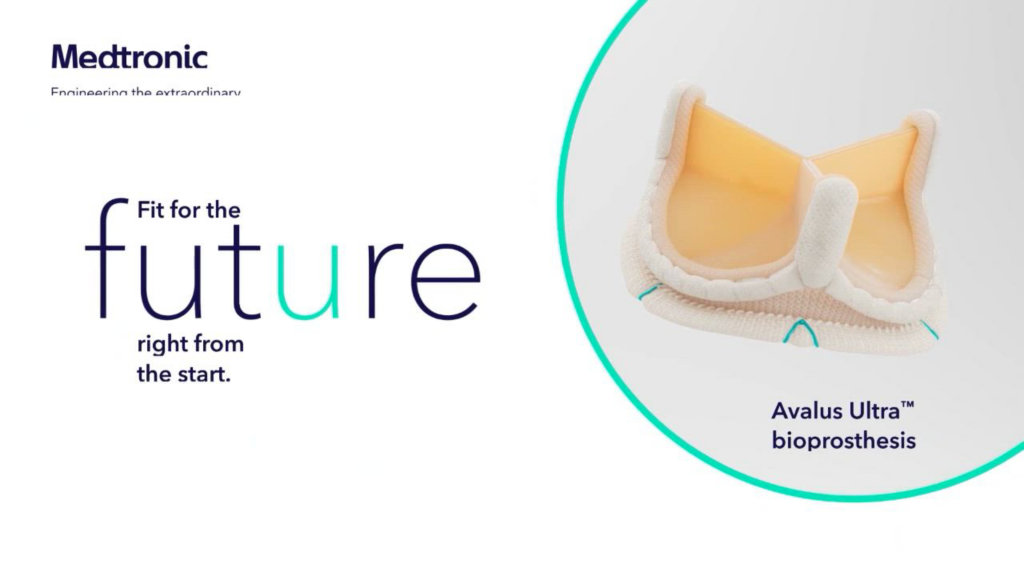

Product details
- Low valve profile
- Large internal diameter
- Flexible sewing cuff
- Circular TAVI landing zone
- Durable stent post and base frame
- Platinum iridium radiopaque coil and AU tantalum badge
- AOA™ anti-calcification tissue treatment
- Laser-cut leaflets
Clinical evidence
Trusted performance, established in evidence
The Avalus Ultra™ valve’s design is built on the 10 years of clinical experience with the Avalus™ valve. The Avalus Ultra™ valve is supported by the robust and real-world evidence of the Avalus™ valve, which demonstrates excellent durability, industry-leading EOAs, stable low gradients, and valve circularity.4,14
Performance is based on data gathered from the Avalus™ valve.
The PERIGON 7-year results
The PERIGON Pivotal trial is the largest prospective study of any contemporary stented surgical valve to date — 1,312 patients at 39 centers across 8 countries.4 Nineteen of those sites agreed to participate in long-term follow-up (> 5 years), and 576 patients were re-consented.
Compared to other SAVR valves and studies, the Avalus™ valve leads with a combination of longer patient follow-up, more patients enrolled, and more robust comparative data.


Objectives
Safety, efficacy, and durability are important considerations when selecting a bioprosthesis for aortic valve replacement (AVR). This study assessed seven-year clinical outcomes and hemodynamic performance of the Avalus™ bioprosthesis.

Methods
Patients indicated for surgical AVR were enrolled in this prospective, nonrandomized trial, conducted across 39 sites globally. The primary endpoint of this analysis was freedom from surgical explant or percutaneous valve-in-valve reintervention due to structural valve deterioration (SVD) at seven years of follow-up, determined using Kaplan-Meier (KM) analysis. We also evaluated a composite endpoint of SVD or severe hemodynamic dysfunction (SHD) requiring reintervention. Survival, valve related safety events, and hemodynamic performance were assessed. Deaths and safety events were adjudicated by an independent clinical events committee.

Results
A total of 1,132 patients underwent surgical AVR. Mean age was 70 years; 854 patients (75%) were men. Mean STS risk of mortality was 2.0 ± 1.4%, and 659 patients (58%) had a NYHA classification of I/II. One or more concomitant procedures were performed in 577 patients (51%). At seven years, the KM rate of SVD/SHD‡ requiring reintervention was 1.2% (0.5–2.5%) with no cases adjudicated as SVD. The survival rate was 82.6% (79.5–85.0%). The KM event rate was 5.7% (4.3–7.7%) for reintervention, 6.3% (4.9–8.3%) for endocarditis, and 0.4% (0.1–1.1%) for valve thrombosis. Mean aortic gradient, dimensionless velocity index, and effective orifice area were 13.8 ± 5.9 mmHg, 0.42 ± 0.09, and 1.99 ± 0.53 cm2, respectively.

Conclusions
This analysis demonstrated excellent durability of the Avalus™ valve with excellent clinical outcomes and stable hemodynamic performance through seven years of follow-up.
Risks may include infection, surgical complications, stroke, endocarditis, and death.
Manuals and technical guides
Access instructions for use and other technical manuals in the Medtronic manual library. Search by the product name (e.g., Avalus Ultra™) or model number.
Ordering information
- Stent diameter
- Internal orifice diameter (stent frame with tissue) and internal orifice diameter (stent frame without tissue)
- External sewing ring diameter
- Valve profile height
- Aortic protrusion
)
| Item number | Valve size | Stent diameter | Internal orifice diameter (stent frame with tissue) | Internal orifice diameter (stent frame without tissue) | External sewing ring diameter | Valve profile height | Aortic protrusion |
|---|---|---|---|---|---|---|---|
| 400U19 | 19 mm | 19 mm | 17.5 mm | 18 mm | 26.0 mm | 13.0 mm | 11.0 mm |
| 400U21 | 21 mm | 21 mm | 19.5 mm | 20 mm | 28.0 mm | 14.0 mm | 12.0 mm |
| 400U23 | 23 mm | 23 mm | 21.5 mm | 22 mm | 30.0 mm | 15.0 mm | 13.0 mm |
| 400U25 | 25 mm | 25 mm | 23.5 mm | 24 mm | 32.0 mm | 16.0 mm | 14.0 mm |
| 400U27 | 27 mm | 27 mm | 25.5 mm | 26 mm | 35.0 mm | 17.0 mm | 15.0 mm |
| 400U29 | 29 mm | 29 mm | 27.5 mm | 28 mm | 37.0 mm | 18.0 mm | 16.0 mm |
Accessories
| Item number | Description |
|---|---|
| 7420 | Valve handle |
| 7400SU | Avalus Ultra™ sizer |
| T7400U | Avalus Ultra™ tray |
| 7779 | Jar wrench |
Resources


TM* Third-party brands are trademarks of their respective owners.
† The benefits of AOA™ tissue treatment have been demonstrated through animal testing. No direct clinical evaluation of the benefits of AOA™ treatment in humans has been conducted.
‡ Structural valve deterioration (SVD) was defined as a confirmed intrinsic abnormality causing stenosis or regurgitation. Severe hemodynamic dysfunction (SHD) was defined as severe stenosis and/or severe transvalvular regurgitation and/or reintervention without adequate evidence to adjudicate SVD, nonstructural valve dysfunction, endocarditis, or valve thrombosis.
- Based on internal test report D00998354, Avalus Ultra™ HFE design validation test.
- Based on internal document D00437207, Avalus Ultra™ design concept.
- Klautz RJM, Rao V, Reardon MJ, et al. Hemodynamic function of contemporary surgical aortic valves 1 year postimplant. Abstract presented at 37th Annual Meeting of the European Association for Cardio-Thoracic Surgery, Vienna, Austria. 2023.
- Klautz RJM, Dagenais F, Reardon MJ, et al. Surgical aortic valve replacement with a stented pericardial bioprosthesis: 5-year outcomes. Eur J Cardiothorac Surg. 2022;62(3):ezac374. doi: 10.1093/ejcts/ezac374.
- Based on internal test report D00998399, Design characterization report: External sewing ring diameter, valve housing external diameter, and inflow orifice.
- Gorlin R, McMillan IK, Medd WE, Matthews MB, Daley R. Dynamics of the circulation in aortic valvular disease. Am J Med. 1955;18(6):855–870. doi:10.1016/0002-9343(55)90169-8.
- Gott JP, Pan-Chih, Dorsey JM, et al. Calcification of porcine valves: a successful new method of antimineralization. Ann Thorac Surg. 1992;53(2):207–215. doi:10.1016/0003-4975(92)91321-y.
- Girardot MN, Girardot JM, Schoen FJ. Development of the AOA process as antimineralization treatment for bioprosthetic heart valves. Trans Soc Biomat. 1993;16:266.
- Girardot MN, Torrianni M, Girardot JM. Effect of AOA on glutaraldehyde-fixed bioprosthetic heart valve cusps and walls: Binding and calcification studies. Int J Artif Organs. 1994;17(2):76–82.
- Medtronic data on file DOC10029153. October 14, 2011.
- Medtronic data on file TR-0177-012. March 4, 2010.
- Weber PA, Jouan J, Matsunaga A, et al. Evidence of mitigated calcification of the Mosaic versus Hancock Standard valve xenograft in the mitral position of young sheep. J Thorac Cardiovasc Surg. 2006;132(5):1137–1143. doi:10.1016/j.jtcvs.2006.06.027.
- Based on internal test report D00997823, Avalus Ultra™ full valve stiffness design verification report.
- Verbelen T, Roussel JC, Cathenis K, et al. Real-world data on the Avalus™ pericardial aortic valve: initial results from a prospective, multi-center registry. Presented at: Heart Valve Society 2024; February 18–21; Boston, MA.