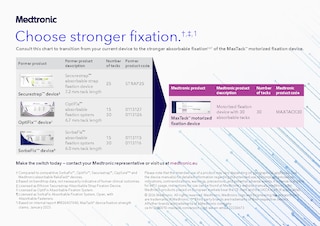
| Item number | Description | Units per box |
|---|---|---|
| MAXTACK30 | MaxTack™ motorized fixation device with 30 absorbable tacks | 6 |


Hernia fixation devices
MaxTack™ motorized fixation device
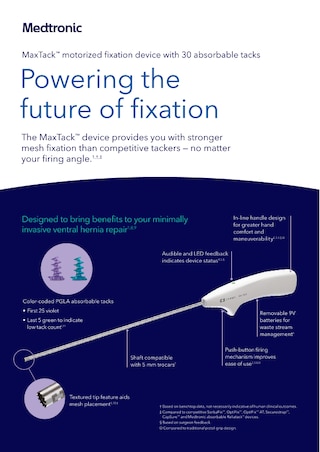
<p>The MaxTack™ motorized fixation device provides a push-button firing mechanism, tacks, and an in-line handle design for minimally invasive ventral hernia repair procedures.</p>
Features
Built for hernia repair surgeons and patients
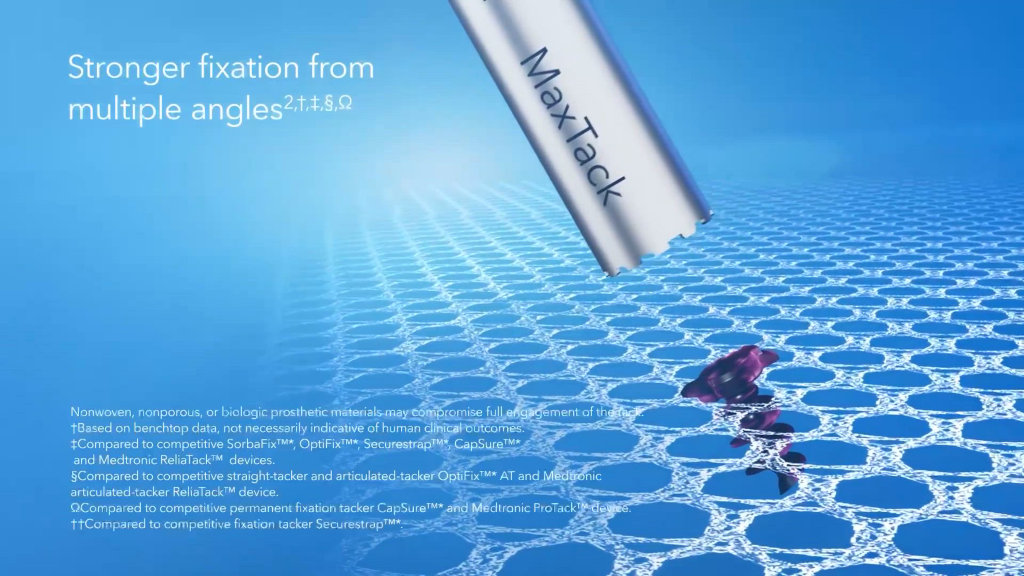
Stronger mesh fixation†,‡,2
The MaxTack™ device provides consistently stronger fixation than any other absorbable or permanent tacker, no matter your firing angle.†,‡,¶,∆,2 Your minimally invasive hernia procedures can benefit from:
- Stronger fixation at a 90° angle of deployment than other absorbable†,‡,2 and permanent†,∆,2 tackers
- Stronger fixation than other absorbable tackers (straight and articulated) when tacking from challenging non-90° firing angles, including 45° and 60°†,¶,2
- A unique tack design with optimized features that securely fixate a variety of meshes, including large-pore constructions†,7,9
- Significant tack absorption in three to five months after implantation, with absorption essentially complete within one year†,10
Get acquainted.
Watch how the design of the MaxTack™ device makes it a game-changer for hernia repair.
The next step in hernia mesh fixation technology
Fixation at the pull of a tab
The MaxTack™ device delivers easy-to-use,§,◊,3,4 innovative hernia repair technology straight out of the box — no assembly required.11 At the pull of a yellow activation tab, two 9V alkaline batteries are ready to power the MaxTack™ device’s push-button firing mechanism, consistently deploying preloaded absorbable tacks while providing you with audible and LED color-coded feedback.◊,11,12 An in-line handle design results in greater hand comfort and maneuverability,§,◊,3,4 while color-coded tacks (25 violet followed by 5 green) alert you when the tack count is running low.13
Frequently asked questions
The MaxTack™ device is single use.
The device may be inserted through a 5 mm cannula, or a larger cannula with the use of a converter, for use in minimally invasive procedures.14
MaxTack™ devices come with a total of 30 absorbable tacks that include two tack colors, 25 violet tacks followed by 5 green tacks, to indicate when the tack count runs low.13
Yes, the tacks are absorbable. MaxTack™ device tacks are made of copolymer poly (glycolide-co-L-lactide) (PGLA). This copolymer degrades and is absorbed by hydrolysis as glycolic acid and lactic acid, which are then metabolized by the body.†,10
The absorption profile of PGLA in the first two weeks after initial implantation is minimal, with a significant absorption rate seen in the period from three months to five months after implantation. Following this significant breakdown, the copolymer absorption is essentially completed prior to one year after implantation.†,10
Nonclinical testing demonstrated that a representative polymer tack is MRI-safe. A patient with these tacks can be scanned safely immediately after placement of the tack(s). In nonclinical testing, there is no detectable image artifact caused by the polymer tack.
Ordering information
Resources
In-service video
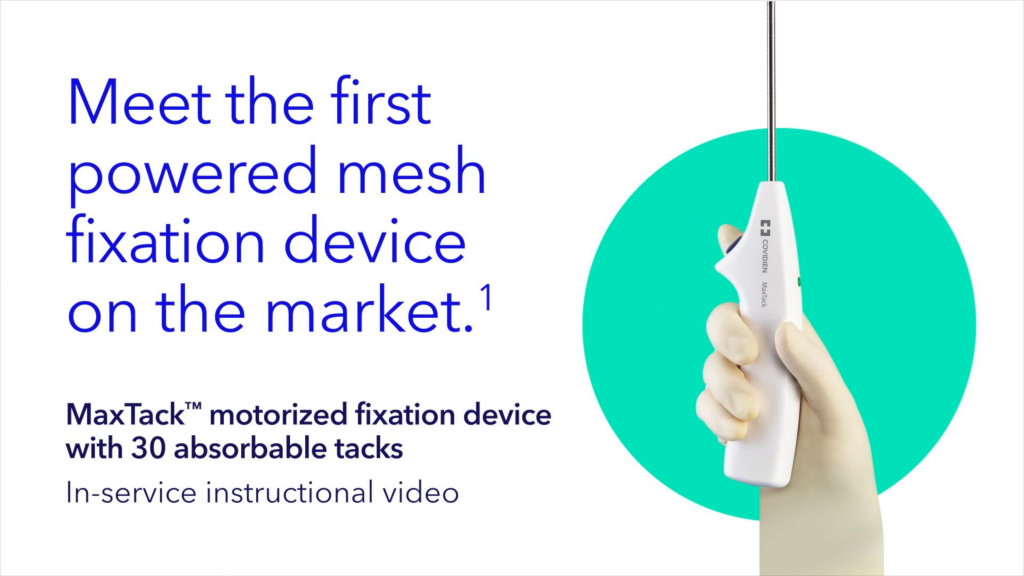
MaxTack™ motorized fixation device in-service (05:04)
Similar products
-
 AbsorbaTack™ fixation device
The AbsorbaTack™ fixation device is intended for fixation of prosthetic material to soft tissue in various minimally invasive and open surgical procedures.
-
 Endo Universal™ stapler
The Endo Universal™ stapler is indicated to affix prosthetic material or approximate tissue in a variety of endoscopic or other surgical procedures.
-
 ProTack™ fixation deviceThe ProTack™ fixation device is used to fix prosthetic material and approximate tissue in various endoscopic surgical specialties such as hernia repair.
 -
 ReliaTack™ articulating reloadable fixation deviceThe ReliaTack™ fixation device is intended for fixation of prosthetic material to soft tissue in minimally invasive and open surgical hernia repair procedures.
TM* Third-party brands are trademarks of their respective owners.
† Based on benchtop data, not necessarily indicative of human clinical outcomes.
‡ Compared to competitive SorbaFix™*, OptiFix™*, Securestrap™*, and CapSure™* absorbable tackers and Medtronic Reliatack™ absorbable tacker.
§ Compared to competitive OptiFix™* and Securestrap™* absorbable tackers.
◊ Based on surgeon feedback.
¶ Compared to competitive OptiFix™* AT straight-tacker and articulated-tacker and Medtronic ReliaTack™ articulated-tacker.
# Compared to competitive Securestrap™* fixation tacker.
∆ Compared to competitive CapSure™* permanent fixation tacker and Medtronic ProTack™ device.
- Based on memorandum RE00450435 rev A, MaxTack™ first motorized fixation device memo report. March 2023.
- Based on internal report RE00437048, MaxTack™ device fixation strength claims. January 2023.
- Based on internal report RE00422041, rev A, Effects of instrument design on body posture with repetitive motions of a lap ventral hernia repair surgeon protocol. October 2022.
- Based on internal report RE00422048, Effects of instruments design on body posture with repetitive motions of lap ventral hernia repair surgeon report. August 2022.
- Based on internal report RE00435620, MaxTack™ device reliability demonstration report. January 2023.
- Based on internal report RE00406203, MaxTack™ device blue overmold trigger button testing and reliability. June 13, 2022.
- Based on internal report #RE00171443, VersaFix Tack Feature DOE. June 2018.
- Based on internal report RE00453235, MaxTack™ device groin indication preclinical study. March 2023.
- Based on internal report #RE00433643, MaxTack™ Design Verification Report. June 2023.
- Based on internal report #RE00528853, MaxTack™ and AbsorbaTack™ in-vitro mass loss comparative study.
- Based on internal report RE00336812, MaxTack™ device AVT configuration and technical specification. May 2021.
- Based on internal report RE00412158, MaxTack™ device summative usability lab clinician feedback. January 2023.
- Based on internal report RE00339412, MaxTack™ tack colors (violet and green) justification. May 2021.
- Based on internal report RE00265771, MaxTack™ device shaft length specification. August 2020.
MaxTackTM Motorized Fixation Device is indicated for use in fixation of prosthetic material to soft tissue in minimally invasive ventral hernia repair procedures.
WARNINGS:
- Nonwoven, non-porous, or biologic prosthetic materials may compromise full engagement of the tack. The prosthetic material should be carefully evaluated prior to application.
- A minimum thickness of tissue over underlying bone, vessels, or viscera is needed for full engagement of the tack. The total distance from the surface of the tissue (including the material to be fixated) to the underlying bone, vessels, or viscera should be carefully evaluated prior to application of the device. Refer to the tack specification chart for tack dimensions.
- Tacking into tissues that have a direct anatomic relationship to major vascular structures such as through diaphragm in the vicinity of the pericardium, aorta, or inferior vena cava, could result in critical injury to cardiac tissues or other major vascular structures.
- Depressing the trigger button when not in approximation to mesh and/or tissue will cause the device to deploy a tack, which could potentially fall into the body cavity.
- Do not power cycle the device by removing and reinstalling batteries during intra-operative use.
ADVERSE REACTIONS
While every attempt has been made to reduce patient and user risks, all surgeries using this device carry some residual risk, even when used by trained physicians. The potential adverse reactions associated with the use of the MaxTack™ fixation device are: unspecified infection, fistula, foreign body in the patient, burns, tissue breakdown, hemorrhage/blood loss/bleeding, perforation, nerve damage, hernia recurrent, cardiac tamponade, foreign body in patient due to loose tack in cavity, environmental contamination, delay of treatment (reoperation), unintended radiation exposure and unspecified infection secondary to chronic inflammation (seroma).
CONTRAINDICATIONS
The device is not intended for use where prosthetic material fixation is contraindicated. Do not use the device on tissue(s) which cannot be inspected visually for hemostasis. This device should not be used in tissues that have a direct anatomic relationship to major vascular structures. This would include the deployment of tacks in the diaphragm in the vicinity of the pericardium, aorta, or inferior vena cava during diaphragmatic hernia repair. Do not use on ischemic or necrotic tissue.