
Signia™ powered with Tri-Staple™ Technology for Bedside stapling
Don't compromise on staple lines in robotic surgery
Download the Signia™ stapling vs SureForm™ comparison data
Download the Signia™ stapling vs SureForm™ comparison data
No matter what surgical robot you use, staple line formation and the underlying stapling technology should not be compromised on.
As a surgeon you should have a choice in which surgical tools and stapling technology to use for open, laparoscopic and robotic procedures.
We believe in deploying the best stapling technology for those critical moments in robotic surgery or robotic-assisted surgery (RAS) procedures to promote better patient outcomes, reduce pain points for the Surgical First Assistant (SFA) and enhance clinical confidence.
The intelligent performance of Signia™ with Tri-Staple™ technology provides better staple formation than the da Vinci SureForm™* stapler.1,†

Image taken from signia-tri-staple-vs-sureform-competitive-brochure
As the comparison data highlights, SureForm™ staple formation underperforms across medium to extra thick tissue (Black, Green, Blue), leaving an undercrimped or compromised quality staple formation.1,†

A surgical technique that uses a manual or energy powered stapler to close incisions after surgery.
This involves deploying a handheld or bedside stapling device such as the Signia™ linear stapler with Tri-Staple™ technology, instead of using the in-built stapling arm of a surgical robot.
Using a laparoscopic, hand-held stapler alongside robotic arms in surgery has shown to have positive impact on patients, in-patient costs and operative time– see section below.
Using a hand-held stapler allows the Surgical First Assistant (SFA) to fire the stapler at the bedside (at the operating table). Adaptive firing feedback gives the SFA instant data on the tissue thickness. This supports the freeing up the surgeon to control other instruments at the console.
For training surgical residents, the consultant could fire the stapler at the bedside (acting as their Surgical First Assistant) as they become more proficient at the console.
The bedside stapling approach can be planned from the beginning of the procedure or converted to if there are concerns over patient safety, equipment integrity or to enhance time efficiency. This can become the robotic stapler system or your robotic surgical stapling approach in your operating theatre.
For a deep dive into this topic, check out this webinar with Mr Joel Dunning, Consultant Thoracic Surgeon from James Cook Hospital, UK. He shares his own case studies for using the bedside stapling approach in robotic lobectomy procedures.
Key moment: From 06:00 – Operating room time lapsed comparison from set up to first firing between robotic arm firing and bedside (Hybrid) stapling.

You can also view this on Medtronic Academy. Sign up for a free account or Login
Get in touch with your local Energy and Stapling Rep, or complete this form to be contacted by a member of our team.
A study in Surgical Endoscopy publish in July 2024 analysed data over a 12-month period tracking how well a cohort of patients in the US recovered after their robotic bariatric surgery that utilised Medtronic’s Signia™ linear stapler with Tri-Staple™ technology in a bedside stapling approach and Intuitive’s SureForm™* robotic stapler.
You can access the full study here via Open Access

Bedside staplers
8.5 times less than robotic staplers (SureForm™*), p<0.05
Medtronic bedside staplers
17.2 times lower likelihood than robotic staplers (SureForm™*), p<0.001

Bedside staplers
19 minutes less than robotic staplers (SureForm™*), p<0.001
Medtronic bedside staplers
32 minutes less than robotic staplers (SureForm™*), p<0.001

Bedside staplers
$1,267 USD less than robotic staplers (SureForm™*), p<0.001
Medtronic bedside staplers
$2,670 USD less than robotic staplers (SureForm™*), p<0.001
The LigaSure™ RAS Maryland jaw vessel sealer-divider pairs with the Hugo™ RAS system as the first robotically driven LigaSure™ instrument.
Learn more about the Hugo™ RAS system.

Strong staple line is key to minimising complications in bariatric surgery.
Medtronic’s reinforced reloads with Tri-Staple™ technology are designed to work in harmony with the natural properties of tissue before, during and after stapling.

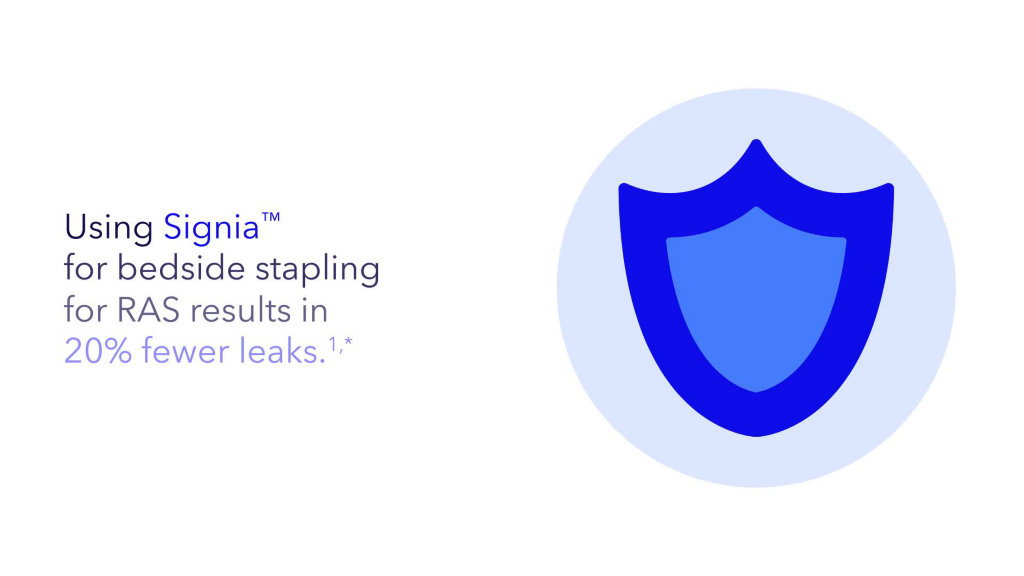
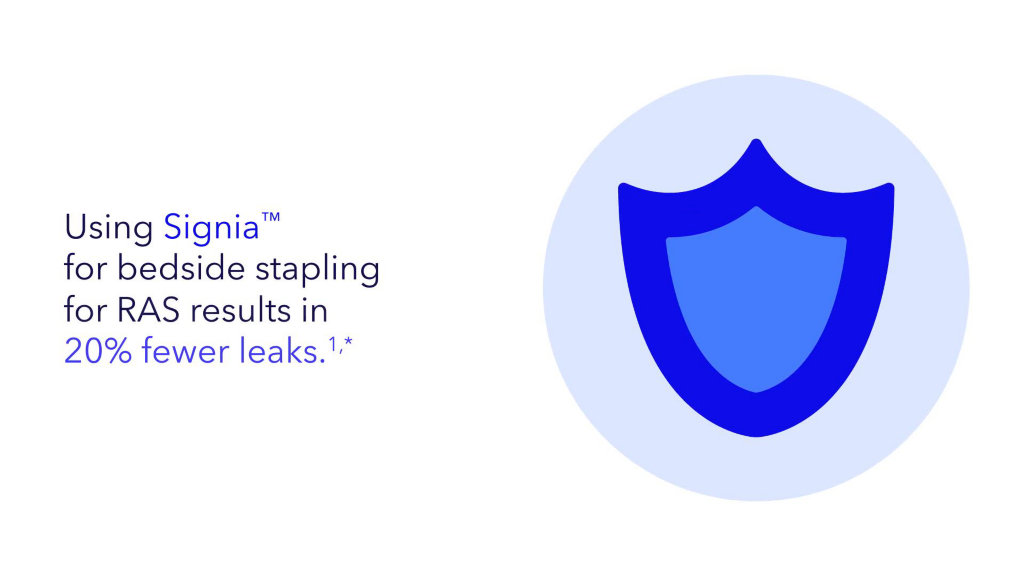
Maximizing blood supply to the anastomotic site is crucial in reducing the risk of anastomotic leaks.
Tri-Staple™ technology's graduated compression profile with varied staple heights allow for greater perfusion into the staple line.2,††

Thoracic surgeons rely on consistent stapling technology.
Learn more about our Reinforced Reloads with Tri-Staple™ technology and Signia™ small diameter reloads.
Click below to learn more about the Signia™ platform technology
† When fired in indicated porcine tissue thickness. Preclinical testing may not be indicative of clinical performance.
†† Compared to flat-faced cartridges with single-height staples.
1. Based on internal report #RE00498029, Competitive evidence final report — Signia™ with Tri-Staple™ technology vs. Intuitive’s da Vinci robotic stapling system with SureForm™* SmartFire technology.
2. Based on internal test report #2128-002-2, Final analysis of staple-line vascularity using MicroCT. July 2015.
3. Clapp. B.L. et all, Effectiveness of Bedside Staplers in Bariatric Robotic Procedures. , July 2024, pp. 1–9.
The material on this website should not be considered the exclusive source of information, it does not replace or supersede information contained in the device manual(s). Please note that the intended use of a product may vary depending on geographical approvals. See the device manual(s) for detailed information regarding the intended use, the (implant) procedure, indications, contraindications, warnings, precautions, and potential adverse events. For a MRI compatible device(s), consult the MRI information in the device manual(s) before performing a MRI. If a device is eligible for eIFU usage, instructions for use can be found at Medtronic’s website manuals.medtronic.com. Manuals can be viewed using a current version of any major internet browser. For best results, use Adobe Acrobat® Reader with the browser. Medtronic products placed on European markets bear the CE mark and the UKCA mark (if applicable). For any further information, contact your local Medtronic representative.
We do not review or control the content of external sites and are not responsible for any interactions or transactions that may occur there. Any product availability and regulatory requirements on the destination site may differ depending on your location. When you continue, the terms of use and privacy statement of the external site will apply.
Product availability and regulatory requirements may differ depending on your location. The destination website is governed by the laws and regulations of the country in which it operates, which may be different from those in your country. When you continue, the terms of use and privacy statement of the destination Medtronic site will apply.