Pacemakers
<p>Micra™ AV2 provides an unmatched leadless pacing experience for patients with bradycardia.</p>
Micra™ AV2 Model MC2AVR1 is indicated for VDD pacing in patients when a dual chamber transvenous pacing system is considered a poor option or not deemed necessary for effective therapy, and when a right ventricular transcatheter pacing system promoting atrioventricular (AV) synchrony at rest is acceptable. Conditions when a patient is considered a poor candidate for transvenous pacing may include, but are not limited to, tortuous anatomy, a need to preserve venous access, or increased risk of infection. The device provides AV synchrony at rest and rate responsive (VVIR) pacing during periods of high patient activity.
Device-mediated AV synchrony can vary depending on patient condition and activity levels, and it can be limited at high sinus rates. During periods of intermittent AV synchrony, the device will provide ventricular pacing support with an increased potential for pacing rate variability. Micra™ AV2 is indicated for use in patients who have experienced one of the following:
The device is designed to be used only in the right ventricle.
Micra™ AV2 Model MC2AVR1 devices are contraindicated for use in the following situations:
For the MRI contraindications for patients with a Micra™ AV2 MRI device, refer to the Micra™ AV2 MRI technical manual.
End of service (EOS): When the EOS condition is met, the clinician has the option of permanently programming the device to “off” and leaving it in the heart, or retrieving the device, provided the device has not yet become encapsulated. Removal of the Micra™ device after it has become encapsulated may be difficult because of the development of fibrotic tissue. If removal of the device is required, it is recommended that the removal be performed by a clinician who has expertise in the removal of implanted leads.
MRI conditions for use: Before an MRI scan is performed on a patient implanted with the Micra™ device, the cardiology and radiology professionals involved in this procedure must understand the requirements specific to their tasks as defined in the device manuals.
Rate-responsive mode may not be appropriate for patients who cannot tolerate pacing rates above the programmed “lower rate.” The patient’s age and medical condition should be considered by physicians and patients as they select the pacing system, mode of operation, and implant technique best suited to the individual.
Precautions should be taken before administering anticoagulant agents, antiplatelet agents, or contrast media in patients with known hypersensitivity to these agents.
The use of deactivated Micra™ devices in situ and an active Micra™ device, or an active transvenous pacemaker or defibrillator, has not been clinically tested to determine whether EMI or physical interaction is clinically significant. Bench testing supports that implantation of an active Micra™ device, or an active transvenous pacemaker or defibrillator, next to an inactivated Micra™ device is unlikely to cause EMI or physical interaction. Post-approval studies are planned to characterize risks of co-implanted, deactivated Micra™ devices. Currently recommended end of device life care for a Micra™ device may include the addition of a replacement device with or without explanation of the Micra™ device, which should be turned off.
Patient activities and environments which present mechanical vibrations to the patient can interfere with the mechanical sensing of atrial contractions. This can result in a loss of AV synchrony.
Potential complications include, but are not limited to, toxic/allergic reaction, oversensing, pacemaker syndrome, cardiac arrest, necrosis, and surgical complications such as cardiac perforation, pericardial effusion, cardiac tamponade, device embolization, hematoma, AV fistula, vessel dissection, infection, cardiac inflammation, and thrombosis.
See the device manuals for detailed information regarding the implant procedure, indications, contraindications, warnings, precautions, MRI conditions for use, and potential complications/adverse events.
Caution: Federal law (United States) restricts these devices to sale by or on the order of a physician.
MAJ_83734
Read the Micra™ AV2 product specifications document for details on the Micra™ AV2 transcatheter pacing system.
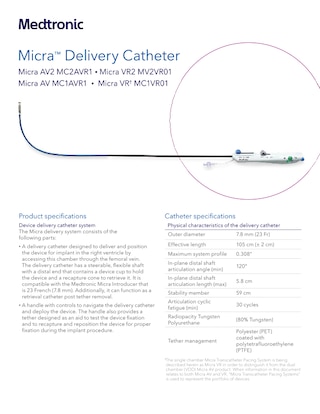
Learn more about the Micra™ family of delivery catheters, including physical characteristics and specs.
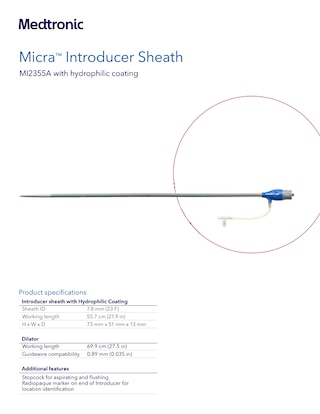
Read the product specifications brochure for details on the Micra™ introducer sheath.
Micra™ VR2 provides an unmatched leadless pacing experience for patients with bradycardia.
The Adapta™ pacing system includes pacing with automaticity.
Advisa™ MRI SureScan™ implantable pacing generators (IPGs) are approved for 1.5T and 3T full-body MRI scans.
The Azure™ MRI SureScan™ pacemaker manages atrial fibrillation (AF) in pacemaker patients with tablet-based programming and app-based remote monitoring.
Your information will be used and protected in accordance with our {link}
Hours: 8:00 a.m. - 8:00 p.m. EST
Phone: 763-514-4000
Toll-free: 800-633-8766
Just to confirm, is this the product or product type that interests you?
{{productNamePlaceholder}}
OR
Before we get started, what best describes you?
If you subscribe to email updates, you can unsubscribe anytime via the link in each email. We use technology to measure email opens and clicks, to improve our communications and provide relevant content. For details, see our {link}
Your personal data will be used to manage your relationship with Medtronic in accordance with our {link}
If you consent to receive emails, you can unsubscribe anytime via the link in each email. We use technology that measures email opens and clicks, to improve our communications and provide relevant content. For details, see our {link}


 Adapta™ pacemaker
 Advisa™ MRI SureScan™ pacemaker
 Azure™ MRI SureScan™ pacemaker
 Micra™ VR2 leadless pacemaker