


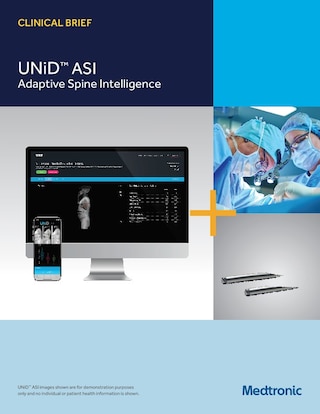
This clinical brief provides an overview of the clinical rationale, components, and clinical applications of UNiD™ adaptive spine intelligence (ASI).


Complex fixation systems
UNiD™ patient-specific rods
<p>UNiD™ patient-specific rods are designed by the GAiTEWAY™ platform to help achieve alignment goals in spinal surgeries.</p>
Features
Workflow
GAiTEWAY™ plan
Available through the GAiTEWAY™ software platform, you can request concierge surgical plans from an AiBLE™ Clinic engineer. These plans use AI-driven predictive modeling to support more informed decision-making.

UNiD™ rod execution
Create patient-specific rods precisely manufactured to the approved surgical plan, ensuring alignment between planning and intraoperative execution.

GAiTEWAY™ analysis
Access on-demand post-operative analytics through the GAiTEWAY™ platform to review outcomes, identify trends, and continuously inform future planning.

Clinical evidence
UNiD™ rods are associated with lower incidence of rod fracture.1
Evaluation of postoperative data indicates a reduction in the rod fracture rate.1
In adult deformity cases (greater than five levels) at least one year after surgery, UNiD™ rods had a fracture rate of 10 out of 453 patients (2.2%). In a subset of International Spine Study Group (ISSG) data with the same parameters, 18 out of 200 (9%) of adult deformity patients experienced rod fractures.1,2
When patients from the same two studies underwent a pedicle subtraction osteotomy (PSO) in the procedure, the rate is reduced by 79% when using UNiD™ rods, an improvement over the 22% rod fracture rate associated with procedures involving a PSO.1,2
Rod fracture rates in adult deformity cases
9% 18 out of 200 patients Historic ISSG data |
|
2.2% 10 out of 453 patients UNiD™ patient-specific rod data1 |
|
Rod fractures rate in cases involving a PSO
22% 11 out of 50 patients Historic ISGG data |
|
4.7% 6 out of 127 patients UNiD™ patient-specific rod data1 |
|
Sagittal alignment is the most dominant radiographic predictor of patient outcomes.3,4
Achieving harmonious alignment of key spinopelvic parameters, such as the sagittal vertical axis (SVA), pelvic incidence/lumbar lordosis mismatch (PI-LL), and pelvic tilt (PT), is a key goal of spinal deformity surgery.5
Patients possessing postoperative spinopelvic parameters within normative ranges exhibit improved patient outcomes scores.2,3
Patient-specific alignment makes a difference.

Rod-bending with templates yields better accuracy.
In a study by Sardi et al., ten experienced surgeons were asked to contour rods using a French bender to 40, 60, and 80 degrees.6
Without a template, surgeons overbent by a mean of 17.5 to 20.2 degrees for each desired angle, but with a template, they came within an average of two degrees of their target angle.
Average distance from target angle

UNiD™ patient-specific rods are a part of the AiBLE™ ecosystem.

Related links
Related products
-
 GAiTEWAY™ software platform
The GAiTEWAY™ software platform brings together AI-driven planning and post-operative analytics for spinal surgery into a single interface.
-
 O-arm™ surgical imaging system
The O-arm™ surgical imaging system offers on-demand imaging, robotic positioning, and device mobility for spinal and cranial procedures.
-
 Stealth AXiS™ surgical system
The Stealth AXiS™ surgical system is a versatile platform uniting planning, navigation, and robotics into one platform for spine, cranial, and ENT surgery.
- Fiere V, Fuentes S, Burger E, Raabe T, Passias P, et al. Patient-specific rods show a reduction in rod breakage incidence. Medicrea whitepaper. October 2017.
- Smith JS, Shaffrey CI, Klineberg E, et al. Prospective multicenter assessment of risk factors for rod fracture following surgery for adult spinal deformity. J Neurosurg Spine. 2014;21(6):994–1003. doi:10.3171/2014.9.SPINE131176.
- Glassman SD, Bridwell K, Dimar JR, Horton W, Berven S, Schwab F. The impact of positive sagittal balance in adult spinal deformity. Spine (Phila Pa 1976). 2005;30(18):2024–2029. doi:10.1097/01.brs.0000179086.30449.96.
- Glassman SD, Berven S, Bridwell K, Horton W, Dimar JR. Correlation of radiographic parameters and clinical symptoms in adult scoliosis. Spine (Phila Pa 1976). 2005;30(6):682–688. doi:10.1097/01.brs.0000155425.04536.f7.
- Jang JS, Lee SH, Min JH, Kim SK, Han KM, Maen DH. Surgical treatment of failed back surgery syndrome due to sagittal imbalance. Spine (Phila Pa 1976). 2007;32(26):30813087. doi:10.1097/BRS.0b013e31815cde71.
- Sardi JP, Ames CP, Coffey S, et al. Accuracy of rod contouring to desired angles with and without a template: Implications for achieving desired spinal alignment and outcomes. Global Spine Journal. 2021:1-7. doi:10.1177/219256822199837