
A path to symptom improvement
For someone living with dystonia, everyday activities like eating, sleeping, talking, and mobility can feel like daily battles.1-3 But there is hope. Medtronic has been serving people living with dystonia for more than 20 years.†
DBS significantly improves dystonia symptoms1
For adults
- Improves movement, disability, and severity scores1 in adults living with generalized, segmental‡, and cervical dystonia
- Improves quality of life in adults living with generalized and segmental‡ dystonia1-3
- Reduces pain on average in adults living with generalized, segmental,‡ and cervical dystonia1,3,7,8
Every child deserves to learn, play, and grow
The only DBS system backed by safety and effectiveness data for children age 12 and older with primary generalized dystonia
- Improvement in BFMDRS motor scores1
- Significant improvement in disability scores with benefits sustained up to 3 years1,4,5

How does DBS therapy work?
A small pacemaker-like device (neurostimulator) placed under the skin in the chest sends electrical stimulation to correct abnormal brain activity causing dystonic symptoms through extensions to very thin wires (leads) that are placed in specific areas of the brain.
Who is a candidate for DBS for dystonia?
To see if DBS could be right for you, see a neurologist who is experienced with DBS. Usually, these doctors are movement disorder specialists.
DBS may be right for someone who:
- Has chronic dystonia
- Has been unable to successfully manage their symptoms with oral and/or injectable medications
- Has primary dystonia, including generalized, segmental dystonia of the head and neck, and cervical dystonia (torticollis) in adult patients
- Has primary generalized dystonia and is age 12 and older
Always talk with your doctor about diagnosis and treatment information.
Talk with someone who has gone through the process
When making any important decision, it’s often helpful to talk with someone who has had a similar experience. Through the Ambassador Program, you can talk with someone who has received Medtronic DBS therapy to treat their dystonia symptoms.
Real patients. Real experiences with DBS.
Mary, receiving DBS for dystonia
"With DBS, my body felt restored. My pain is now manageable. I can walk again, and I've returned to work after 10 years."
Mary's story is based on her individual experience. Not all patients will experience similar results.
Caroline, receiving DBS for dystonia
"At 12, dystonia took away my quality of life. For seven years, simple tasks like walking, talking and brushing my hair were my biggest battles. Since DBS surgery, I can now live my life without struggling everyday just to move. I am so grateful to the Medtronic DBS system as it has given me a second chance at life.”
Caroline's story is based on her individual experience. Not all patients will experience similar results.
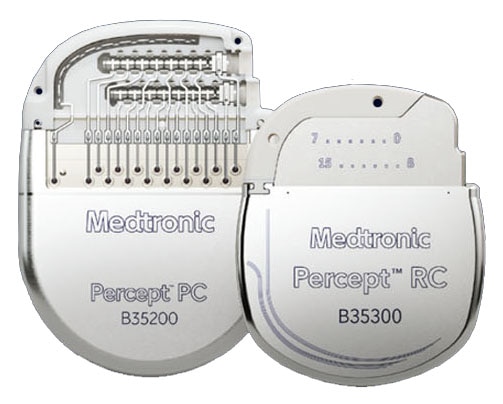
Medtronic DBS offers:
- Sensing technology§ that enables clinicians to personalize and adapt therapy to your individual needs
- Designed small for comfort with the smallest, thinnest rechargeable DBS neurostimulator available◊
- Choice of recharge-free (PC) battery or rechargeable (RC) battery with 15-year service life
- MRI access with the world’s first full-body MRI capable DBS device portfolio¶,6, including:
- Access to 1.5T and 3T MRI scans for when you need high-quality imaging
- Ability for DBS therapy to remain on (in bipolar mode) during an MRI scan
Understanding risks
DBS therapy may help you manage some of the symptoms of dystonia, including involuntary movements, but it is not a cure.
Potential risks related to the device, therapy, or surgery can include implant site pain, tingling sensations, ineffective stimulation, and implant site infection. Possible side effects with DBS therapy for dystonia might include:
- Status dystonicus
- Risk of depression, suicidal ideations, and suicide
- Rebound effect: an abrupt cessation of stimulation may cause a return of disease symptoms and in some cases with a greater intensity than prior to implant
- Pediatric patients may have increased risk of infections and device-related complications.
Always talk to your doctor about the benefits and risks of DBS therapy.
† FDA approved for safety and probable benefit in 2003; FDA approved for safety and effectiveness in 2025.
‡ Of the head and neck
§ The sensing feature of the Percept™ PC system and Percept™ RC system is intended for use in patients receiving DBS where chronically recorded bioelectric data may provide useful, objective information regarding patient clinical status. Signal may not be present or measurable in all patients treated for dystonia.
◊ Percept™ RC as compared to Boston Scientific Vercise Genus™ R16 (MP92328632-10 REV A), accessed February 24, 2026, and Abbott Liberta RC™ IPG (ARTEN600340313 B), accessed February 24, 2026.
¶ Medtronic DBS Systems are MR Conditional. Refer to product labeling for full list of conditions. https://manuals.medtronic.com/manuals/mri/region.
1. Medtronic DBS Therapy for Dystonia Clinical Summary, 2025. M944810A003 Rev B
2. Volkmann J. et al. Pallidal deep brain stimulation in patients with primary generalised or segmental dystonia: 5-year follow-up of a randomised trial. Lancet Neurol. 2012;11:1029-38 (suppl mat).
3. Kupsch A, et al. Pallidal deep-brain stimulation in primary generalized or segmental dystonia. N Engl J Med. 2006;355(19):1978-1990.
4. Coubes P. et al. Electrical stimulation of the globus pallidus internus in patients with primary generalized dystonia: long-term results. J Neurosurg. 2004;101(2):189-194.
5. Haridas A, Tagliati M, Osborn I, et al. Pallidal deep brain stimulation for primary dystonia in children. Neurosurgery. 2011;68(3):738-743. doi:10.1227/NEU.0b013e3182077396.
6. MRI guidelines for Medtronic deep brain stimulation systems 37601, 37602, 37603, 37612, B35200, B35300 - M056974C001 rev A. See Medtronic manual library: https://manuals.medtronic.com/manuals/mri/region.
7. Volkmann J. et al. Pallidal neurostimulation in patients with medication-refractory cervical dystonia: a randomised, sham-controlled trial. Lancet Neurol. 2014;13(9):875-884.
8. Krause P. et al. Long‐Term Outcomes on Pallidal Neurostimulation for Dystonia: A Controlled, Prospective 10‐Year Follow‐Up. Mov Disord. 2025;40(6):1098-1111.