

Implantable cardioverter defibrillators
Aurora EV-ICD™ system
<p>The Aurora EV-ICD™ system is used to treat sudden cardiac arrest and abnormal heart rhythms with defibrillation and antitachycardia pacing (ATP).</p>
Features
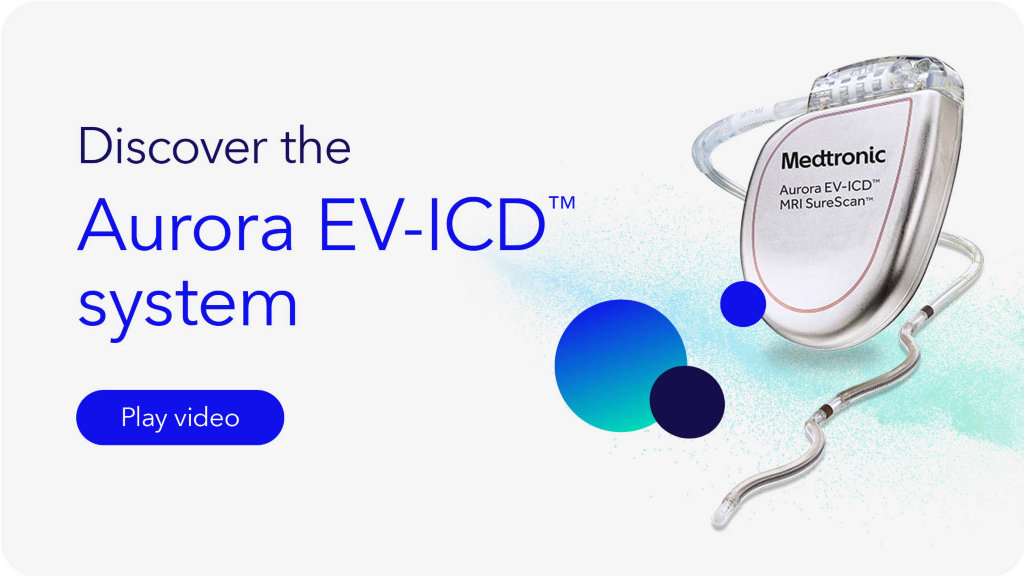
Extravascular implant location

The only extravascular ICD to offer ATP
In the EV ICD Pivotal Clinical Study, ATP successfully terminated 77% of episodes (37/48), long-term results.§,4 This is in the range of the ATP efficacy reported in transvenous ICD publications, 52% to 87%.5–8

Size and PhysioCurve™ design
The Aurora EV-ICD™ system offers a small size (33 mL) and PhysioCurve™ design — the same size and shape as Medtronic transvenous single-chamber ICDs.2

Projected longevity
The Aurora EV-ICD™ system has 11.7 years projected longevity,2 which is similar to other Medtronic single-chamber ICDs. Greater device longevity may result in fewer device replacements, fewer associated procedure risks, and lower total product costs.9
Projected battery longevity estimates are based on accelerated battery discharge data and device modeling. Results for individual patients vary based on programmed parameters and features.

Pause Prevention pacing
Pause Prevention pacing is a pacing feature that monitors the heart for significant pauses and responds by providing temporary bradycardia pacing support.2

Post-shock pacing
The Aurora EV-ICD™ system can deliver temporary post-shock pacing following a defibrillation or cardioversion therapy, as there may be a temporary bradycardia or asystole after the heart receives a high-voltage therapy.2

Monitor zone
The Aurora EV-ICD™ system has a ventricular tachycardia (VT) monitor zone that allows for documentation of slow VTs, including nonsustained VTs.2

Remote monitoring and CareAlert™ notifications
Alerts can be delivered by the device tone and by the patient’s home monitor.2

MRI access
The Aurora EV-ICD™ system offers 1.5T and 3T MRI access when MR conditions for use are met.2
Clinical evidence
Enlighten: The Aurora EV-ICD™ system’s Post-Approval Registry
The Enlighten Study is an ongoing global, prospective, observational, multisite registry study.10 Real-world one-year results demonstrated that the Aurora EV-ICD™ system had high ATP success and effective defibrillation in a single device while safely outside the vascular space11 (758 patients implanted with average follow-up of 10.5 months).
High ATP success11
- 74% ATP success rate,◊ in line with transvenous ICDs5–8 and consistent with EV ICD Pivotal Study performance4
- Shock was avoided in 65 episodes and 22 patients due to the availability of ATP.
- No patient had ATP programmed Off after receiving ambulatory ATP therapy.
Safe, low risk of complications11
- 95.8% freedom from chronic system-related major complications¶ at one year, in line with the EV ICD Pivotal Study one-year rate of 97.3%
- No cases of mediastinitis, sepsis, or endocarditis related to Aurora EV-ICD™ system through one year
Effective defibrillation11
- 100% (61/61) defibrillation success of discrete# spontaneous episodes through most recent device follow-up
- 99% of patients had effective defibrillation of induced episodes at implant.
Inappropriate shock11
- A 7.1% rate of inappropriate shock at one year was observed.
- The rate is 28% lower than what was observed in the EV ICD Pivotal Study (9.8% at one year4).
- The proportion of inappropriate shocks due to P-wave oversensing decreased from 51% of episodes in the EV ICD Pivotal Study4 to 31% in Enlighten.11
- There are three strategies for mitigating inappropriate shock: lead positioning at implant, use of the Smart Sense algorithm, and device programming.
Primary results∆,1
Effectively terminated life-threatening rhythms with ATP and shocks while safely outside the vascular space
Safe procedure
Primary safety objective met, 92.6% patients free from major system- or procedure-related complications at six months∞
Effective defibrillation
Primary efficacy objective met, 98.7% defibrillation success rate at implant, 100% conversion of discrete spontaneous episodes#
Successful ATP
70% of episodes successfully terminated, avoiding 33 shocks in seven patients∆,12
Long-term results§,††,4
EV-ICD demonstrated high ATP success and effective defibrillation in a single device while safely outside the vascular space.
Successful ATP with 77% of episodes terminated§
Shock was avoided in nearly half of all VT/VF episodes because of the availability of ATP.§
- ATP use increased significantly through the duration of follow-up (p < 0.0001).‡‡
- No patient with successful ATP had therapy programmed off subsequently.
Safe procedure, safe system††
- No major intraprocedural complications
- No unique complications observed related to the EV-ICD procedure or system
- No reports of mediastinitis, sepsis, or endocarditis related to EV-ICD
- Thirty-one system- or procedure-related major complications occurred in 29 patients throughout the study. Of these, the most common were revision for lead dislodgement and treatment for postoperative wound or pocket infection.
Shock treated
44 episodes

ATP treated and
shock avoided in
38 episodes
Specifications
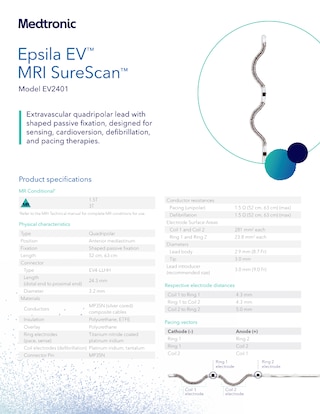
The Epsila EV™ MRI SureScan™ defibrillation lead is an MR Conditional lead approved for use when an extravascular implantable cardioverter defibrillator is indicated to treat tachycardia.
The epsilon-shaped distal section is intended to optimize the electrodes’ locations relative to the heart and the device.
- Defibrillation coils positioned toward the patient’s right side for a wider defibrillation vector between the coils and the device
- Pacing/sensing ring electrodes positioned toward the patient’s left side so they are closer to the heart

- Curvature intended to help stabilize the lead in the mediastinal tissue
- Four electrodes, consisting of two coils and two rings, support three different pacing vector options and three sensing vector options
- Isodiametric 8.7 Fr lead body and four conductor cables extend to the distal tip of the lead to provide high tensile strength for extractability
Epsila EV™ sternal tunneling tool13
The Epsila EV™ sternal tunneling tool is designed to deliver an introducer to place an extravascular lead into the anterior mediastinum during implant of an extravascular implantable device system.
- Handle
- Thumb tab
- Stainless steel tunneling rod
- External guide (removable)

SafeSheath™ II hemostatic peel-away introducer system14
The SafeSheath™ II hemostatic peel-away introducer system is a specialized implant tool for the Aurora EV-ICD™ system that is used with the Epsila EV™ sternal tunneling tool. The SafeSheath™ II hemostatic peel-away introducer system is packaged and sold separately.
- 9 Fr diameter
- 19.13 cm length to fit with the Epsila EV™ sternal tunneling tool

Epsila EV™ transverse tunneling tool15
The Epsila EV™ transverse tunneling tool is designed to deliver the proximal portion of an extravascular lead to the device pocket during implant of an extravascular implantable device system.
- Handle
- Channel for lead delivery
- Tunneling rod

Ordering information
Item number |
Product |
Description |
| DVEA3E4 | Aurora EV-ICD™ MRI SureScan™ | Extravascular implantable cardiovascular defibrillator |
| EV240152 | Epsila EV™ MRI SureScan™ | Extravascular quadripolar lead with shaped passive fixation – 52 cm |
| EV240163 | Epsila EV™ MRI SureScan™ | Extravascular quadripolar lead with shaped passive fixation – 63 cm |
| EAZ101 | Epsila EV™ | Sternal tunneling tool |
| EAZ201 | Epsila EV™ | Transverse tunneling tool |
| SSCL9 | SafeSheath™ II | Hemostatic peel-away introducer system |
Resources


Similar products
-
 Cobalt XT™ MRI SureScan™ ICD
Cobalt™ XT ICDs are used to treat sudden cardiac arrest and abnormal heart rhythms.
-
 Cobalt™ MRI SureScan™ ICD
Cobalt™ ICDs are used to treat sudden cardiac arrest and abnormal heart rhythms.
-
 Crome™ ICD MRI SureScan™
Crome™ ICDs are used to treat sudden cardiac arrest and abnormal heart rhythms.
TM* Third-party brands are trademarks of their respective owners. All other brands are trademarks of a Medtronic company.
† Projected battery longevities are as reported in the approved device labeling. Assumes no pacing, no high voltage therapy, and nominal settings.2,3
‡ The Aurora EV-ICD™ lead is not intended for implantation within the heart or vasculature, and, thus, Aurora EV-ICD™ lead is expected to avoid vascular complications associated with transvenous leads. There were no major intraprocedural complications observed in the EV ICD Pivotal Clinical Study.1
§ Follow-up duration is an average of 30.6 months for the n = 299 patients with a successful implant.
◊ Generalized estimating equations (GEE)-adjusted success rate (95% CI: 57.6%, 85.9%).
¶ Enlighten Study primary safety endpoint is chronic (> 30 days after implant) system-related major complications (excluding infections).
# Discrete episodes are defined as less than or equal to two events within 24 hours.
∆ Through an average 10.6-month follow-up.
∞ Kaplan-Meier estimate.
†† Follow-up duration is an average of 29.0 months for the n = 316 patients with an implant attempt.
‡‡ Based on a paired statistical test comparing pre-hospital discharge to last available follow-up.
- Friedman P, Murgatroyd F, Boersma LVA, et al. Efficacy and safety of an extravascular implantable cardioverter-defibrillator. N Engl J Med. 2022;387(14):1292–1302. doi:10.1056/NEJMoa2206485.
- Medtronic Aurora EV-ICD™ MRI SureScan™ DVEA3E4 implant manual. M991372A001 REV. E. Medtronic; 2023.
- Emblem™* MRI S-ICD technical manual. Boston Scientific. Accessed March 27, 2026.
- Friedman P, Murgatroyd F, Boersma LVA, et al. Performance and safety of the extravascular implantable cardioverter defibrillation through long-term follow-up: Final results from the Pivotal Study. Circulation. 2025;151(4):322–332. doi:10.1161/CIRCULATIONAHA.124.071795.
- Sterns LD, Auricchio A, Schloss EJ, et al. Anti-tachycardia pacing success in implantable cardioverter defibrillators by patient, device, and programming characteristics. Heart Rhythm. 2022;20(2): P190–197. doi: 10.1111/pace.13980.
- Schuger C, Daubert JP, Zareba W, et al. Reassessing the role of antitachycardia pacing in fast ventricular arrhythmias in primary prevention implantable cardioverter-defibrillator recipients: results from MADIT-RIT. Heart Rhythm. 2021;18(3):399–403. doi:10.1016/j.hrthm.2020.11.019.
- Arenal A, Proclemer A, Kloppe A, et al. Different impact of long-detection interval and anti-tachycardia pacing in reducing unnecessary shocks: data from the ADVANCE III trial. Europace. 2016;18(11):1719–1725. doi:10.1093/europace/euw032.
- Lee S, Stern R, Wathen, M, et al. Anti-tachycardia pacing therapy effectively terminates fast ventricular tachycardia after longer detection duration in primary prevention patients: results from the PREPARE Trial. Poster PO5–103. Heart Rhythm. 2008;5(5):S334–S356. doi:10.1016/j.hrthm.2022.10.015.
- Boriani G, Merino J, Wright DJ, Gadler F, Schaer B, Landolina M. Battery longevity of implantable cardioverter-defibrillators and cardiac resynchronization therapy defibrillators: technical, clinical and economic aspects. An expert review paper from EHRA. Europace. 2018;20(12):1882–1897. doi:10.1093/europace/euy066.
- Boersma LVA, Amin A, Clémenty N, et al. Design of a post-market registry for the extravascular implantable cardioverter-defibrillator: the Enlighten Study. Heart Rhythm O2. 2025;6(1):64–69. doi:10.1016/j.hroo.2024.09.022.
- Boersma LVA, Amin A, Murgatroyd F, et al. Real-world experience with the extravascular ICD through one year: The Enlighten Post-Approval Registry Study. Circulation. Published online September 2026.
- Crozier I. Primary outcome results from the global extravascular implantable cardioverter defibrillator (EV ICD) pivotal study. Presented at: ESC 2022; August 28, 2022; Barcelona, Spain.
- Medtronic Epsila EV™ sternal tunneling tool Model EAZ101 technical manual. M999188A001 REV. D. Medtronic; 2023.
- Pressure Products SafeSheath™ II hemostatic tear-away introducer system with infusion side port instructions for use. 00SSII-MED/01 Pressure Products Medical Supplies, Inc.; March 2016.
- Medtronic Epsila EV™ transverse tunneling tool Model EAZ201 technical manual. M999195A001 REV. D. Medtronic; 2023.