You can order the Bio-Medicus™ NextGen adult-size cannulae as an individual unit or kit. You may order insertion kits separately for the pediatric and adult cannulae. See our product manual for complete, detailed product information.


Femoral cannulae
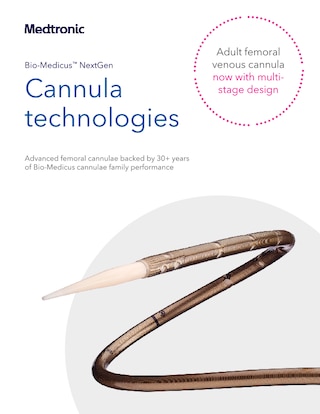
Bio-Medicus™ NextGen cannula
<p>Bio-Medicus™ NextGen arterial and venous cannulae, intended for peripheral placement, are available in sizes appropriate for adult and pediatric patients.</p>
Product details
Femoral arterial/jugular venous cannulae
- Intended for internal jugular venous usage
- Traditional femoral arterial insertion achieves high flow rates with minimal pressure differential1
- Cannula
- Internal jugular venous position promotes efficient venous drainage2 with minimal pressure differential1

Multi-stage femoral venous cannulae
- Designed for easy placement across the atrium during MICS procedures2
- Advanced multi-stage design optimizes drainage of the entire circulation by accessing the inferior vena cava (IVC), atrium, and superior vena cava (SVC).3
- Traditional IVC/atrial junction position promotes efficient venous drainage2

Bi-caval femoral venous cannulae
- Bi-caval capability with optimized basket placement4
- Designed to enable right atrium occlusion and access — 27 Fr and 29 Fr models

Pediatric arterial and venous cannulae
- Arterial or venous cannula, hemostasis cap, adjustable radiopaque suture ring
- Tapered solid core and percutaneous-style introducer
- Cannula/tubing retention clip
Pediatric arterial
Tapered, percutaneous-style, 0.025 in (0.635 mm) diameter guidewire

Pediatric venous
Reinforced side holes support smooth insertion3


Features
Femoral arterial/internal jugular venous cannulae
The Bio-Medicus™ NextGen cannula offers ease of insertion and is engineered for smooth transitions.3 Fingerlet supports are formed into the tapered tip to create a smooth transition between the introducer and the thin cannula wall. All of these advanced Bio-Medicus™ cannula design features add up to your opportunity for a smooth insertion.3
Hemostasis management — the right fit
Our cap and introducer design for every NextGen cannula offers improved function. The increased friction fit between cap and introducer helps prevent backing out when inserting or advancing in the vessel.3 The introducer hub’s smaller guidewire opening also equates to a reduction in blood loss.4
- Repositionable suture ring is radiopaque2
- Friction fit hemostasis cap
- Vented standard 3/8 in connector
- Shorter clamp site eases tubing management

Multi-stage femoral venous cannulae
- Depth markings allow for visualizing the introducer’s length beyond the tip of the cannula body
- Tip taper location indicator
- 3/8 in non-vented connector

- Echo-friendly cannula body design2
- Elongated taper allows introducer to dilate the vessel over a longer distance during insertion
- Overall tip length up to 60 cm


- Long-tapered introducer facilitates placement for efficient tracking3
- Tapered tip design for smooth transitions3
- Smooth side holes facilitate easy insertion and removal2
- Easy insertion and removal with smooth side holes3
- Marker band indicates all side holes are inserted at minimum depth within vessel
- Flexible and kink-resistant4 stainless-steel wire winding and reinforced side hole baskets
Femoral bi-caval venous cannulae
Elongated taper on bi-caval venous cannula models offers dilation over a longer distance.

Introducer markings confirm alignment of cannula and introducer tip.


- One-piece non-phthalate PVC introducer4 with elongated taper
- No-step transition zone promotes easy insertion3
- Smooth side-hole port design for easy insertion3
- Thin-wall design promotes maximum flow rates1
- Fingerlet reinforced tip design offers ease of insertion3
- Flexible and kink-resistant4 stainless-steel wire winding and reinforced baskets
Flow performance
Femoral arterial1
Pressure drop vs. flow

Internal jugular venous1
Pressure drop vs. flow

Femoral venous multi-stage1
Pressure drop vs. flow

Femoral venous bi-caval1
Pressure drop vs. flow

Pediatric arterial1
Pressure drop vs. flow

Pediatric venous1
Pressure drop vs. flow

Risks of cannulation include vessel dissection or perforation, myocardial infarction, hematoma, thrombosis, embolization, renal failure, and death.
Ordering information
Femoral arterial/jugular venous cannulae
- 3/8 in (0.95 cm) vented connector
- One unit per carton
| Item number | Kit model | French size | Overall length | Tip length |
|---|---|---|---|---|
96570-115 |
96530-115 |
15 Fr (5.0 mm) |
31.8 cm |
18.0 cm |
96570-117 |
96530-117 |
17 Fr (5.7 mm) |
31.8 cm |
18.0 cm |
96570-119 |
96530-119 |
19 Fr (6.3 mm) |
31.8 cm |
18.0 cm |
96570-121 |
96530-121 |
21 Fr (7.0 mm) |
31.8 cm |
18.0 cm |
96570-123 |
96530-123 |
23 Fr (7.7 mm) |
31.8 cm |
18.0 cm |
96570-125 |
96530-125 |
25 Fr (8.3 mm) |
31.8 cm |
18.0 cm |
Femoral venous cannulae
- 3/8 in (0.95 cm) non-vented connector
- One unit per carton
| Item number | Kit model | French size | Overall length | Tip length |
|---|---|---|---|---|
96670-115 |
96600-115 |
15 Fr (5.0 mm) |
64.8 cm |
50.0 cm |
96670-117 |
96600-117 |
17 Fr (5.7 mm) |
64.8 cm |
50.0 cm |
96670-119 |
96600-119 |
19 Fr (6.3 mm) |
69.9 cm |
55.0 cm |
96670-121 |
96600-121 |
21 Fr (7.0 mm) |
69.9 cm |
55.0 cm |
96670-123† |
96600-123† |
23 Fr (7.7 mm) |
76.2 cm |
60.0 cm |
96670-125† |
96600-125† |
25 Fr (8.3 mm) |
76.2 cm |
60.0 cm |
96670-127† |
96600-127† |
27 Fr (9.0 mm) |
76.2 cm |
60.0 cm |
96670-129† |
96600-129† |
29 Fr (9.7 mm) |
76.2 cm |
60.0 cm |
Pediatric arterial cannulae with introducer
- 1/4 in (0.64 cm) non-vented connector
- One unit per carton, 22.9 cm overall length
| Item number | French size | Tip length |
|---|---|---|
96820-108 |
8 Fr (2.7 mm) |
10.0 cm |
96820-110 |
10 Fr (3.3 mm) |
10.5 cm |
96820-112 |
12 Fr (4.0 mm) |
11.0 cm |
96820-114 |
14 Fr (4.7 mm) |
11.5 cm |
Pediatric venous cannulae with introducer
- 1/4 in (0.64 cm) non-vented connector
- One unit per carton, 22.9 cm overall length
| Item number | French size | Tip length |
|---|---|---|
96830-108 |
8 Fr (2.7 mm) |
10.0 cm |
96830-110 |
10 Fr (3.3 mm) |
10.5 cm |
96830-112 |
12 Fr (4.0 mm) |
11.0 cm |
96830-114 |
14 Fr (4.7 mm) |
11.5 cm |
Insertion kits
Five units per carton
| Item number | Style |
|---|---|
96551 |
Venous |
96552 |
Arterial/jugular |
96553 |
Pediatric arterial/venous |
Resources

Related links
Medtronic customer service
Phone: 800-854-3570
Medtronic Academy
Find available training resources for extracorporeal life support products.
Manuals and technical guides
Important safety information
Care and caution should be taken to avoid damage to vessels and cardiac tissue during cannulation or other cardiac procedures.
For a listing of indications, contraindications, precautions, warnings, and potential adverse events, please refer to the instructions for use.
Caution: Federal law (USA) restricts this device to or on the order of a physician.
† 1/2 in (1.27 cm) to 3/8 in (0.95 cm) tubing adapter included with venous models 23 Fr through 29 Fr only.
- Based on Medtronic flow rate/pressure loss data on file. Clinical results will vary due to patient’s condition and blood composition.
- Medtronic data on file. Design validation. These tests may not be indicative of clinical performance.
- Medtronic data on file. Design validation and verification reports. These tests may not be indicative of clinical performance.
- Medtronic data on file. Design verification testing reports. These tests may not be indicative of clinical performance.