


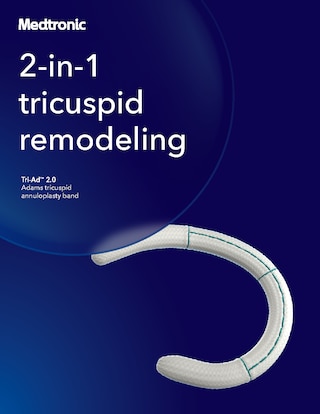
Download this brochure to read about how the Tri-Ad™ 2.0 Adams annuloplasty band repairs annular dilation and demonstrates industry-low pacemaker rates after tricuspid repair.


Annuloplasty
Tri-Ad™ 2.0 Adams annuloplasty band
<p>The Tri-Ad™ 2.0 Adams annuloplasty band repairs annular dilation through semi-rigid remodeling, with flexible ends designed to preserve 3-D motion.</p>
Features
Flexible and semi-rigid combined advantage
- Flexible remodeling while preserving 3-D motion — the Tri-Ad™ 2.0 band arms are flexible, whereas semi-rigid remodeling is targeted at the annular dilation.
- The Tri-Ad™ 2.0 platform has demonstrated industry-low rates of permanent pacemaker implantation post-tricuspid valve repair.2–4
- The wide-open antero-septal aspect helps reduce the risk of potential conduction problems.
- Large open area to reduce conduction risks2,3
- Soft, flexible segments to prevent ring dehiscence2,3,5
- Semi-rigid segment for targeted remodeling of annulus dilation5

Dilated annulus pre-repair

Annulus post-repair

Photos courtesy of Dr. David Adams, Mount Sinai Hospital, New York
Real-world clinical evidence
Evidence suggests a high rate (> 10%) of permanent pacemaker implantation following tricuspid valve repair.6,7 However, tricuspid repair contemporary device design with semi-rigid, flexible segments and a large opening area, may help preserve the conduction system.4 See how the Tri-Ad™ platform demonstrates industry-leading, low pacemaker implantation rates.

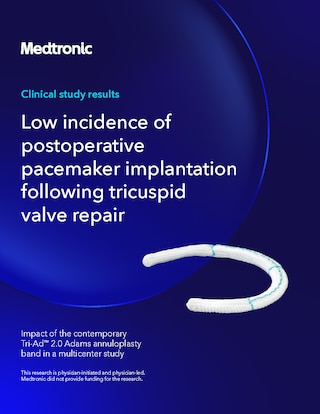
Low incidence of postoperative pacemaker implantation following tricuspid valve repair4
This prospective multicenter study evaluated 120 patients who underwent tricuspid valve repair using the Tri-Ad™ 2.0 annuloplasty band at the time of mitral valve surgery at two Canadian high-volume centers: University of Western Ontario, London, and University of Ottawa Heart Institute, Ottawa.
- 3.3% permanent pacemaker implantation
- 94% of patients had tricuspid regurgitation (TR) ≤ 2 with a mean follow-up of 0.5 ± 0.6 years
- 97.5% survival rate at 30 days

Rationale and initial experience with the Tri-Ad™ Adams tricuspid annuloplasty ring2
In this retrospective study, 42 consecutive patients who underwent concomitant tricuspid repair with the Tri-Ad™ platform were analyzed.
- Pre-discharge TTE revealed absent or minimal TR in all patients
- 0 ring dehiscence
- 0% permanent pacemaker implantation

Early clinical outcomes of tricuspid valve repair with a Tri-Ad™ annuloplasty ring in comparison with the outcomes using an MC3 ring3
In this retrospective, single-center study, 36 patients undergoing tricuspid repair with the Tri-Ad™ platform were analyzed.
- Tri-Ad™ ring corrected functional TR effectively and provided good early clinical and echo outcomes comparable to those obtained using the MC3 ring, with the absence of residual significant TR.
- 0 ring dehiscence
- 0% permanent pacemaker implantation

Midterm outcomes of tricuspid annuloplasty using the Tri-Ad™ Adams tricuspid annuloplasty ring5
A retrospective analysis was conducted on 248 patients who underwent tricuspid annuloplasty using the Tri-Ad™ platform between August 2016 and October 2021. The median age was 64.0 (interquartile range: 56.0–71.5) years. At baseline, tricuspid regurgitation of grade 2–3 was observed in 63.7% of cases, and the median tricuspid annular diameter was 3.3 (2.8–3.6) cm.
- Survival at four years: 96.9%
- Freedom from TR ≥ moderate at four years: 91.6% — 0 tricuspid valve reoperations
- 0 ring dehiscences
- 1.2% pacemaker implantations related to TV repair (6% in total)
Key risks of tricuspid annuloplasty include recurrent regurgitation, stenosis, and ring dehiscence.
Accessory enhancements
Ordering information
Tri-Ad™ 2.0 Adams tricuspid annuloplasty band, Model 900SFC
 |
|
Tri-Ad™ 2.0 accessories
| Item number | Description |
|---|---|
| T7900P | Tri-Ad™ 2.0 tray |
| 7900PS | Set of 6 Tri-Ad™ 2.0 sizers (26–36 mm) |
| 7686 | Annuloplasty handle (216 mm) |
| 7686L | Annuloplasty handle (254 mm) |
| 7686XL | Annuloplasty handle (373 mm) |
Resources
Similar products
-
 CG Future™ annuloplasty ring and band
The CG Future™ annuloplasty ring and band provide targeted remodeling for mitral valve repair.
-
 Contour 3D™ annuloplasty ring
The Contour 3D™ annuloplasty ring is a remodeling ring with a physiological tricuspid valve shape.
-
 Profile 3D™ annuloplasty ring
The Profile 3D™ annuloplasty ring has a unique asymmetrical 3-D remodeling ring design based on the annular geometry of normal human mitral annuli.
-
 SimuForm™ annuloplasty ring
The SimuForm™ annuloplasty ring has a flexible segment designed to accommodate anterior motion, while the semi-rigid posterior segment enables remodeling.
-
 SimuPlus™ flexible annuloplasty ring and band
The SimuPlus™ flexible annuloplasty ring and band offer flexible solutions to mitral and tricuspid (band only) valve repair.
- Pyo WK, Suh YJ, Lee S, et al. Influence of annuloplasty prosthesis in fractional area change after tricuspid valve repair: Annular motion analysis based on computed tomography. Presented at AATS Annual Meeting; 2023.
- Milla F, Castillo JG, Varghese R, Chikwe J, Anyanwu AC, Adams DH. Rationale and initial experience with the Tri-Ad™ Adams tricuspid annuloplasty ring. J Thorac Cardiovasc Surg. 2012;143(4 Suppl):S71–S73. doi:10.1016/j.jtcvs.2011.11.015.
- Jung W, Choi JW, Hwang HY, Kim KH. Early clinical outcomes of tricuspid valve repair with a Tri-Ad™ annuloplasty ring in comparison with the outcomes using an MC3 ring. Korean J Thorac Cardiovasc Surg. 2018;51(2):92–99. doi:10.5090/kjtcs.2018.51.2.92.
- Loshusan B. Low incidence of postoperative pacemaker implantation following tricuspid valve repair: impact of a contemporary tricuspid valve annuloplasty device in a multi-center study. Presented at: AATS Mitral Conclave; December 11–12, 2025; New York, NY.
- Lee H, Kim J, Jung JH, Yoo JS. Mid-term outcomes of tricuspid annuloplasty using the Tri-Ad Adams tricuspid annuloplasty ring. Interdiscip Cardiovasc Thorac Surg. 2024;39(1):ivae131. doi:10.1093/icvts/ivae131.
- Ragnarsson S, Taha A, Nielsen SJ, et al. Pacemaker implantation following tricuspid valve annuloplasty. JTCVS Open. 2023;16:276–289. doi:10.1016/j.xjon.2023.08.017.
- Chick W, Alkhalil M, Egred M, et al. A systematic review and meta-analysis of the clinical outcomes of isolated tricuspid valve surgery. Am J Cardiol. 2023;203:414–426. doi:10.1016/j.amjcard.2023.07.006.
- Medtronic data on file, Report 10786211DOC.