

Gastrointestinal artificial intelligence
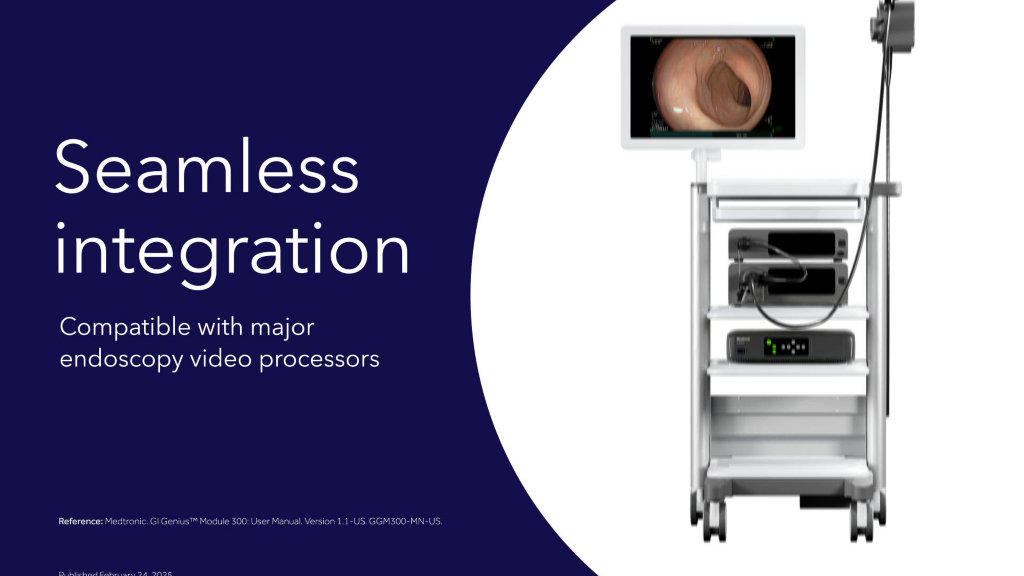
GI Genius™ intelligent endoscopy module
<p>The GI Genius™ system is the first-to-market AI-assisted colonoscopy device that alerts physicians to potential lesions in real-time.</p>

Features
Bring AI-assisted detection to your colonoscopy procedures with the GI Genius™ system.
Real-world impact in fight against colorectal cancer
GI Genius™ system is among the most extensively studied AI-assisted endoscopy systems available today. Published clinical and real-world evidence supports its ability to improve precancerous polyp detection, helping reduce the risk of interval colorectal cancer.2-11
Enhance detection
Traditional colonoscopies miss 26% of precancerous polyps.12 GI Genius™ improves adenoma detection across experience levels and baseline ADRs.
14%
absolute ADR increase
Randomized controlled trial2
Randomized controlled trial2
1 in 8–10
patients undergoing colonoscopy with GI Genius™ system have one additional adenoma detected.
Meta-analysis of 7 RCTs13
Detect the undetected
GI Genius™ system helps catch what the eye alone can miss.
50%
fewer missed adenomas
Tandem RCT4
Tandem RCT4
Sessile serrated lesions are key precursors to colorectal cancer, but their flat, subtle shape makes them easy to overlook.14
46%
higher odds of detecting a sessile serrated lesion
Pragmatic RCT9
Pragmatic RCT9
Reduce cancer risks
Each 1% increase in ADR is associated with a 3% decrease of interval cancer risks.15
In a propensity-matched analysis of >3 million colonoscopy comparing patient outcome of AI-era to non-AI Era, AI-Era is associated with
47%
lower likelihood of interval colorectal cancer.
2026 DDW Abstract.16
2026 DDW Abstract.16
Findings demonstrate association, not causation.
Next-generation AI hardware
Engineered for ColonPRO™ software today. Scalable for future innovation.
Experience ColonPROTM software.1
Beyond polyp detection, ColonPRO™ software now automates procedure highlights to help standardized reporting.
By analyzing the entire procedure, ColonPRO™ can automatically capture key procedure highlights and objectively measures quality metrics, helping support more consistent documentation and standardized reporting.

AI Access™ platform
Smarter AI. Smarter insights. Seamless integration.
Grab hold of the future today
AI is here, and so are the possibilities for healthcare.
The GI Genius™ module now enables AI Access™ Platform.
AI Access is a digital ecosystem that will allow third party developers to host responsible, regulated AI applications through the GI Genius™ module.
Our vision is to help standarize care with a suite of AI solutions so physicians can access what they need for the right patient at the right time.

See what a colorectal cancer expert has to say.
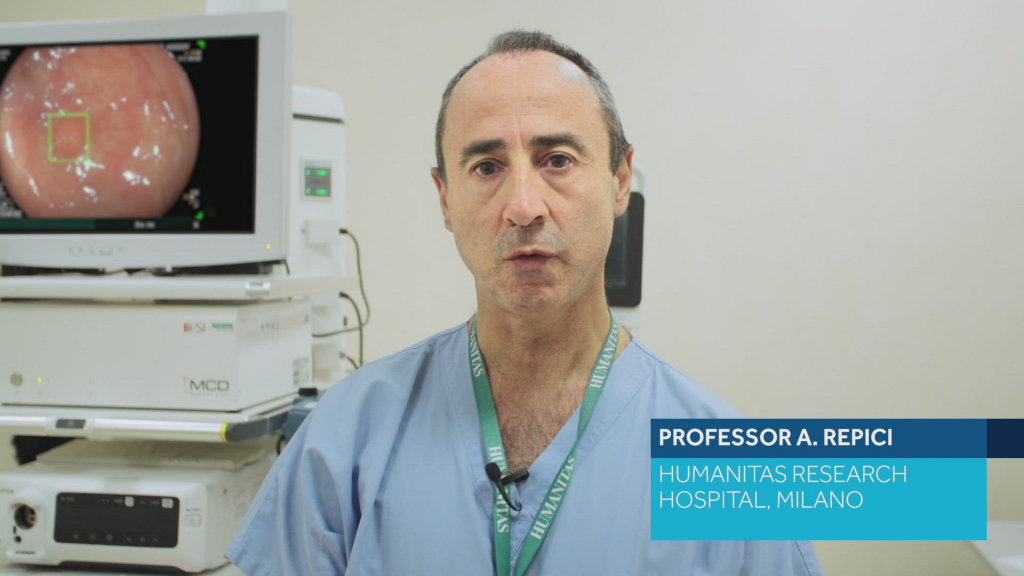
The GI Genius™ intelligent endoscopy module offers a transformative solution — to address the challenges of preventing colorectal cancer. By harnessing deep learning algorithms and real-time data, we empower physicians to detect and treat colorectal polyps through enhanced visualization.
Professor Alessandro Repici describes his clinical experience with the GI Genius™ intelligent endoscopy module.
Colorectal cancer is treatable and beatable, with early diagnosis.
Despite evidence that screening reduces colorectal cancer (CRC) incidence and mortality, about 40% of age-eligible adults are not up to date on CRC screenings.6
“Go and screen. It’s the smartest thing anyone could do — eliminate a problem before it occurs.”
– Patrick, colon cancer survivor
Related links
This device is not intended to replace clinical decision making. For complete risk information, please refer to the Instructions for use (IFU).
GI Genius™ module vGGM300 User Manual.
Repici, A. et al. (2020). Efficacy of real-time computer-aided detection of colorectal neoplasia in a randomized trial. Gastroenterology. 159(2): 512–520 e7.
Repici, A. et al. (2022). Artificial intelligence and colonoscopy experience: Lessons from two randomized trials. Gut. 71(4): 757–765.
Wallace, M. B. et al. (2022). Impact of artificial intelligence on miss rate of colorectal neoplasia. Gastroenterology, 163(1), 295–304 e5.
Karsenti, D. et al. (2023). Effect of real-time computer-aided detection of colorectal adenoma in routine colonoscopy (COLO-GENIUS): A single-centre randomized controlled trial. Lancet Gastroenterol & Hepatolgy. 2023 Aug;8(8):726–734. doi: 10.1016/S2468-1253(23)00104-8.
Ahmad, A. et al. (2023). Evaluation of a real-time computer-aided polyp detection system during screening colonoscopy: AI-DETECT study. Endoscopy. 55(4): 313–319.
Mangas-Sanjuan, C. et al. (2023). Role of artificial intelligence in colonoscopy detection of advanced neoplasias. https://doi.org/10.7326/M22-2619.
Engelke, et al. (2023). Prospective study of computer-aided detection of colorectal adenomas in hospitalized patients. https://doi.org/10.1080/00365521.2023.2212309.
Seager, A. et al. (2024). Polyp detection with colonoscopy assisted by the GI Genius™ artificial intelligence endoscopy module compared with standard colonoscopy in routine colonoscopy practice (COLO-DETECT): A multicenter, open-label, parallel-arm, pragmatic randomized controlled trial. The Lancet Gastroenterology & Hepatology. 9(10): 911–923.
Schöler J,Alavanja M, de Lange T, et al. Impact of AI-aided colonoscopy in clinical practice: a prospective randomized controlled trial. BMJ Open Gastroenterol. 2024. 11:e001247. /bmjgast-2023-001247.
Thiruvengadam, N. R. et al. (2024). The efficacy of real-time computer-aided detection of colonic neoplasia in community practice: A pragmatic randomized controlled trial. Clinical Gastroenterology and Hepatology.
Zhao S et al. Adenoma Miss Rate: Systematic Review & Meta-analysis. Gastroenterology. 2019.156:1661–1674.e11.
Sattar A, Sattar A, Khan M, et al. Effectiveness of the GI Genius™ computer-aided detection system versus standard colonoscopy: a systematic review and meta-analysis of randomized controlled trials. Cureus. 2025:17(10): e94624.
Sweetser, S., Smyrk, T. C., & Sinicrope, F. A. (2013). Serrated colon polyps as precursors to colorectal cancer. Clinical Gastroenterology and Hepatology, 11(7), 760-767. https://doi.org/10.1016/j.cgh.2012.12.004
Corley DA, Jenson CD, Marks AR JR, et al. Adenoma detection rate and risk of colorectal cancer and death. NEJM. 2014: 370:1298-306.
Butt, M., Karna, V., et al. (2026). [Article/abstract title]. Gastroenterology. 170(Suppl. 1), S-138. https://doi.org/10.1016/S0016-5085(26)00669-4.