Fluid management
<p>The HysteroLux™ system enables uterine distention while monitoring a patient’s fluid deficit in real-time during hysteroscopic procedures.</p>
The HysteroLux™ fluid management system is a combined suction and irrigation control unit for use in hysteroscopic interventions. This system is intended to provide liquid distension of the uterus during diagnostic and operative hysteroscopy, and to monitor the volume differential between the distension fluid flowing into and out of the uterus.
Use of the HysteroLux™ fluid management system for intrauterine distension is contraindicated whenever hysteroscopy is contraindicated. See the operator's manual of your hysteroscope for absolute and relative contraindications.
In case the device or any of the accessories fail during surgery, a replacement device and replacement accessories should be kept within proximity to be able to finish the operation with the replacement components.
The physician must determine a distension fluid suitable for the application and medical procedure.
Only the physician can evaluate the clinical factors involved with each patient and determine if the use of this device is indicated. The physician must determine the specific technique and procedure that will accomplish the desired clinical effect.
The device is intended to be used only by surgeons and support personnel with the necessary training in the appropriate indication — technical terms may be used.
Factory settings are not mandatory settings for the physician. The physician is responsible for all settings affecting the surgical procedure.
Different default settings of the warning message for identical or similar devices in the operating room may cause a risk due to conflicting acoustic signals.
For your own safety and that of your patient, use only original accessories. (See Accessory List chapter in operator's manual.)
Check the warning signals prior to each device use. Set up the system so that all warning signals can be perceived.
The vacuum tube sets for this device contain diethylhexylphthalate (DEHP), which is classified as toxic to reproduction according to the EU Directive 1272/2008/EECon Classification, Labeling and Packaging of Dangerous Substances. DEHP may impair fertility and may cause harm to the unborn child. Therefore, this product must not be used for unauthorized applications. When applied within the intended use, the potential risk to pregnant or breastfeeding women as well as to children resulting from the DEHP contained in this product is not critical.
The device is not explosion-proof. Do not operate the device in the vicinity of explosive anesthetic gases and not in the vicinity of oxygen-enriched environments.
Place the device on a stable and level surface. Cables must be laid safely. Tubes between the device and the patient must not create any obstruction.
To prevent electrical shock, do not open this device. Never open this device yourself. Notify the authorized service technicians of any required repairs.
To avoid the risk of electrical shock, only use this device when connected to a properly grounded power supply network.
Unplug the power cable from the device before checking the fuse.
The instructions for use do not include descriptions or instructions for surgical procedures/techniques. It is not suitable for training physicians in the use of surgical techniques. Medical peripherals and devices may be used only by physicians or medical assistants with the appropriate technical/medical qualifications working under the direction and supervision of a physician.
The function test must be performed prior to each device use.
Do not use this system if a defect is suspected or detected during the function check. This also applies to obvious defects, especially defects and damage to the power plug and power cord.
If a device defect is suspected or confirmed, do not use the device. Make sure the device can no longer be operated until a qualified service technician conducts the appropriate tests and repairs.
Do not use this device if a defect is suspected or detected during the function check. It is prohibited to use the device in the case of obvious defects.
An authorized service technician must check the device if the specific parameters and tolerances are exceeded.
Always work exclusively with sterile substances and media, sterile fluids, and sterile accessories if so indicated.
Replace the fuse only with a fuse of the same type and rating. See Accessory List chapter in the operator's manual, page 71.
Do not open the device. The device may not be opened or calibrated by the user. Only authorized service technicians are permitted to repair, calibrate, or modify the device or its equipment.
Protect device from moisture. Do not use if moisture has penetrated the device.
Do not sterilize the control unit and the scale.
Distension may be lost when resetting the nominal flow or nominal pressure settings.
The device is only intended for use with flexible fluid bags. Do not use glass containers as they might break. With rigid containers, fluid cannot flow quickly enough due to the vacuum being generated inside of the containers. There is risk of implosion with rigid containers.
Incorrect height of the bag setting may lead to a deviation of the flow in comparison to the specification of the device. Deficit calculation could be incorrect in this case.
Set up the device in such a way as to allow for easy monitoring of the display values, device functions, and access to the control elements.
Always keep a full fluid bag on hand to replace an empty one. This avoids having to interrupt surgery due to a lack of distention fluid.
Do not use device and/or accessories if signs of contamination are detected. Make sure the device and/or accessories can no longer be operated until a qualified service technician conducts the appropriate tests and repairs.
Sterilize reusable instruments and reusable tube sets before surgery to prevent infections. Check all the single-use/disposable items before removing them from the package to ensure that the packaging is intact and the expiration date is still valid.
Reuse of product may pose an infection hazard for patients and/or users, and impairment of product functionality. There is risk of injury, illness, or death due to contamination and/or impaired functionality of the product. Do not reprocess the product.
For electrical safety reasons, do not touch the patient and the on/off button at the same time.
The on/off push button does not disconnect the device from the main power supply. This requires pulling the plug located in the rear of the device.
Additional equipment connected to medical electrical devices must be demonstrated to be compliant with their respective IEC or ISO standards (IEC 60601-1, IEC 60950, or IEC 62368 for data processing equipment). Furthermore, all configurations must comply with the normative requirements for medical systems (see section 16 of the last valid edition of IEC 60601-1). Anyone who connects additional devices to medical electrical equipment is a system configurator and as such is responsible for the system's compliance with the normative requirements for systems. Please contact the technical service if you have additional questions.
Portable HF communication equipment can affect the performance characteristics of the device HysteroLux™ fluid management system. Such equipment must therefore comply with a minimum distance of 30 cm (regardless of all calculations) from the device HysteroLux™ fluid management system, and its components and cables.
The HysteroLux™ fluid management system, including its scale, should not be used directly next to other devices as this could result in malfunctions. The HysteroLux™ fluid management system, including its scale, was tested for compliance with IEC 60601-1-2 as a stand-alone system. Therefore, do not stack other devices on the system. If usage in the manner described above is nevertheless required, this system and the other devices should be monitored to make sure they function properly. The only exception to this rule is the TruClear™ tissue removal system. Please refer to the Electromagnetic Compatibility chapter of the operator's manual for details, page 62.
When tissue removal is used, the combination of low nominal pressures and excessively high vacuum pressures may result in a significant loss of intracavity distension pressure, which has the potential to affect the visibility of the surgical field. Conversely, when employing high distension pressures, the deactivation of the morcellator system can lead to pressure spikes exceeding 150 mmHg.
There is a risk of irrigation fluid reaching the circulatory system of the patient's soft tissue. This can be affected by distention pressure, flow rate, perforation of the distended body cavity, and duration of the endoscopic surgery. It is critical to closely monitor the input and outflow of the distending liquid at all times.
Continuous flow of distention fluids can lead to a lowering of the patient's body temperature. Lower body temperatures can cause coronary and cardiovascular problems. Always monitor the patient's body temperature during the entire surgery procedure, especially ensuring that the following hypothermia-promoting operation conditions are avoided as best as possible:
An air embolism can be the result of air contained in the tube set or connected instrument reaching the patient. Ensure there is always fluid in the bag to prevent air from being pumped into the patient.
When using the scale, follow the operating instructions in the instructions for use. Touching the canisters and their holders and vibrations of the balancing system should be avoided during surgery to prevent triggering a false detection of the canister change and not negatively affect the accuracy of the deficit calculation.
Containers should be changed quickly to avoid affecting the accuracy of the deficit calculation.
The deficit display value is lost in case of a power loss or “brownout.”
Intrauterine distension is usually possible with pressure values between 35 to 70 mmHg. A pressure above 75 mmHg is required only in rare cases or if the patient has excessively high blood pressure.
Strict fluid intake and output surveillance should be maintained due to the risk of fluid overload. For healthy patients, the maximum fluid deficit of 1,000 mL is suggested when using a hypotonic solution (e.g., glycine, sorbitol, and mannitol). If isotonic solutions (e.g., saline, lactated Ringer's) are used, the fluid deficit should not exceed 2,500 mL.
Some distension fluids may lead to fluid overload and, consequently, hyponatremia with its attending sequelae. This can be affected by the distending pressure, flowrate, and duration of hysteroscopic procedure. It is critical to closely monitor the input and outflow of the distending liquid at all times.
A surgical procedure is associated with a risk of developing pulmonary edema resulting from fluid overload with isotonic fluids. It is critical to closely monitor the input and outflow of the distending liquid at all times.
Hysteroscopic surgery is associated with a risk of developing cerebral edema resulting from fluid overload and electrolyte disturbances with hyperosmolar (nonionic) fluids such as glycine 1.5% and sorbitol 3.0%. It is critical to closely monitor the input and outflow of the distending liquid at all times.
In rare cases, idiosyncratic reactions may occur, such as:
Distention of the uterus may lead to a tear of the fallopian tube should there be an obstruction or permanent occlusion. The rupture could lead to irrigation fluid flowing into the patient's peritoneal cavity, resulting in a fluid overload. It is critical to closely monitor the input and outflow of the distending liquid at all times.
Stop the device using the start/stop button if replacing the instrument during surgery.
Deficit displays and warnings serve as a tool for the treating physician and do not replace the monitoring of the patient's condition.
The fluid left in the patient and the concentration of sodium in the blood serum must both be monitored. The deficit amount is the entire amount of fluid lost by or to the system. Take note of the measurement tolerance of the system. While the system provides fluid deficit estimation, it is ultimately the physician's responsibility to monitor fluid deficit.
The pressure should be kept as low as possible to allow for sufficient intrauterine distention and to reduce the forces that could allow fluid, ambient air, and/or gas into the circulatory system.
The HysteroLux™ fluid management system has a maximum allowable fluid inflow volume of 32,450 mL when the scale is in use. If the inflow volume reaches 30,000 mL, the pump will pause fluid inflow. The inflow volume and deficit value will freeze at the current values when the pump is paused. If the physician decides to continue the operation, manual count for continued deficit monitoring must be performed.
Filling the tubing with irrigation fluid and resetting the deficit display to zero are to be done at the physician’s discretion.
Make sure the fluid bags hang freely, are not resting on something, and do not touch other objects except the bag deflectors. Failure to follow these instructions means the deficit cannot be calculated correctly.
The vacuum tube with integrated filter is designed for a maximum use of 30 days. Replace the vacuum tube if it is obviously contaminated. The filter prevents body fluids from entering the interior of the device. Please note that the filter may reduce the suction capacity.
There are no restrictions as to the specification of the patient group when using the device as intended, and its use does not endanger the patient's health.
After 24 hours of continuous operation, switch the device off and then on again so that the device self-test can be carried out.
The device may not be used in conjunction with a defibrillator since it is not equipped with corresponding safety elements. The manufacturer accepts no liability in this case for ensuing damage.
When a tissue removal device/shaver system is used, the combination of low nominal pressures and excessively high vacuum pressures may result in a significant loss of intracavity distension pressure, which has the potential to affect the visibility of the surgical field. Conversely, when employing high distension pressures, the deactivation of the tissue removal device can lead to pressure spikes exceeding 150 mmHg.
To avoid a malfunction, the user must be positioned correctly within a display viewing angle of ±50° to operate the device, up to 2 m/6.5 ft from the device front for monitoring the actual values.
Check to make sure the available mains voltage matches the data listed on the type label attached to the back of the device. Incorrect voltage can cause errors and malfunctions and may destroy the device.
Any power cables employed by the user that are not provided by the manufacturer must meet the safety requirements of the national standards in the respective current valid version.
Before switching on the device, sufficient time must have passed to adjust to the indoor climate.
The device may only be connected with hysteroscopes designed for and featuring the technical specification permitting such a combined use. Any utilized hysteroscopes must comply with the most recent versions of IEC 60601-2-18 and ISO 8600. Combining/connecting with other devices generates a medical electrical system (MES). The system configurator is responsible for compliance with the standard IEC 60601-1 / EN 60601-1 in its last version.
The instrument recognition must be performed outside and at the level of the patient.
See the Electromagnetic Compatibility chapter, page 62. Care was taken during the development and testing of this device that electrical interference of or from other devices or instruments was practically eliminated. However, if you still detect or suspect such interference, please follow these suggestions:
The use of accessories, transducers, and cables other than those specified, except for transducers and cables sold by the manufacturer of the ME equipment or ME system. See the operator’s manual glossary, as replacement parts for internal components, may result in increased emissions or decreased immunity of the ME equipment or ME system.
The medical electrical (ME) device is suitable for integration in ME equipment systems, see the operator’s manual glossary. Operation of the ME device in vicinity of non-ME devices may result in voiding the intended use of the ME device.
Additional peripheral equipment connected to interfaces of the medical monitor has to meet the requirements of the following specifications in the respective current valid version: IEC 60601-2-18 / EN 60601-2-18 for endoscopic devices and IEC 60601-1 / EN 60601-1 for electrical medical devices. All configurations have to comply with IEC 60601-1 / EN 60601-1 specifications. Whoever connects additional equipment to signal output or signal input is considered the system configurator and as such is responsible for complying with requirements of the standard IEC 60601-1 / EN 60601-1.
The scale to be connected must be attached to the device before the device is switched on or the device does not detect the scale.
The device is transportable. The rollers of the cart/scale system are used for positioning at the usage site. To transport the device, remove all fluid bags from the hooks and make sure there are no containers or only completely emptied containers on the cart/scale. Inflow and outflow tubes must be completely removed. Make sure the power supply line does not touch the ground and there are no other objects located on the pump or on the scale. Always use the handle to move the system safely.
To avoid affecting the accuracy of the deficit calculation ensure that the first step of the container change is to disconnect tubing from the full containers. Reconnect tubing to the new containers only if they are already inserted into the scale.
Make sure the bag height of the used fluid bags is set correctly in the menu if not using a scale. See the Fluid Bag Configuration chapter in the operator’s manual – "Use without Scale," page 49.
The message “Critical Overpressure!” overwrites all other possible messages. Over-pressure warnings serve as information for the attending physician to respond appropriately to the existing excess pressure. The intrauterine pressure can be reduced by opening the outflow cannula, for example. If possible, the attending physician should perform this task.
To ensure compliance with the requirements of IEC 60601-1-2 in the current version, the device HysteroLux™ fluid management system must be used only with the accessories listed in the Accessory List chapter in the operator’s manual.
For more information, refer to the Instructions for Use (IFU).
HysteroLux™ system benefits include:
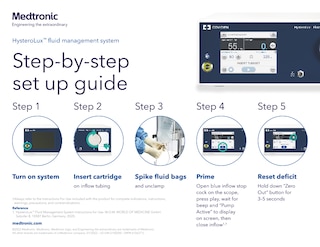
View a step-by-step guide for in-office setup for the HysteroLux™ fluid management system.
View setup and trouble shooting scenarios including recommended regulator settings for the Hysterolux™ canister.
The smaller diameter TruClear™ 5C hysteroscope set enables a see-and-treat approach to intrauterine pathologies.
The TruClear™ Elite hysteroscopes enable a see-and-treat approach for intrauterine pathologies.
The TruClear™ dense tissue shaver provides tissue removal in hysteroscopic procedures and comes in both a plus and a mini size.
The smallest diameter hysteroscope in the TruClear™ portfolio, TruClear™ set duo provides the option of a diagnostic or operative sheath for the office setting.
The TruClear™ system offers a complete solution for diagnosing and treating intrauterine abnormalities that may be causing abnormal uterine bleeding.
TruClear™ soft tissue shavers provide tissue removal in hysteroscopic procedures and comes in both a plus and mini size.
† Compared to our legacy hysteroscopic fluid management system.
Your information will be used and protected in accordance with our {link}
Hours: 8:00 a.m. - 8:00 p.m. EST
Phone: 763-514-4000
Toll-free: 800-633-8766
Just to confirm, is this the product or product type that interests you?
{{productNamePlaceholder}}
OR
Before we get started, what best describes you?
If you subscribe to email updates, you can unsubscribe anytime via the link in each email. We use technology to measure email opens and clicks, to improve our communications and provide relevant content. For details, see our {link}
Your personal data will be used to manage your relationship with Medtronic in accordance with our {link}
If you consent to receive emails, you can unsubscribe anytime via the link in each email. We use technology that measures email opens and clicks, to improve our communications and provide relevant content. For details, see our {link}