| Item number | Size (cm) | Size (in) | Recommended trocar size | Quantity per box |
|---|---|---|---|---|
| ADG1510 | 15 × 10 | 5.9 × 3.9 | 8 mm | 1 |
| ADG2015 | 20 × 15 | 7.9 × 5.9 | 8 mm | 1 |
| ADG3020 | 30 × 20 | 11.8 × 7.9 | 12 mm | 1 |
| ADG4030 | 40 × 30 | 15.7 × 11.8 | 15 mm | 1 |


Self-gripping mesh
<p>ProGrip™ advanced self-gripping polypropylene mesh is made for use in ventral hernia repair using either laparoscopic or robotic-assisted surgical techniques.</p>
Your free experience kit gives you a hands-on opportunity to feel what it's like to suture with the ProGrip™ advanced self-gripping polypropylene mesh.

Discover all the benefits of ProGrip™ advanced self-gripping polypropylene mesh.
| Textile material4 | Polypropylene |
| Microgrip material4 | Polylactic acid |
| Fast-resorbing film composition4 | Collagen and glycerol |
| Surface density before grips absorption28 | 79 g/m2 |
| Surface density after grips absorption28,29 | 44 g/m2 |
| Pore size28 | 1.7 × 1.7 mm (height by width) |
A: No. The collagen-based film is not intended to minimize tissue attachment, and thus this product cannot be used intraperitoneally.30
A: Benchtop studies demonstrate that the mesh rolled in the lengthwise direction with the grips outside and the collagen-based film inside is compatible with the following trocars:§§,1,2
A: Indications30 ProGrip™ advanced self-gripping polypropylene mesh is intended for use in reinforcement of abdominal wall soft tissues where weakness exists. It is indicated for use in the extraperitoneal space during ventral hernia repair procedures, utilizing either conventional laparoscopic or robotic-assisted surgical techniques.
Contraindications30 - As ProGrip™ advanced self-gripping polypropylene mesh will not stretch to accommodate growth, its use is not appropriate in patients in a period of growth or pregnancy. - Any foreign material may potentiate or prolong infection in the presence of bacterial contamination, and as such, the use of ProGrip™ advanced self-gripping polypropylene mesh is not appropriate in an infected or contaminated site. Furthermore, this product should be used with the understanding that infection may require removal of the mesh. - The collagen-based film is not intended to minimize tissue attachment, and thus this product cannot be used intraperitoneally.
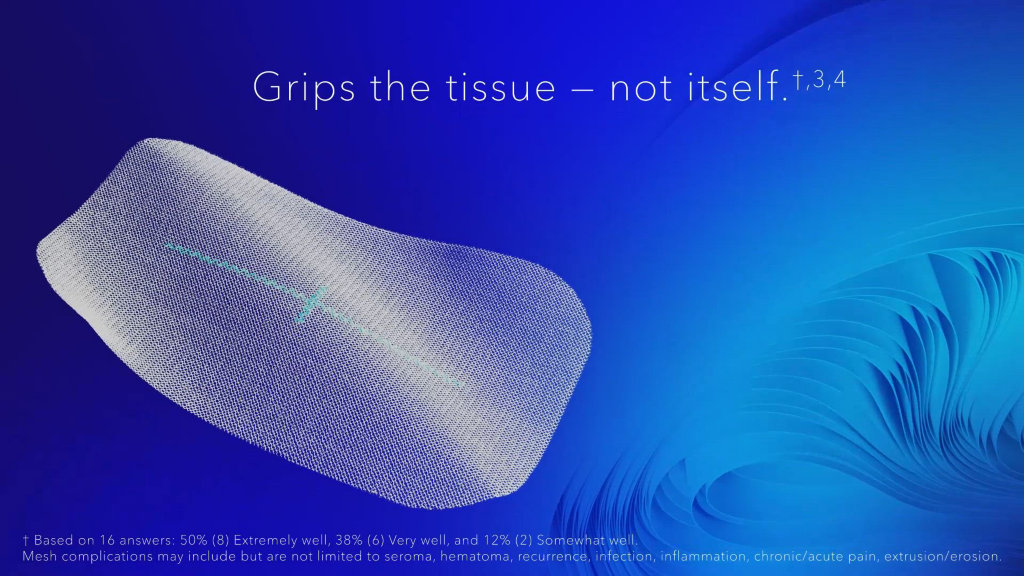
A: The mesh is a sterile non-pyrogenic device made of a nonabsorbable bidimensional monofilament polypropylene textile with resorbable monofilament polylactic acid grips on one side and an absorbable continuous collagen-based film on the other side. This film is made of collagen from porcine origin and glycerol. A colored yarn (D&C Blue No. 6) marker is present on the center of the mesh.30
A: The mesh shall be placed grips either up or down in retromuscular space. The mesh shall be placed grips up in preperitoneal space to avoid direct contact with peritoneum.30
A: Yes. However, if the mesh is trimmed the marking may no longer be centered and will thus lose its functions.30
A: ProGrip™ advanced self-gripping polypropylene mesh should be hydrated before being handled. Hydrate the mesh by immersing it completely in a sterile saline solution for several seconds. If the mesh is not hydrated, trocar passage may not be optimal and the film may no longer facilitate mesh handling and deployment.◊◊,30
| Item number | Size (cm) | Size (in) | Recommended trocar size | Quantity per box |
|---|---|---|---|---|
| ADG1510 | 15 × 10 | 5.9 × 3.9 | 8 mm | 1 |
| ADG2015 | 20 × 15 | 7.9 × 5.9 | 8 mm | 1 |
| ADG3020 | 30 × 20 | 11.8 × 7.9 | 12 mm | 1 |
| ADG4030 | 40 × 30 | 15.7 × 11.8 | 15 mm | 1 |

Dextile™ anatomical mesh is intended to be used for the reinforcement of soft tissues during repair of inguinal hernias by laparoscopic approach.


Parietene™ monofilament polypropylene flat sheet mesh is indicated for abdominal wall hernia repair by open or laparoscopic approach.

Parietene™ macroporous mesh is intended for reinforcement of abdominal wall soft tissue where a weakness exists, involving abdominal wall hernia repairs.

Parietex™ composite mesh is used for the reinforcement of tissues during surgical repairs including hiatal hernias.


Parietex™ hydrophilic 2-D mesh is intended for reinforcement of the abdominal wall soft tissue during inguinal hernias repairs.

Parietex™ hydrophilic 3-D mesh is intended for reinforcement of the abdominal wall soft tissue during inguinal and incisional hernias repairs.


Parietex™ optimized composite mesh is intended for the reinforcement of abdominal wall soft tissues where a weakness exists.


ProGrip™ laparoscopic self-fixating mesh is indicated for the reinforcement of soft tissues during repair of inguinal hernia defects by laparoscopic approach.


The ProGrip™ self-gripping polypropylene mesh portfolio provides more sizes for your inguinal and ventral hernia repair procedures.

The Symbotex™ composite mesh is intended for the reinforcement of abdominal wall soft tissue where a weakness exists.

Transorb™ self-gripping resorbable mesh is intended for use in open extraperitoneal ventral hernia repairs.

Versatex™ monofilament mesh is intended for reinforcement of abdominal wall soft tissue where a weakness exists involving abdominal wall hernia repairs.
Mesh complications may include but are not limited to seroma, hematoma, recurrence, infection, inflammation, chronic/acute pain, extrusion/erosion. The collagen film is not intended to minimize tissue attachment, and thus this product cannot be used intraperitoneally. Direct contact with the viscera may lead to risks of adhesions, fistula formation, and bowel obstruction. The safety and effectiveness of the mesh positioned in the onlay space have not been established. When implanting in a preperitoneal site, the mesh shall be placed with the grips towards the muscle/fascia with the mesh completely covered with peritoneum. The self-gripping side of the mesh can be differentiated from the continuous collagen-based film side visually or through tactile feel. Please refer to IFU for complete contraindication and risk information.
† Based on preclinical animal and/or benchtop studies, not necessarily indicative of human clinical outcomes.
‡ Based on feedback from 16 surgeons conducted in lab setting with cadaver.
§ Compared to a flat sheet mesh affixed with 40% more fixation devices (i.e., sutures or tacks).
◊ Based on responses from 16 participants, 14 (88%) described their experience either extremely well (8 respondents; 50%) or very well (6 respondents; 38%), while 2 respondents (12%) described their experience somewhat well.
¶ Based on 16 answers: 63% (10) Extremely well, 31% (5) Very well, and 6% (1) Somewhat well. Refer to the IFU for the trocar size recommendations. Do not force the mesh through the trocar. Inappropriate insertion may lead to textile and/or grips damage.
# Sizes up to 20 × 15 cm are designed to be inserted in an 8 mm robotic trocar without being damaged.
∆ Based on 16 answers: 18% (3) Very easy, 44% (7) Easy, 32% (5) Quite easy, and 6% (1) Not easy.
∞ Compared to mesh with pores < 1.5 mm.
†† Based on biaxial tensile tests with strain measurements made on linea alba in human cadaver (data from Cooney et al., 2016) and on ProGrip™ advanced self-gripping polypropylene mesh (clamps adapted for textile use).
‡‡ Drawn from both published studies and non-published registry data.
§§ Mesh insertion capability may vary depending on how the surgeon rolls the mesh and their choice of graspers/trocars. These choices are based on the surgeon’s judgement and experience. Do not force the mesh through the trocar. Inappropriate insertion may lead to textile and/or grips damage.
◊◊ Before hydration, it is recommended not to fold the mesh with the film facing itself as it may stick on itself during the hydration phase and alter its function.
