
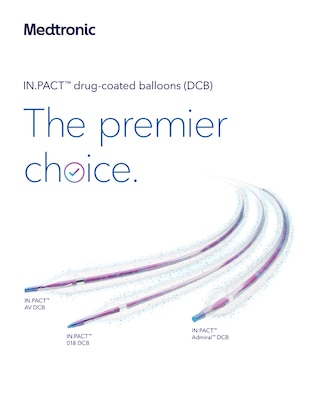
Download this brochure to learn about the IN.PACT™ 018 and IN.PACT™ Admiral™ drug-coated balloon risk-share program.


Peripheral drug-coated balloons
IN.PACT™ Admiral™ and IN.PACT™ 018 drug-coated balloons
<p>The IN.PACT™ Admiral™ and IN.PACT™ 018 drug-coated balloons (DCB) are proven treatments for femoropopliteal disease. </p>
Drug-coated balloons

IN.PACT™ Admiral™ DCB
- Compatible with 0.035" guidewires
- Tested and trusted, with more than 500,000 patients treated worldwide
- Five years of efficacy and safety data,1 even in complex lesions2
- Available in 200 mm and 250 mm balloon lengths

IN.PACT™ 018 DCB
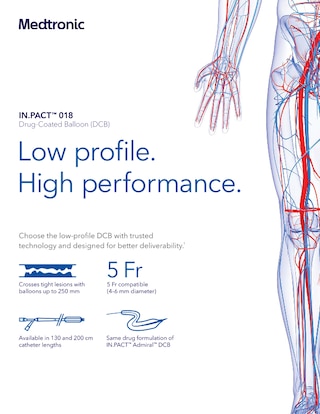
- Compatible with 0.014" and 0.018" guidewires
- Uses the same proven drug formulation as IN.PACT™ Admiral™ DCB
- Available in 200 mm and 250 mm balloon lengths
- 130 cm and 200 cm catheter lengths allow the option to treat via femoral or radial† access
Proven formulation of paclitaxel in tissue
Only the IN.PACT™ Admiral™ and IN.PACT™ 018 DCBs release the drug into the tissue through the restenotic window.
Duration of paclitaxel in tissue‡

Competitive DCB indications
| Product | SFA/Popliteal | SFA/Popliteal lesions over 180 mm | ISR |
|---|---|---|---|
| IN.PACT™ Admiral™ DCB | ✓ | ✓ | ✓ |
| IN.PACT™ 018 DCB | ✓ | ✓ | ✓ |
| Ranger™* DCB | ✓ | X | X |
| Lutonix™* DCB | ✓ | ✓ | ✓ |
| Stellarex™* DCB | ✓ | X | ✓ |
| Surveil™* DCB | ✓ | X | X |
Backed by unmatched clinical evidence
IN.PACT™ Admiral™ DCB is the only DCB that has:
- Demonstrated a statistically significant delta versus PTA for primary patency at three years§,1
- Demonstrated a statistically significant delta versus PTA for freedom from CD-TLR at five years1
- Five-year data on ISR, CTO, and long lesions1
- More than 30 sponsored publications◊
The safety and effectiveness of the IN.PACT™ Admiral™ DCB (0.035 guidewire compatible), as established in the clinical studies that were performed primarily via femoral access, can be considered supportive for the IN.PACT™ 018 DCB. The IN.PACT™ 018 DCB has not been evaluated in a clinical study.
Risks may include: access site pain or infection, hemorrhage, local or distal embolic events, perforation or rupture of the artery, amputation and death.
Mechanism of action: Efficient drug delivery
IN.PACT™ DCBs are coated with a combination of paclitaxel and an excipient, urea. The unique formulation allows rapid and efficient delivery of drug to the vessel wall.
Watch a video to see how our DCBs work.

Outcomes protection program
Both IN.PACT™ DCBs are backed by our Outcomes Protection Program. We’re so confident in our clinical outcomes that we will share in the cost of care if your patients require reintervention within one year of treatment.
Frequently asked questions
Risks may include: access site pain or infection, hemorrhage, local or distal embolic events, perforation or rupture of the artery, amputation and death.
IN.PACT™ Admiral™ and IN.PACT™ 018 DCBs are the only DCBs to treat lesions in the SFA with drug-in tissue through the restenotic window.3-6 IN.PACT™ Admiral™ DCB is the only DCB backed by more than 30 publications and IN.PACT™ 018 DCB is the only 0.018" DCB platform with a 250 mm length balloon.
IN.PACT™ Admiral™ DCB is supported by extensive multiyear data across randomized trials and global registries, including complex lesion subsets such as in-stent restenosis (ISR), long lesions, and chronic total occlusions (CTOs). With more than 30 peer-reviewed publications, IN.PACT™ Admiral™ has the largest clinical evidence base of any DCB, including follow-up out to 5 years.
Yes. Real‑world quality‑of‑life outcomes were reported in the French Post‑Reimbursement Registry, presented by Professor Yann Gouëffic at the 2025 Paris Vascular Insights Course:
- In the real-world study of 80 patients — 36% with diabetes, 33% with critical limb ischemia, and 35% with total occlusions — treatment with IN.PACT™ Admiral™ DCB led to significant improvements in quality of life (EQ‑5D‑5L) and walking ability by 12 months.7
- Clinical outcomes found 98.8% freedom from major amputation, 84.4% freedom from target vessel revascularization through 24 months and a drop in critical limb ischemia rates from 32.5% to 3% at one year.7
This analysis is part of the Medtronic Product Surveillance Registry.
Randomized evidence from the IN.PACT™ SFA trial shows that IN.PACT™ Admiral™ DCB provides significantly better long-term patency than PTA.1 Through three years, IN.PACT™ Admiral™ DCB demonstrated a +24.4% higher primary patency compared to PTA , with primary patency rates of 62.0% for IN.PACT™ Admiral™ DCB versus 45.1% for PTA at 37 months (p < 0.001).
Long-term durability is further supported by the finding that 75% of patients treated with IN.PACT™ Admiral™ DCB remained reintervention-free at five years.1
Drug: Paclitaxel
Dose: 3.5 µg/mm2
Excipient: Urea
The unique formulation used in IN.PACT™ drug-coated balloons allows rapid and efficient delivery of drug to the vessel wall. Paclitaxel is an anti‑proliferative agent that inhibits the cell types involved in the restenotic cascade. Embedded paclitaxel crystals dissolve slowly into tissue, providing controlled, extended drug release for up to 180 days.3
IN.PACT™ Admiral™ and IN.PACT™ 018 DCBs are indicated for treatment of de novo, restenotic, or in‑stent restenotic lesions up to 360 mm in the superficial femoral and popliteal arteries with reference vessel diameters of 4 mm to 7 mm.
Resources
Specifications
Features |
IN.PACT™ Admiral™ DCB |
IN.PACT™ 018 DCB |
Guidewire compatibility |
0.035 in |
0.014 and 0.018 in |
Catheter design |
Over-the-wire (OTW) |
Over-the-wire (OTW) |
Catheter lengths |
130 cm |
130 and 200 cm |
Balloon diameters |
4.0 to 7.0 mm |
4.0 to 7.0 mm |
Balloon lengths |
40, 60, 80, 120, 150, 200, 250 mm¶ |
40, 60, 80, 100, 120, 150, 200, 250 mm |
Balloon fold configurations |
4.0 mm: 3 folds 5.0, 6.0, and 7.0 mm: 6 folds |
4.0 mm: 3 folds 5.0, 6.0, and 7.0 mm: 6 folds |
Paclitaxel drug dose |
3.5 µg/mm2 |
3.5 µg/mm2 |
Excipient |
Urea |
Urea |
Ordering information
IN.PACT™ Admiral™ DCB
| 130 cm catheter | Balloon diameter (mm) |
Balloon length (mm) |
Recommended introducer sheath (Fr) |
Nominal pressure (atm) |
RBP (atm) |
|---|---|---|---|---|---|
| ADM04004013P | 4.0 | 40 | 5 | 8 | 14 |
| ADM04006013P | 4.0 | 60 | 5 | 8 | 14 |
| ADM04008013P | 4.0 | 80 | 5 | 8 | 14 |
| ADM04012013P | 4.0 | 120 | 5 | 8 | 14 |
| ADM04015013P | 4.0 | 150 | 5 | 8 | 14 |
| ADM04020013P | 4.0 | 200 | 5 | 5 | 11 |
| ADM04025013P | 4.0 | 250 | 5 | 5 | 11 |
| ADM05004013P | 5.0 | 40 | 6 | 8 | 14 |
| ADM05006013P | 5.0 | 60 | 6 | 8 | 14 |
| ADM05008013P | 5.0 | 80 | 6 | 8 | 14 |
| ADM05012013P | 5.0 | 120 | 6 | 8 | 14 |
| ADM05015013P | 5.0 | 150 | 6 | 8 | 14 |
| ADM05020013P | 5.0 | 200 | 6 | 5 | 11 |
| ADM05025013P | 5.0 | 250 | 6 | 5 | 11 |
| ADM06004013P | 6.0 | 40 | 6 | 8 | 14 |
| ADM06006013P | 6.0 | 60 | 6 | 8 | 14 |
| ADM06008013P | 6.0 | 80 | 6 | 8 | 14 |
| ADM06012013P | 6.0 | 120 | 6 | 8 | 14 |
| ADM06015013P | 6.0 | 150 | 6 | 8 | 14 |
| ADM06020013P | 6.0 | 200 | 6 | 5 | 11 |
| ADM06025013P | 6.0 | 250 | 6 | 5 | 11 |
| ADM07004013P | 7.0 | 40 | 7 | 8 | 14 |
| ADM07006013P | 7.0 | 60 | 7 | 8 | 14 |
| ADM07008013P | 7.0 | 80 | 7 | 8 | 14 |
IN.PACT™ 018 DCB
| 130 cm catheter | 200 cm catheter | Balloon diameter (mm) |
Balloon length (mm) |
Recommended introducer sheath (Fr) |
Nominal pressure (atm) |
RBP (atm) |
|---|---|---|---|---|---|---|
| IPU04004013P | IPU04004020P | 4.0 | 40 | 5 | 8 | 10 |
| IPU04006013P | IPU04006020P | 4.0 | 60 | 5 | 8 | 10 |
| IPU04008013P | IPU04008020P | 4.0 | 80 | 5 | 8 | 10 |
| IPU04010013P | IPU04010020P | 4.0 | 100 | 5 | 8 | 10 |
| IPU04012013P | IPU04012020P | 4.0 | 120 | 5 | 8 | 10 |
| IPU04015013P | IPU04015020P | 4.0 | 150 | 5 | 8 | 10 |
| IPU04020013P | IPU04020020P | 4.0 | 200 | 5 | 8 | 10 |
| IPU04025013P | IPU04025020P | 4.0 | 250 | 5 | 8 | 10 |
| IPU05004013P | IPU05004020P | 5.0 | 40 | 5 | 8 | 10 |
| IPU05006013P | IPU05006020P | 5.0 | 60 | 5 | 8 | 10 |
| IPU05008013P | IPU05008020P | 5.0 | 80 | 5 | 8 | 10 |
| IPU05010013P | IPU05010020P | 5.0 | 100 | 5 | 8 | 10 |
| IPU05012013P | IPU05012020P | 5.0 | 120 | 5 | 8 | 10 |
| IPU05015013P | IPU05015020P | 5.0 | 150 | 5 | 8 | 10 |
| IPU05020013P | IPU05020020P | 5.0 | 200 | 5 | 8 | 10 |
| IPU05025013P | IPU05025020P | 5.0 | 250 | 5 | 8 | 10 |
| IPU06004013P | IPU06004020P | 6.0 | 40 | 5 | 8 | 10 |
| IPU06006013P | IPU06006020P | 6.0 | 60 | 5 | 8 | 10 |
| IPU06008013P | IPU06008020P | 6.0 | 80 | 5 | 8 | 10 |
| IPU06010013P | IPU06010020P | 6.0 | 100 | 5 | 8 | 10 |
| IPU06012013P | IPU06012020P | 6.0 | 120 | 5 | 8 | 10 |
| IPU06015013P | IPU06015020P | 6.0 | 150 | 5 | 8 | 10 |
| IPU06020013P | IPU06020020P | 6.0 | 200 | 5 | 8 | 10 |
| IPU06025013P | IPU06025020P | 6.0 | 250 | 5 | 8 | 10 |
| IPU07004013P | IPU07004020P | 7.0 | 40 | 6 | 8 | 10 |
| IPU07006013P | IPU07006020P | 7.0 | 60 | 6 | 8 | 10 |
| IPU07008013P | IPU07008020P | 7.0 | 80 | 6 | 8 | 10 |
Related products
-
 F-14™* and F-18™* peripheral guidewires
F-14™* and F-18™* stainless steel guidewires are available in multiple tip loads, two lengths, and are engineered for routine to complex interventions.
-
 HawkOne™ directional atherectomy system
Treat above and below the knee with the HawkOne™ directional atherectomy system to remove plaque in patients with peripheral arterial disease (PAD).
-
 IN.PACT™ AV drug-coated balloon
The IN.PACT™ AV drug-coated balloon (DCB) is used for arteriovenous (AV) access maintenance.
The safety and effectiveness of the IN.PACT™ Admiral™ DCB (0.035 in guidewire compatible), as established in the clinical studies that were performed primarily via femoral access, can be considered supportive for the IN.PACT™ 018 DCB. The IN.PACT™ 018 DCB has not been evaluated in a clinical study.
TM* Third-party brands are trademarks of their respective owners. All other brands are trademarks of a Medtronic company.
† Complications associated with radial access may include but are not limited to: abrupt vessel closure, vessel spasm, perforation or rupture of the artery, dissection, pseudoaneurysm, hematoma, thrombosis, and stroke.
‡ Data comes from different individual studies and may differ in a head-to-head comparison, and therefore may not be predictive of clinical results.
§ Primary patency not assessed after three years.
◊ List of publications on file with Medtronic.
¶ 120, 150, 200, and 250 mm lengths are not offered on the 7.0 mm diameter balloon.
- Laird JA, Schneider PA, Jaff MR, et al. Long-term clinical effectiveness of a drug-coated balloon for the treatment of femoropopliteal lesions: Five-year outcomes from the IN.PACT SFA randomized trial. Circ Cardiovasc Interv. 2019;12(6):e007702. doi:10.1161/CIRCINTERVENTIONS.118.007702.
- Tepe G. 5-year results from the IN.PACT Global Study prespecified cohorts: ISR, CTO and long lesions. Presented at: VIVA 2021; October 3–7, 2021; Las Vegas, NV.
- FDA. PMA P140010: Summary of safety and effectiveness data. Accessed January 2, 2026.
- FDA. PMA P190019: Summary of safety and effectiveness data. Accessed January 2, 2026.
- Yazdani SK, Pacheco E, Nakano M, et al. Vascular, downstream, and pharmacokinetic responses to treatment with a low dose drug-coated balloon in a swine femoral artery model. Catheter Cardiovasc Interv. 2014;83(1):132–140. doi:10.1002/ccd.24995.
- FDA. PMA P160049: Summary of safety and effectiveness data. Accessed January 2, 2026.
- Gouëffic Y. Quality of life outcomes Following treatment of femoropopliteal artery disease with paclitaxel‑coated balloons in a real‑world French population. Presented at: Paris Vascular Insights Course; December 13, 2025; Carrousel du Louvre, Paris, France.