| Item number | Dimensions (cm) | Dimensions (in) | Units per box |
|---|---|---|---|
| TSB1510 | 15 × 10 | 5.9 × 3.9 | 1 |
| TSB2020 | 20 × 20 | 7.9 × 7.9 | 1 |
| TSB3030 | 30 × 30 | 11.8 × 11.8 | 1 |
| TSB4030 | 40 × 30 | 15.7 × 11.8 | 1 |


Self-gripping mesh
Transorb™ self-gripping resorbable mesh
<p>Transorb™ self-gripping resorbable mesh is used for open extraperitoneal ventral hernia repairs.</p>
Features
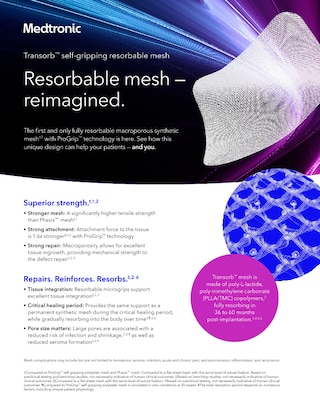
Superior strength†,1,2
- Strong mesh: A significantly higher tensile strength than Phasix™* mesh‡,1
- Strong attachment: Attachment force to the tissue is 1.6 times stronger§,◊,2 with ProGrip™ technology
- Strong repair: Macroporosity allows for excellent tissue ingrowth, providing mechanical strength to the defect repair◊,2–5
Repairs. Reinforces. Resorbs.◊,2–6
- Tissue integration: Resorbable microgrips support excellent tissue integration◊,2,7
- Critical healing period: Provides the same support as a permanent synthetic mesh during the critical healing period, while gradually resorbing into the body over time◊,¶,2,6
- Pore size matters: Large pores are associated with a reduced risk of infection and shrinkage,2,3,8 as well as reduced seroma formation◊,2,9
Ready to experience the Transorb™ self-gripping resorbable mesh?

Specifications
| Materials | Poly-L-lactide, poly-trimethylene carbonate copolymer (PLLA/TMC) with grips on one side10 |
| Resorption | Mesh degradation by hydrolysis is nearly complete in 18 to 24 months, with remaining fibers essentially resorbed in 36 to 60 months. The total resorption period depends on numerous factors, including unique patient physiology.◊,2,6 |
| Pore size | Large pore (1.4 mm × 1.4 mm)#,2 |
| ProGrip™ technology | Grips are present over the entire mesh surface to help maintain the device in place during abdominal wall closure11,12 and may limit the need for additional fixation◊,13 |
Frequently asked questions
Transorb™ self-gripping resorbable mesh is designed for ventral hernia repair when placed in an extraperitoneal space by open surgical approach.
At 18 to 24 months, mesh degradation is nearly complete. The remaining mesh fibers are essentially resorbed in 36 to 60 months post-implantation. The total resorption period depends on numerous factors, including unique patient physiology.◊,2,6
Preclinical studies showed that the mesh maintains mechanical characteristics to reinforce the abdominal wall in vivo for at least 20 weeks and progressively resorbs.◊,¶,2,6
Preclinical studies showed that the grips contribute to the fixation of the mesh to surrounding tissue in vivo for at least four weeks.◊,13
Three years.
Ordering information
Resources
Similar products
-
 Dextile™ anatomical mesh
Dextile™ anatomical mesh is used for the reinforcement of soft tissues during repair of inguinal hernias by laparoscopic approach.
-
 Parietene™ DS composite mesh
Parietene™ DS composite mesh is used for the reinforcement of abdominal wall soft tissue where a weakness exists.
-
 Parietene™ macroporous mesh
Parietene™ macroporous mesh is used for reinforcement of abdominal wall soft tissue where a weakness exists, involving abdominal wall hernia repairs.
-
 Parietex™ composite mesh
Parietex™ composite mesh is used for the reinforcement of tissues during surgical repairs including hiatal hernias.
-
 Parietex™ composite parastomal mesh (PCOPM)
Parietex™ composite parastomal mesh is used for the reinforcement of abdominal wall soft tissues where a weakness exists during hernia repair.
-
 Parietex™ composite ventral patch
The Parietex™ composite ventral patch is used for the reinforcement of adbominal wall soft tissue where a weakness exists for primary ventral hernia repair.
-
 Parietex™ optimized composite mesh
Parietex™ optimized composite mesh is used for the reinforcement of abdominal wall soft tissues where a weakness exists.
-
 ProGrip™ laparoscopic self-fixating mesh
ProGrip™ laparoscopic self-fixating mesh is used for the reinforcement of soft tissues during repair of inguinal hernia defects by laparoscopic approach.
-
 ProGrip™ self-gripping polyester mesh
ProGrip™ self-gripping polyester mesh is used for reinforcement of abdominal wall soft tissue where weakness exists.
-
ProGrip™ self-gripping polypropylene mesh
The ProGrip™ self-gripping polypropylene mesh is used for reinforcement of abdominal wall soft tissue where weakness exists.
-
 Symbotex™ composite mesh
Symbotex™ composite mesh is used for the reinforcement of abdominal wall soft tissue where a weakness exists.
-
 Versatex™ monofilament mesh
Versatex™ monofilament mesh is used for reinforcement of abdominal wall soft tissue where a weakness exists involving abdominal wall hernia repairs.
TM* Third-party brands are trademarks of their respective owners.
† Compared to ProGrip™ self-gripping polyester mesh and Phasix™* mesh. Compared to a flat sheet mesh with the same level of suture fixation. Based on preclinical testing and benchtop studies, not necessarily indicative of human clinical outcomes.
‡ Based on benchtop studies, not necessarily indicative of human clinical outcomes.
§ Compared to a flat sheet mesh with the same level of suture fixation.
◊ Based on preclinical testing, not necessarily indicative of human clinical outcomes.
¶ Compared to ProGrip™ self-gripping polyester mesh in simulated in vitro conditions at 20 weeks.
# These are mean values measured from one batch, which may vary slightly within and between batches depending on the testing method used.
- Based on internal report 1203CR764a, Phasix™* mesh versus Transorb™ self-gripping resorbable mesh — ball burst statistical comparison. October 2021.
- Vestberg R, Lecuivre J, Radlovic A, Payet E, Bayon Y, Bouré L. A novel self-gripping long-term resorbable mesh providing temporary support for open primary ventral and incisional hernia. J Mater Sci Mater Med. 2023;34(11):59.
- Brown CN, Finch JG. Which mesh for hernia repair? Ann R Coll Surg Engl. 2010;92(4):272–278.
- Lake SP, Ray S, Zihni AM, Thompson DM Jr, Gluckstein J, Deeken CR. Pore size and pore shape — but not mesh density — alter the mechanical strength of tissue ingrowth and host tissue response to synthetic mesh materials in a porcine model of ventral hernia repair. J Mech Behav Biomed Mater. 2015;42:186–197.
- Weyhe D, Cobb W, Lecuivre J, et al. Large pore size and controlled mesh elongation are relevant predictors for mesh integration quality and low shrinkage — Systematic analysis of key parameters of meshes in a novel minipig hernia model. Int J Surg. 2015;22:46–53.
- Based on internal report 1203CR462a. November 2023.
- Based on internal report BIO111-a. October 1, 2021.
- Weyhe D, Belyaev O, Müller C, et al. Improving outcomes in hernia repair by the use of light meshes — a comparison of different implant constructions based on a critical appraisal of the literature. World J Surg. 2007;31(1):234–244.
- Jin J, Schomisch S, Rosen MJ. In vitro evaluation of the permeability of prosthetic meshes as the possible cause of postoperative seroma formation. Surg Innov. 2009;16(2):129–133.
- Transorb™ self-gripping resorbable mesh instructions for use, Trévoux, France: Medtronic; 2024.
- Based on internal report 1203CR621a, Design verification activities associated with DI-261 (ex vivo gripping test without fixation). November 2020.
- Based on internal report 1203CR752a, Design validation and summative usability evaluation of Transorb™ self-gripping resorbable mesh — additional study. October 2021.
- Based on internal report 1203CR867, Evaluation and comparison of meshes fixation strengths in a porcine model at four weeks after implantation: pivotal study. November 2023.
This product is licenced with Health Canada as TRANSORB SELF-GRIPPING RESORBABLE MESH on HC MDL # 113437.