




| Item number | Description |
|---|---|
| PMB4000 | BIS™ Advance monitor |
| PMB4000ACBL | BIS™ Advance monitor lock adapter cable |
| PMB4000BAT | BIS™ Advance monitor battery |
| PMB4000DOC | BIS™ Advance docking station |
| PMB4000PMT | BIS™ Advance monitor IV pole mount |
| PMB4000PWS | BIS™ Advance monitor power supply |

Brain channel monitoring
BIS™ Advance monitor
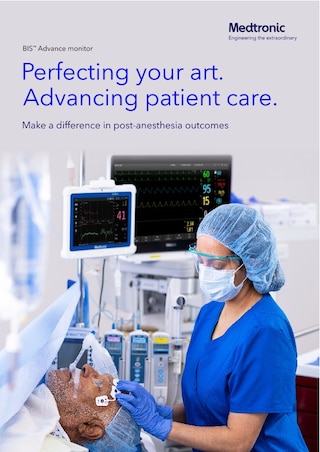
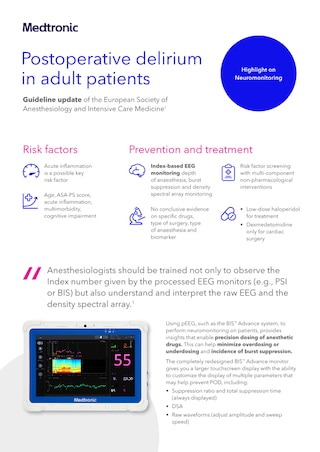
<p>The BIS™ Advance monitor empowers anesthesia providers by reflecting the anesthetic effect on a patient’s brain.</p>
Features
More insights. For a more personalized anesthetic approach.3
- Simple to read — large, high-resolution touchscreen monitor3
- See the information you want — configurable data and settings3
- Quickly review readings — color-coordinated data3
)
Monitor details3
- EMG (electromyogram) shown in numerical and as a bar
- SQI (signal quality index)
- BIS™ value (with alarm range if programmed)
- SR (suppression ratio) percentage (with alarm limit if programmed)
- ST (suppression time) in minutes and seconds
- MF (median frequency)
- SEF (spectral edge frequency)
- Adjustable EEG amplitude scale and sweep speed
- Built-in troubleshooting guides
- Graphic display of BIS™ value and secondary variable
- High-resolution DSA (density spectral array)
- Two- or four-channel capabilities
See the evidence for the BIS™ proven algorithm.
Clinical evidence

Designed for more efficient workflow
- Save time with data output protocols that enable connectivity to electronic medical records (EMRs).3
- Set system-wide default preferences to save time — no need to re-set every time.3
- Maintain continuous monitoring when moving between care settings.
Ordering information
Item numbers can differ per country, please contact your local sales representative for the correct order code
Resources



Related links
Related products
-
 BIS™ bilateral sensorThe BIS™ bilateral sensor captures EEG signals from the left and right hemispheres of the brain's frontal cortex that are processed by the BIS™ algorithm.
 -
 BIS™ pediatric sensor
The BIS™ pediatric sensor, intended for children age 4 and above, captures EEG signals from the frontal brain cortex to be displayed on the BIS™ monitor.
-
 BIS™ quatro sensorThe BIS™ quatro sensor captures EEG signals from the frontal brain cortex that are processed by the BIS™ algorithm and displayed on the BIS™ monitor.
Similar products
- Lewis SR, Pritchard MW, Fawcett LJ, Punjasawadwong Y. Bispectral index for improving intraoperative awareness and early postoperative recovery in adults. Cochrane Database Syst Rev. 2019;9(9):CD003843.
- Gan TJ, Glass PS, Windsor A, et al. Bispectral index monitoring allows faster emergence and improved recovery from propofol, alfentanil and nitrous oxide anesthesia. Anesthesiology. 1997;87(4):808–815. doi:10.1097/00000542-199710000-00014.
- BIS™ Advance Monitor Operators Manual. Medtronic; 2023; 95–127.
- Punjasawadwong Y, Phongchiewboon A, Bunchungmongkol N. Bispectral index for improving anaesthetic delivery and postoperative recovery. Cochrane Database Syst Rev. 2014;2014(6):CD003843. doi:10.1002/14651858.CD003843.pub3.
- Song D, Joshi GP, White PF. Titration of volatile anesthetics using bispectral index facilitates recovery after ambulatory anesthesia. Anesthesiology. 1997;87(4):842–848.
- Luginbühl M, Wüthrich S, Petersen-Felix S, Zbinden AM, Schnider TW. Different benefit of bispectal index (BIS) in desflurane and propofol anesthesia. Acta Anaesthesiol Scand. 2003;47(2):165–173.
- Klopman MA, Sebel PS. Cost-effectiveness of BIS™pectral index monitoring. Curr Opin Anaesthesiol. 2011; 24(2):177-181)
- Shepherd J, Jones J, Frampton G, Bryant J, Baxter L, Cooper K. Clinical effectiveness and cost-effectiveness of depth of anaesthesia monitoring (E-Entropy, BIS™pectral Index and Narcotrend): a systematic review and economic evaluation. Health technol assess. 2013;17(34):1-264.
- Wong J, Song D, Blanshard H, Grady D, Chung F. Titration of isoflurane using BIS index improves early recovery of elderly patients undergoing orthopedic surgeries. Can J Anaesth. 2002;49(1):13–18. doi:10.1007/BF03020413.
- Punjasawadwong Y, Chau-In W, Laopaiboon M, Punjasawadwong S, Pin-On P. Processed electroencephalogram and evoked potential techniques for amelioration of postoperative delirium and cognitive dysfunction following non-cardiac and non-neurosurgical procedures in adults. Cochrane Database Syst Rev. 2018;5:CD01128.
- White PF, Ma H, Tang J, et al. Does the use of electroencephalographic bispectral index or auditory evoked potential index monitoring facilitate recovery after desflurane anesthesia in the ambulatory setting? Anesthesiology. 2004;100:811-817.