No Image Available

Insertable cardiac monitors

LINQ II™ insertable cardiac monitor

<p>The LINQ II™ insertable cardiac monitor (ICM) with AccuRhythm™ AI algorithms is used for long-term heart monitoring.</p>

To view the indications, safety, and warnings, scroll down or click on one of the links below to jump you down the page to that product.

LINQ II™ ICM ISW

Brief statement for LINQ II™ insertable cardiac monitor system (ICM) and accessories

Indications

The LINQ II™ ICM is an insertable automatically activated and patient-activated monitoring system that records subcutaneous ECG and is indicated in adult patients, and in pediatric patients who are at least two years old, in the following cases:

  • Patients with clinical syndromes or situations at increased risk of cardiac arrhythmias
  • Patients who experience transient symptoms such as dizziness, palpitation, syncope, and chest pain that may suggest a cardiac arrhythmia

Contraindications

There are no known contraindications for the insertion of the LINQ II™ ICM or its accessories. However, the patient’s particular medical condition may dictate whether or not a subcutaneous, chronically inserted device can be tolerated.

Warnings and precautions

Patients with the LINQ II™ ICM should avoid sources of diathermy, high sources of radiation, electrosurgical cautery, external defibrillation, lithotripsy, therapeutic ultrasound and radiofrequency ablation to avoid electrical reset of the device, and/or inappropriate sensing as described in the medical procedure and EMI warnings, precautions, and guidance manual. MRI scans should be performed only in a specified MR environment under specified conditions as described in the LINQ II™ MRI technical manual.

Accessories available for use with LINQ II™ ICM may experience connectivity or performance issues.  See product manuals for details and troubleshooting instructions.

Potential adverse events or potential complications

Potential adverse events from the LINQ II™ ICM include, but are not limited to, device rejection phenomena (including local tissue reaction), device migration, infection, and erosion through the skin.

There are no known adverse events associated with the use of any LINQ II™ ICM accessory.  

See the device manuals for detailed information regarding the implant procedure, indications / intended use, contraindications, warnings, precautions, and potential complications/adverse events. For further information, please call Medtronic at 800-328-2518 (technical services) or 800-551-5544 (patient services).

Caution: Federal law (United States) restricts prescription devices to sale by or on the order of a physician.

MAJ_90968

AccuRhythm™ AI Algorithms ISW

AccuRhythm AI ECG classification system brief statement

Indications

The intended use of the system is to reduce false positive cardiac arrhythmia episodes.

Contraindications

There are no known contraindications for AccuRhythm AI Models ZA400, ZA410, or ZA420.

Precautions

The AccuRhythm AI ECG classification system may incorrectly adjudicate a true positive episode as an AI false episode, causing that episode to be suppressed in the remote monitoring system.

See the device manual for detailed information regarding the intended use, contraindications, warnings, precautions, and potential complications/adverse events. For further information, Medtronic Technical Services at (800) 328-2518 and/or consult Medtronic’s website at www.medtronic.com.

Caution: Federal law (USA) restricts these devices to sale by or on the order of a physician.

MAJ_84705


AccuRhythm™ AI algorithms 

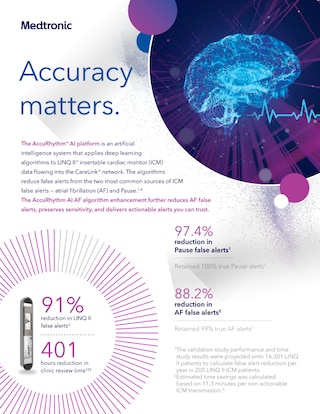
AccuRhythm™ AI algorithms for atrial fibrillation (AF) and Pause further enhance the accuracy of LINQ II™ ICM data.3–5 The cloud-based AI system reduces false alerts while retaining true alerts, so clinicians can manage diagnostic yield and spend more time on the human side of care.

The AccuRhythm™ AI platform is an artificial intelligence (AI) system that applies deep learning algorithms to LINQ II™ insertable cardiac monitor (ICM) data flowing into the CareLink™ network.


Innovative PVC algorithm

The innovative PVC detector may help identify high-risk patients.6,7


Seamless experience and connectivity

BlueSync™ technology within the LINQ II™ ICM enables secure, wireless communication via Bluetooth®* Low Energy without compromising device longevity.1


  1. Reveal LINQ™ mobile manager
  2. LINQ II™ ICM
  3. MyCareLink Heart™ mobile app on patient’s smartphone or tablet, or 
  4. MyCareLink Relay™ home communicator for bedside use 
  5. CareLink™ network 
  6. Medtronic Stay Connected service
     

Effortless connectivity


  • Portable Bluetooth®* monitoring
  • Monitor automatically detects if new data is available
  • Event notification triggers an actionable alert
     

No manual transmissions


  • Remote access to full ECGs eliminates the need for manual transmissions1
  • Decreases patient action and confusion
     

Enhanced patient compliance

This is a graphic representing the CareLink™ network, Medtronic Stay Connected and Get Connected services.

  • Automatic smartphone notifications help patients stay connected
  • Reduces clinic time spent on patient follow-up

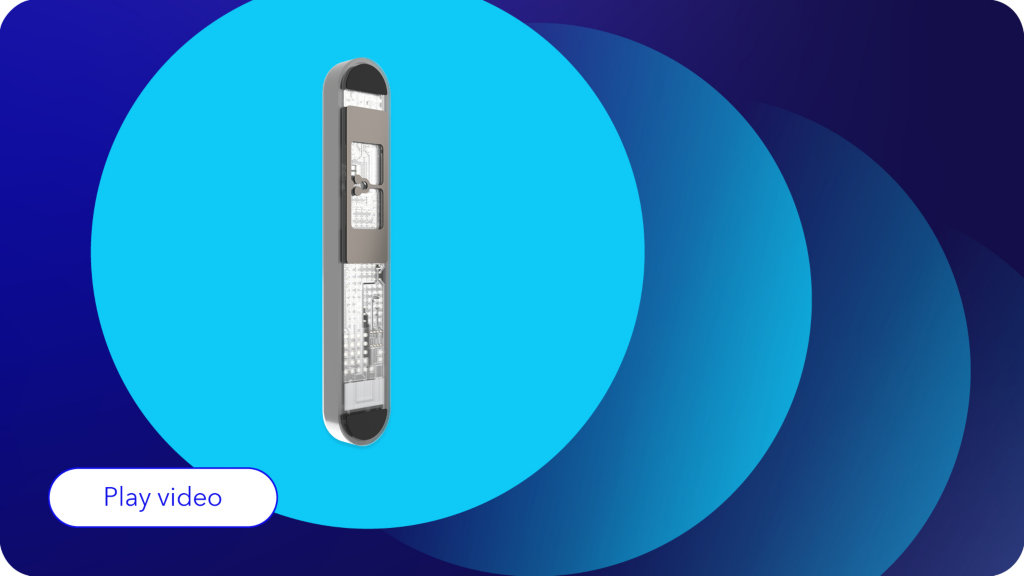
This is an image of the Reveal LINQ™ and LINQ II™ insertable cardiac monitors (ICMs) shown with an EKG strip behind them.

Clarity without compromise

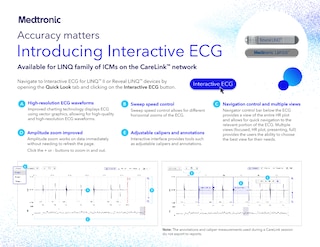
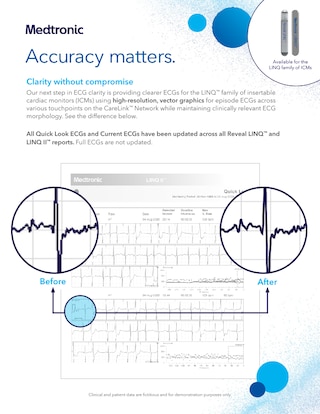
ECG clarity on the LINQ™ family of ICM platform offers a portfolio of enhancements including high-resolution, vector graphics and an advanced Interactive ECG viewer that provides additional tools and capabilities for ICM review.


MRI conditions for use: LINQ II™ ICM system

Conditionally safe MRI access SureScan™ technology
The LINQ II™ ICM is MR Conditional at ≤ 3T with no post-insertion waiting required.1

A patient with a LINQ II™ ICM can be safely scanned in an MR system that meets the following conditions with no post-insertion waiting required. Failure to follow these conditions for use may result in a hazard to the patient during an MRI scan1:

  • Open or closed clinical MRI systems with a static magnetic field of ≤ 3T must be used.
  • Hydrogen proton MRI equipment must be used.
  • Maximum spatial gradient of the static magnetic field specification must be ≤ 25 T/m (2500 gauss/cm).
  • Whole body gradient systems with gradient slew rate specification must be ≤ 200 T/m/s per axis.
  • The Whole Body Specific Absorption Rate (WB-SAR) as reported by the MRI equipment must be ≤ 4.0 W/kg; the head SAR as reported by the MRI equipment must be ≤ 3.2 W/kg.
  • Do not use local transmit coils on the chest, trunk, or shoulder region.
  • There are no restrictions on the placement of receive-only coils, and there are no restrictions on the use of local transmit or receive coils for imaging of the head or extremities.

For more information or to check MRI compatibility, visit the website below.

This is an image of a patient being placed in an MRI machine with a healthcare professional next to her.


Remote programming

The first ICM with remote programming‡,1 

The LINQ II™ ICM enables remote programming capability for all device parameters post-insertion from the clinic, which may reduce patient office visits and scheduling hassles. 

This is an image of a male looking at his mobile phone.

Patient data transmitted to the CareLink™ network via MyCareLink™ Relay or MyCareLink Heart™ app

This is an image of a female healthcare professional wearing scrubs and typing on a computer.

Clinician-initiated reprogramming
via the CareLink™ network
 

This is an image of MyCareLink Relay™ home communicator and MyCareLink Heart™ mobile app as a part of remote programming.

Monitors act as a pass-through.

This is an image of an older man looking at his mobile phone outside with trees in the background.

Device settings automatically update
without the need for an office visit.


Ordering information

Item number Mass (g) Volume (mL) Size — height × width × depth (mm) Surface area of device electrode (mm)2 Distance between electrodes (mm) Battery
LNQ22 3.4 1.4 45.1 × 8.0 × 4.2 16.0 40 Lithium/silver vanadium oxide (SVO) and fluorinated carbon (CFx) cathode


®* The Bluetooth®* word mark and logos are registered trademarks owned by Bluetooth SIG, Inc. and any use of such marks by Medtronic is under license.

Nominal settings.

‡ First European-approved (TÜV-notified body) remote programmable device. 

  1. LINQ II™ ICM insertable cardiac monitor clinical manual. Medtronic; 2022.
  2. Ortega Molina M, Castrejon Castrejon S, Carton Sanchez A, et al. P1414 Miniaturized implantable loop recorders in a pediatric cohort. Europace. 2019;21(S2):i563. doi:10.1093/europace/euz096.

  1. Singh J, Radtke A, Rosemas S, Ousdigian KT. Abstract 18672: Impact of enhanced artificial intelligence on clinic burden from false alerts of insertable cardiac monitors. Circulation. 2023;148(S1):18672. doi:10.1161/circ.148.suppl_1.18672.
  2. Cheng YJ, Ousdigian KT, Sarkar S, Koehler J, Cho YK, Kloosterman ME. B-PO04-036 Innovative artificial intelligence application reduces false pause alerts while maintaining perfect true pause sensitivity for insertable cardiac monitors. Heart Rhythm 2021;18(S8):S293–S294. doi:10.1016/j.hrthm.2021.06.732.
  3. AccuRhythm™ AI clinical manual supplements. Medtronic. March 20, 2024.
  4. Penela D, Fernández-Armenta J, Aguinaga L, et al. Clinical recognition of pure premature ventricular complex-induced cardiomyopathy at presentation. Heart Rhythm. 2017;14(12):1864–1870. doi:10.1016/j.hrthm.2017.07.025.
  5. Penela D, Van Huls Van Taxis C, Aguinaga L, et al. Neurohormonal, structural, and functional recovery pattern after premature ventricular complex ablation is independent of structural heart disease status in patients with depressed left ventricular ejection fraction: a prospective multicenter study. J Am Coll Cardiol. 2013;62(13):1195–1202. doi:10.1016/j.jacc.2013.06.012.