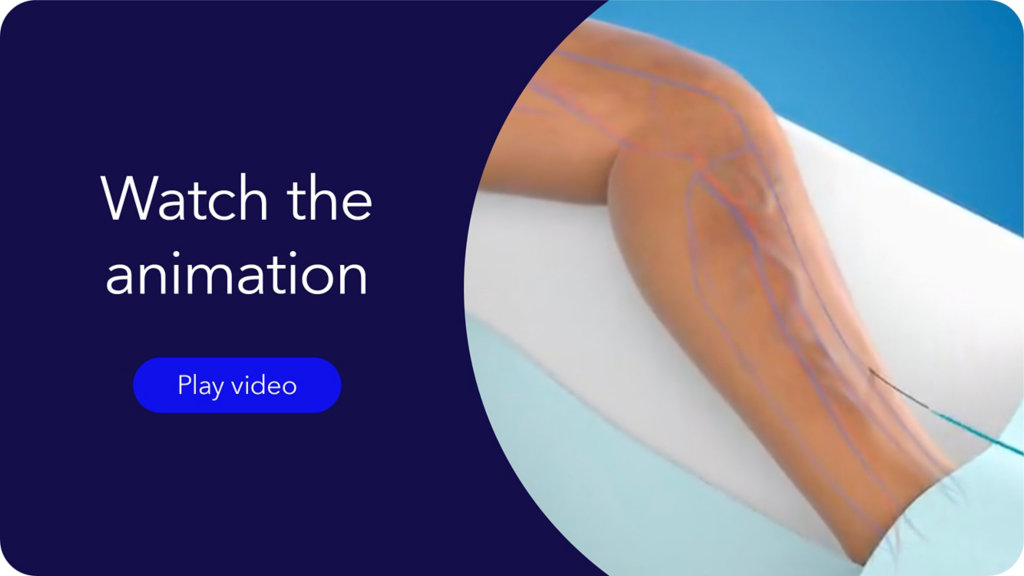
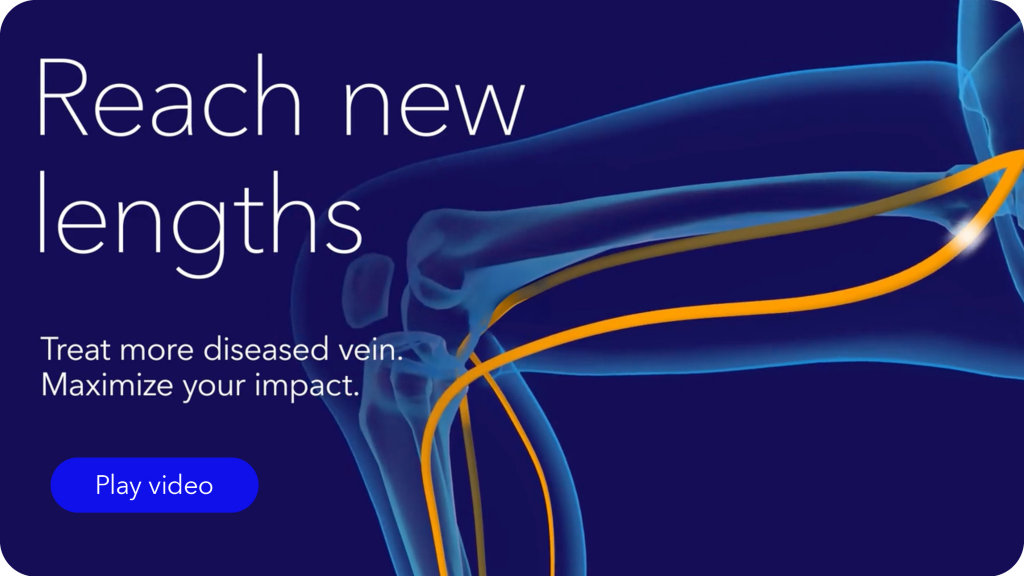
View a VenaSeal™ closure system procedure animation to see how the single, double, and triple segment treatment options work.
Patient impact
Steve’s story
Hear about Steve’s experience with the VenaSeal™ closure system.
Heather’s story
Hear about Heather’s experience with the VenaSeal™ closure system.
The VenaSeal™ closure system procedure offers:
Rapid return to normal activities after treatment1,3
Minimized pain, tenderness, and ecchymosis3
Significant improvements in quality of life6
The VenaSeal™ closure system procedure eliminates2,4:
Tumescent anesthesia
Thermal nerve injury
Post-procedure compression stockings‡
Why choose the VenaSeal™ closure system?
Maximize length of treated vein.
Access the most distal point of reflux with no risk of thermal injury.1
A moderate correlation was demonstrated between diseased vein treatment length and symptom improvement.‡,6
Physicians observed a decreased time to wound healing with VenaSeal™ closure system compared to radiofrequency ablation.§,7
Maximize patient comfort and recovery.
Minimized pain, tenderness, and ecchymosis compared to endothermal ablation8
Rapid return to work and normal activities3
No post-procedure compression stockings◊,2,4
Adverse events can include allergic reaction, inflammation, phlebitis, deep vein thrombosis, and/or pulmonary embolism.
Maximize efficiencies.
More predictable workflow than endothermal therapies with fewer unplanned visits9
Simple, segmental procedure1
Single, double, and triple segment treatment options
Get great outcomes.
94.6% vein closure at five years5
0 DVT (deep vein thrombosis)5
0 PE (pulmonary embolism)5
Significant improvements in quality of life6
‡ Demonstrated in C2–C4 patients.
§ Based on multi-center retrospective cohort study of 119 patients with CEAP class 6 venous ulcers.
◊ Some patients may benefit from the use of compression stockings post-procedure.
Precision
The proprietary catheter is highly visible under ultrasound, allowing precise delivery of the adhesive. The dispensing gun precisely controls the amount of adhesive, delivering 0.10 mL aliquots with each trigger pull.
Polymerization
Upon contact with blood, the adhesive begins to bond with the intima, and compression is applied to close the vein. The adhesive was designed to remain permanently in the diseased vein and is encapsulated by chronic fibrosis.7
Viscosity
The viscosity of the adhesive is specifically designed to minimize migration and embolization.
Flexibility
The adhesive is designed to be soft and flexible and less likely to be felt by the patient.
patients would choose VenaSeal™ procedure again at five years5
75%
improvement in VCSS scores at five years5
94.6%
closure rate at five years5
VenaSeal™ closure system components
Adhesive
Plunger
Release button
Trigger
Dispensing tip
Catheter
Kit specifications
VenaSeal™ adhesive
Five mL of the VenaSeal™ adhesive (a specially formulated n-butyl-2-cyanoacrylate) is contained within a screw-capped vial.
Dispenser gun
The dispenser gun consists of a pistol-type ergonomic handle with an integrated barrel and trigger. Each depression of the trigger delivers a controlled 0.10 mL (range: 0.06–0.12 mL) amount of adhesive.
Catheter
The catheter is 5 Fr with an effective length of 91 cm, laser markings at 3 cm and 85 cm from the tip, and high echogenic visibility.
Introducer
The introducer is 7 Fr with an effective length of 80 cm, with 10 mm spaced circumferential markings along its length for measuring retraction length during the VenaSeal™ procedure.
Dilator
The dilator is 5 Fr with an effective length of 87 cm.
Syringe
The 3 mL syringes are graduated Monoject™* luer-lock syringes, each with a standard threaded luer-lock connector.
Dispenser tips
The dispenser tips are each comprised of a stainless steel, 1.5 mm ID, 3.8 cm length hypotube with a luer-lock connector.
Guidewire
The guidewire is a 0.035 in, 180 cm straight floppy-tip guidewire.
The VenaSeal™ closure system is a nonthermal, nontumescent treatment for superficial vein disease, specifically for the permanent closure of lower extremity superficial truncal veins like the great saphenous vein. It uses a medical adhesive to seal the diseased vein, rerouting blood to healthier veins. The adhesive polymerizes upon contact with blood, bonding with the vein’s intima, and is encapsulated by fibrotic tissue over time.1-4,7
The VenaSeal™ system has a demonstrated closure rate of 94.6% at five years, with 0 DVT (deep vein thrombosis), 0 PE (pulmonary embolism), and significant improvements in quality of life.5,6
The VenaSeal™ system offers advantages over thermal ablation, including no need for tumescent anesthesia, less pain and bruising, and faster recovery time. Thermal ablation uses heat, requiring multiple needle sticks for numbing medicine and compression stockings post-procedure.3,8
The VenaSeal™ system procedure is nonthermal, nonsclerosant vein closure using a proprietary cyanoacrylate adhesive. It uses a single local anesthetic injection with fewer needle punctures compared to foam sclerotherapy. Unlike with foam sclerotherapy, there is no routine need for post-procedure compression stockings after the VenaSeal™ system procedure.◊
The VenaSeal™ system procedure demonstrated a one-year closure rate of 96.8%,¶,5 and a five-year closure rate of 94.6%.¶,5 Foam sclerotherapy one-year closure rate was 73%,¶,10 and no long-term outcomes have been reported. There were zero reported DVTs over five years with the VenaSeal™ system,1 and up to 8.6% DVT risk with foam sclerotherapy.11
The VenaSeal™-treated vein becomes permanently closed as the body creates scar tissue around the adhesive over time, ensuring the vessel remains sealed.7
Insurance coverage for the VenaSeal™ system procedure varies by provider and plan. Some payers, including UnitedHealthcare and others listed in the VenaSeal™ closure system payer coverage list, provide coverage if medical necessity is documented. Providers should confirm coverage with the specific payer.
The VenaSeal™ system procedure is considered safe and effective for treating symptomatic venous reflux. However, it is contraindicated in patients with hypersensitivity to cyanoacrylates, acute superficial thrombophlebitis, thrombophlebitis migrans, or acute sepsis. Potential adverse effects include hypersensitivity reactions, deep vein thrombosis, pulmonary embolism, and others.1
The VenaSeal™ system procedure does not require compression stockings after the procedure, and repeated visits are generally not needed. However, some patients may benefit from compression stockings post-procedure.
Ordering information
VenaSeal™ system
Item number
Description
VS-404
Glass vial with 5 mL adhesive, dispenser gun, 5 Fr x 91 cm catheter, 7 Fr x 80 cm introducer, 5 Fr x 87 cm dilator, (2) 3 mL syringes, (2) 14 ga dispenser tips, guidewire: 0.035 in, (0.89 mm) 180 cm straight floppy-tip
TM* Third-party brands are trademarks of their respective owners.
† Refer to the individual payer policy for full coverage criteria, including patient, physician, and facility requirements. Coverage can vary by plan and within a payer based on an individual's coverage policy. Providers should confirm the policy, coverage status, and prior authorization requirement with the plan for each patient.
‡ Demonstrated in C2–C4 patients.
§ Based on multi-center retrospective cohort study of 119 patients with CEAP class 6 venous ulcers.
◊ Some patients may benefit from the use of compression stockings post-procedure.
¶ After a single treatment.
Morrison N, Gibson K, McEnroe S, et al. Randomized trial comparing cyanoacrylate embolization and radiofrequency ablation for incompetent great saphenous veins (VeClose). J Vasc Surg. 2015;61(4):985–994. doi:10.1016/j.jvs.2014.11.071.
Proebstle T, Alm J, Dimitri S, et al. Three-year follow-up results of the prospective European Multicenter Cohort Study on cyanoacrylate embolization for treatment of refluxing great saphenous veins. J Vasc Surg Venous Lymphat Disord. 2021;9(2):329–334. doi:10.1016/j.jvsv.2020.05.019.
Gibson K, Ferris B. Cyanoacrylate closure of incompetent great, small and accessory saphenous veins without the use of post-procedure compression: Initial outcomes of a post-market evaluation of the VenaSeal system (the WAVES Study). Vascular. 2017;25(2):149–156. doi:10.1177/1708538116651014.
Almeida JI, Javier JJ, Mackay EG, Bautista C, Cher DJ, Proebstle TM. Thirty-sixth month follow-up of first-in-human use of cyanoacrylate adhesive for treatment of saphenous vein incompetence. J Vasc Surg Venous Lymphat Disord. 2017;5(5):658–666. doi:10.1016/j.jvsv.2017.03.016.
Morrison N, Gibson K, Vasquez M, Weiss R, Jones A. Five-year extension study of patients from a randomized clinical trial (VeClose) comparing cyanoacrylate closure versus radiofrequency ablation for the treatment of incompetent great saphenous veins. J Vasc Surg Venous Lymphat Disord. 2020;8(6):978–989. doi:10.1016/j.jvsv.2019.12.080.
Morrison N, Gibson, Vasquez M, et al. VeClose trial 12-month outcomes of cyanoacrylate closure versus radiofrequency ablation for incompetent great saphenous veins. J Vasc Surg. 2017;5(3):321–330. doi:10.1016/j.jvsv.2016.12.005.
Morrison N. VenaSeal closure system vs. radiofrequency ablation for incompetent great saphenous veins (VeClose). 36-month results presented at: IVC; April 20, 2017; Miami, FL.
Proebstle TM, Alm BJ, Gockeritz O, et al. Five-year results from the prospective European multicentre cohort study on radiofrequency segmental thermal ablation for incompetent great saphenous veins. Br J Surg. 2015;102(3):212–218. doi:10.1002/bjs.9679.
Gibson K, Glorieux K. VenaSeal versus ablation with endothermal laser or radiofrequency for saphenous vein incompetence: a comparison of utilization of adjunctive phlebectomy (VenaSeal value). Presented at: AVLS 2019; November 2019; Phoenix, AZ. Abstract available at: journals.sagepub.com/doi/full/10.1177/0268355519893876. Accessed August 28, 2025.
Gibson K, Goldman M, Hertzman P, et al. Durability of treatment effect with polidocanol endovenous microfoam on varicose vein symptoms and appearance (VANISH-2). J Vasc Surg Venous Lymphat Disord. July 2015;3(3):258–264. doi:10.1016/j.jvsv.2015.03.003.
Todd III KL, Wright DI, et al. The VANISH-2 study: a randomized, blinded, multicenter study to evaluate the efficacy and safety of polidocanol endovenous microfoam 0.5% and 1.0% compared with placebo for the treatment of saphenofemoral junction incompetence. Phlebology. October 2014;29(9):608–618.