Postmarket evaluation of the VenaSeal™ closure system
Studies researching cyanoacrylate closure with the VenaSeal™ closure system have been limited to moderate-sized great saphenous veins, and some have mandated postoperative compression stockings.
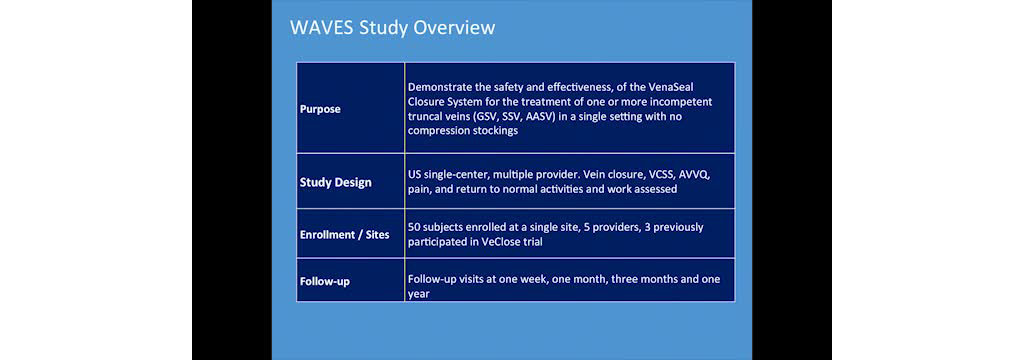
WAVES reports the results of cyanoacrylate closure for the treatment of the great saphenous vein (GSV), small saphenous veins (SSV), and/or accessory saphenous veins (ASV) up to 20 mm in diameter without the need for compression stockings.†
WAVES study 12-month results5,7
98%
closure rate of GSV, SSV, and ASV at 1 year5
20 mm
vein diameter treated successfully in a single session5
22 min
± 7 minutes is the average procedure time (for 1 target vein)7
37predicted
7 actual, 3 months
0 actual, 3–12 months
Need for adjunctive procedure (phlebectomy)5
† Includes nine roll-in patients whose data were not included in this analysis.
‡ Results are from different clinical studies and do not represent a head-to-head comparison of the affected devices; results may differ in a head-to-head comparison. Chart is for illustration purposes only.
§ Demonstrated in C2–C4 patients.
Morrison N, Gibson K, McEnroe S, et al. Randomized trial comparing cyanoacrylate embolization and radiofrequency ablation for incompetent great saphenous veins (VeClose). J Vasc Surg. 2015;61(4):985–994.
Almeida JI, Javier JJ, Mackay EG, Bautista C, Cher DJ, Proebstle TM. Thirty-sixth month follow-up of first-in-human use of cyanoacrylate adhesive for treatment of saphenous vein incompetence. J Vasc Surg Venous Lymphat Disord. 2017;5(5):658–666.
Proebstle T, Alm J, Dimitri S, et al. Three-year follow-up results of the prospective European Multicenter Cohort Study on Cyanoacrylate Embolization for treatment of refluxing great saphenous veins. J Vasc Surg Venous Lymphat Disord. 2021;9(2):329–334.
Morrison N, Gibson K, Vasquez M, Weiss R, Jones A. Five-year extension study of patients from a randomized clinical trial (VeClose) comparing cyanoacrylate closure versus radiofrequency ablation for the treatment of incompetent great saphenous veins. J Vasc Surg Venous Lymphat Disord. 2020;8(6):978–989.
Gibson K, Ferris B. Cyanoacrylate closure of incompetent great, small and accessory saphenous veins without the use of post-procedure compression: Initial outcomes of a post-market evaluation of the VenaSeal system (the WAVES Study). Vascular. 2017;25(2):149–156.
Proebstle TM, Alm J, Dimitri S, Rasmussen L, Whiteley M, Lawson J, Cher D, Davies A. The European multicenter cohort study on cyanoacrylate embolization of refluxing great saphenous veins. J Vasc Surg Venous Lymphat Disord. 2015;3(1):2–7.
Gibson K, Ferris B. Cyanoacrylate closure of incompetent great, small and accessory saphenous veins without the use of post-procedure compression: Initial outcomes of a post-market evaluation of the VenaSeal™ system (the WAVES Study). Vascular. 2017;25(2):149–156.
Rasmussen LH, Lawaetz M, Bjoern L, Vennits B, Blemings A, Eklof B. Randomized clinical trial comparing endovenous laser ablation, radiofrequency ablation, foam sclerotherapy and surgical stripping for great saphenous varicose veins. Br J Surg. 2011;98(8):1079–1087.
Attaran R, Bhalla A, Mena-Hurtado CI, Ochoa Chaar CI. Correlation between great saphenous length of treatment zone and diameter with improvement in symptoms after ablation. J Vasc Surg Venous Lymphat Disord. 2021;9(6):1443–1450.
O'Banion LA, Reynolds KB, Kochubey M, Cutler B, Tefera EA, Dirks R, Kiguchi MM. A comparison of cyanoacrylate glue and radiofrequency ablation techniques in the treatment of superficial venous reflux in CEAP 6 patients. J Vasc Surg Venous Lymphat Disord. 2021;9(5):1215–1221.