
BLADDER & BOWEL SOLUTIONS
Implantable tibial neuromodulation (ITNM)
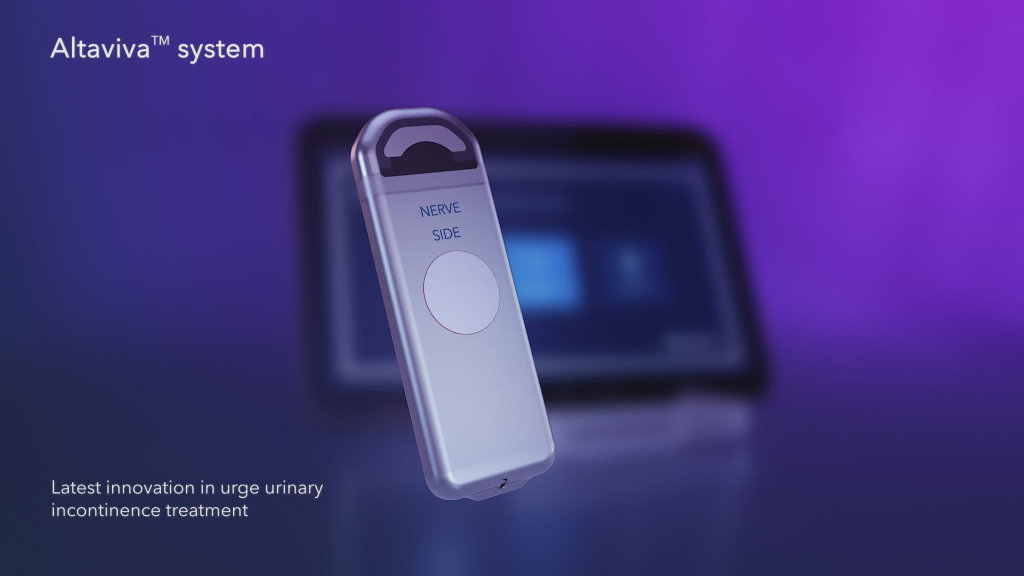
Elevate your treatment options with the Altaviva™ system, a minimally invasive1 option for urge urinary incontinence (UUI).
Less restroom.†,2 More YES room.
Individual results may vary.
† Less restroom is based on patient reported outcomes using the OAB-q, which measures how bladder symptoms affect daily life. Results reflect how patients felt about restroom use and related frustrations, not a direct measurement of restroom visits.
A simple option for you and your patients with urge urinary incontinence (UUI)
Single procedure3
Automatic therapy delivery4
Long-lasting device with expected 15-years of therapy‡,4
Minimally invasive procedure1 designed to fit into your practice’s existing workflow
Approved for urgency with leaks
How does Altaviva™ implantable tibial neuromodulation (ITNM) work?
- The Altaviva™ device can be placed using the Medtronic pocket dissector§ above the fascia near the ankle.
- With no sedation or imaging3 required, the device is placed with a small, 2 cm incision3 along the Langer lines.
- Same-day therapy activation4 delivers stimulation on a schedule to the tibial nerve, helping improve UUI symptoms.5
In addition to risks related to surgery, complications can include pain at the implant site, infection, reaction to local anesthesia, wound complications, lower leg pain, nerve injury, movement of the implant, adverse change in bowel or urinary function, uncomfortable or unintended stimulation sensations, loss of therapeutic effect, discomfort during recharge, or technical or device problems. Please refer to Important Safety Information for more details
§ Surgical instrument is recommended for use, but not required. Sold separately.
Empowering choices.
Expanding access.
The Altaviva™ system is a minimally invasive procedure1 that enables you to treat more patients while providing an option that may help improve their quality of life.5
Medtronic has the most extensive neuromodulation portfolio for bladder and bowel control available, allowing you and your patients to explore options together, for shared decision making.
A simple experience

No sedation or imaging required3

Same day therapy activation4

MRI-ready from the start6
Altaviva™ system for UUI gives your patient access to tibial neuromodulation, a proven therapy for bladder control5,7-10
After 12 months of Altaviva™ therapy:
80%
of patients reported their condition had improved¶ compared to before their implant.5
70%
of patients experienced a clinically meaningful# improvement in health-related quality of life.5
61%
of patients had at least 50% reduction in UUI episodes after 12 months of therapy.5
Adverse events related to the device, procedure, and/or therapy occurred in 20% of implanted subjects through 12‑month follow‑up.
The most common types of related AEs were implant-related infections at the implant site (7%) and implant site pain (3%).
¶ As assessed by the Patient Global Impression of Improvement.
# Minimally Important Difference (MID) = 10 points

“I used to feel trapped. I couldn’t go anywhere without worrying about accidents. Now I can go to the grocery store, travel, and enjoy life again.”
Individual results may vary.
Adeana, living with UUI.
“It’s a boost of confidence... I’m not worried about embarrassing myself somewhere, or always having to carry pads with me.”
Individual results may vary.
Frances, living with UUI.
This patient participated in the TITAN 2 clinical trial that studied the investigational tibial neuromodulation device and its use. For more information, visit clinicaltrials.gov: NCT05226286.

Tibial neuromodulation technology for every day

MRI compatibility:
Backed by 20 years of research provides your patient with full body◊ MRI compatability.

Overdrive™ battery technology:
Our Overdrive™ technology prevents battery degradation over time. This means your patients can expect the same recharge performance in year 15 as in year one.11-13

Support beyond the product:
Comprehensive education, digital diaries, and reporting using the Medtronic Mobile App
Medtronic customer team helps answer patient questions
Patient access connect team supports you and your staff with prior authorization
Discover why the Altaviva™ system is different — only with Medtronic
Submit a request form to connect with a local representative. Expand treatment options and inspire confidence and optimism by offering patients a renewed sense of hope.
Reimbursement
Learn more about the resources that Medtronic has to support you with navigating the reimbursement process including coding, prior authorization, and claims denials.
Prior authorization support
The Medtronic Patient Access Support (PAS) program helps facilitate patient access to Medtronic therapies by providing prior authorization support to healthcare providers upon request. This program is available to support patient access to the pelvic health therapies.
For inquiries, please contact Medtronic
Frequently asked questions
The Altaviva™ implant uses implantable tibial neuromodulation (ITNM), a proven therapy for reducing bladder control symptoms5,7-10 by addressing the underlying neural communication issues.
The device is placed under the skin near the ankle and stimulates the tibial nerve. This may help restore the communication pathway between the brain and bladder,14-15 which may help reduce urgency urinary incontinence.5
Bladder control issues are believed to stem from miscommunication between the brain and the nerves controlling bladder function. By targeting the tibial nerve, the implantable tibial neuromodulation therapy may help to restore normal bladder function.14,15
The device only needs to be recharged 1–2 times per year under standard therapy settings, with each session taking about 30 minutes when properly positioned.16
In addition to risks related to surgery, complications can include pain at the implant site, infection, reaction to local anesthesia, wound complications, lower leg pain, nerve injury, movement of the implant, adverse change in bowel or urinary function, uncomfortable or unintended stimulation sensations, loss of therapeutic effect, discomfort during recharge, or technical or device problems. Please refer to Indications, Safety, and Warnings for more details.
UUI is a chronic condition. Altaviva™ therapy may help manage symptoms effectively, but does not cure the condition.
The Altaviva™ device is expected to be a long-lasting device, with up to 15 years of therapy.4
The procedure is minimally invasive,1 requiring a 2 cm incision. No sedation or radiology is required for placement.3
Yes, patients can have full-body MRI scans if specific conditions are met.6 We can provide detailed safety information to guide you and your patients.
We recommend discussing coverage directly with the patient’s insurance provider. We are happy to support you with prior authorization if needed.
Physicians or patients can contact us for more information. Prospective patients can reach an education specialist at (800) 664-5111, and existing patients can contact a service specialist at (800) 510-6735.
† Less restroom is based on patient reported outcomes using the OAB-q, which measures how bladder symptoms affect daily life. Results reflect how patients felt about restroom use and related frustrations, not a direct measurement of restroom visits
‡ Based on clinical and bench testing for expected therapy settings.
§ Surgical instrument is recommended for use, but not required. Sold separately.
◊ Under certain conditions; see approved labeling for details.
¶ As assessed by the Patient Global Impression of Improvement.
# Minimally Important Difference (MID) = 10 points
- Cameron AP, Chung DE, Dielubanza EJ et al. The AUA/SUFU guideline on the diagnosis and treatment of idiopathic overactive bladder (2024). J Urol. 2024;212:11-20.
- VV-TMF-841603 Statistical Report 29 Apr 2025(v1.0).
- M028930C001RevC- Altaviva™ Model P7850N Neurostimulator Implant Manual.
- M028929C001RevC- Clinician Therapy and Programming Guide Altaviva™ Model P7850N
- Appendix B: Clinical Study Summary. M028929C001 RevC - Clinician Therapy and Programming Guide Altaviva™ Model P7850N.
- M028949C001 RevC MRI Guidelines for Altaviva™ Neurostimulator.
- Peters KM, Carrico DJ, et al. Randomized trial of percutaneous tibial nerve stimulation versus sham efficacy in the treatment of overactive bladder syndrome: results from the SUmiT trial. J Urol. 2010;183:1438-1443.
- Peters KM, MacDiarmid SA, Wooldridge LS, et al. Randomized trial of percutaneous tibial nerve stimulation versus extended release tolterodine: results from the overactive bladder innovative therapy trial. J Urol. 2009;182(3):1055-1061.
- Kobashi K, Nitti V, Margolis E, et al. A prospective study to evaluate efficacy using the NURO percutaneous tibial neuromodulation system in drug naïve patients with overactive bladder syndrome. J Urol. 2019;131:77 82.
- Rogers A, Bragg S, Ferrante K, et al. Pivotal study of leadless tibial nerve stimulation with eCoin for urgency urinary incontinence: an open label, single arm trial. J Urol. 2021;206:399 408.Heesakkers JPFA, Toozs Hobson P, Sutherland SE, et al. A prospective study to assess the effectiveness and safety of the BlueWind system in the treatment of patients diagnosed with urgency urinary incontinence. Neurourol Urodyn. 2024;43:1491-1503.
- M971262A001 RevG - Engineering Bill of Materials InterStim Micro.
- M019324C001 - Bill of Materials Report for P7850N.
- M985332A - InterStim Micro Rechargeable Battery Assembly.
- Li X, Li X, Liao L. Mechanism of action of tibial nerve stimulation in the treatment of lower urinary tract dysfunction. Neuromod. 2023;27:256-266.
- Bhide AA, Tailor V, Fernando R, Vik K, Digesu GA. Posterior tibial nerve stimulation for overactive bladder - techniques and efficacy. Int Urogynecol J. 2020;31:865–70.
- Medtronic data on file: T-Entry System – Recharge Performance Design Verification Test