
Therapies and procedures
Basivertebral nerve ablation (BVNA)
A minimally invasive option for treating chronic vertebrogenic low back pain.
A new way to treat vertebrogenic chronic low back pain
Chronic low back pain can affect nearly every part of a patient’s life, work, and daily responsibilities. Basivertebral nerve ablation (BVNA) is a rapidly growing option for patients experiencing chronic low back pain caused by damaged vertebral endplates.
- Long-term pain relief†,1
- Minimally invasive
- Implant-free

Who may be a candidate for BVNA?
BVNA may be an option for patients with:
- Chronic central low back pain for at least six months
- Modic Type 1 or Type 2 changes on MRI
- Insufficient relief from conservative treatments, such as physical therapy, medications, and injections. These options need to have been tried for at least six months.
BVNA is not for everyone. Risks may include: surgical complications.
Designed to interrupt pain signals at the source
In appropriately selected patients, the BVNA procedure targets the intraosseous basivertebral nerve within the vertebral body using radiofrequency (RF) energy.
By ablating the nerve, BVNA is intended to reduce transmission of pain signals arising from damaged or inflamed vertebral endplates.


A new level of control in BVNA
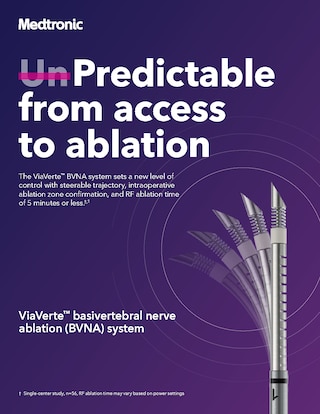
The ViaVerte™ BVNA system is designed to support a more confident approach to vertebrogenic pain treatment, combining precise placement, predictable ablation sizing, and efficient procedure times.‡,1
- Precise | Unparalleled physician-controlled steerability for precise BVN targeting
- Predictable | Intraoperative confirmation of the ablation zone when target temperature is reached
- Fast | Patient-specific RF ablation time of 5 minutes or less‡,1
Access Medtronic Academy
Access on-demand resources — videos, webinars, and more — to deepen your knowledge and uncover the innovations transforming movement disorder care.

Indicates Required Field
† 96.5% clinical success rate for pain reduction (defined as a 2-point decrease in patient-reported pain on a 0-10 scale, single-center study, n=56) at 12 months.
‡ Ablation times may vary based on power setting used.
- De Vivo AE, et al. Neuroradiology. (2021);63(6):809-815. doi: 10.1007/s00234-020-02577-8