
Close

You Are Leaving the Medtronic Australia and New Zealand Site

You just clicked a link to go to another website. If you continue, you may go to a site run by someone else.

We do not review or control the content on non-Medtronic sites, and we are not responsible for any business dealings or transactions you have there. Your use of the other site is subject to the terms of use and privacy statement on that site.

It is possible that some of the products on the other site are not approved in your region or country.

Cancel Continue

Your browser is out of date

With an updated browser, you will have a better Medtronic website experience. Update my browser now.

×

Patients & Caregivers

This information is designed to provide you with helpful educational information but is for information purposes only, is not medical advice, and should not be used as an alternative to speaking with your doctor. No representation is made that the information provided is current, complete, or accurate. Medtronic does not assume any responsibility for persons relying on the information provided. Be sure to discuss questions specific to your health and treatments with a healthcare professional. For more information please speak to your healthcare professional.

Patients & Caregivers

This information is designed to provide you with helpful educational information but is for information purposes only, is not medical advice, and should not be used as an alternative to speaking with your doctor. No representation is made that the information provided is current, complete, or accurate. Medtronic does not assume any responsibility for persons relying on the information provided. Be sure to discuss questions specific to your health and treatments with a healthcare professional. For more information please speak to your healthcare professional.

View Resources

Find a Movement Disorder Specialist Near You

Connect with experienced specialist who can help guide your care and treatment options

Find a specialist

Resources to Help You Prepare

Tools to support conversations with a specialist and better understand your condition

Discussion Guide

Using the DBS Programmer

Connect with Parkinson's Australia

Connect with Essential Tremor Australia


Skip to main content
Medtronic Logo
Menu Close
Search Close
  • English
  • Adriatic Arabia Argentina Australia and New Zealand Bangladesh Belgique (Belgium) België (Belgium) Brasil (Brazil) Bulgaria Canada Canada Europe Central/Eastern, Middle East & Africa, Asia Česká republika (Czech Republic) Chile 中国 (China) Colombia Costa Rica Србија (Serbia) Danmark (Denmark) Deutschland (Germany) Ecuador España (Spain) Europe France Ελλάδα (Greece) 香港特區 (Hong Kong SAR) Indian Subcontinent Israel  ישראל Italia (Italy) 日本 (Japan) Latinoamérica Magyarország (Hungary) México (Mexico) Nederland (Netherlands) Norge (Norway) Österreich (Austria) Panama Paraguay Perú (Peru) Philippines Polska (Poland) Российская Федерация (Russia) Portugal Puerto Rico Romania العربية الشرق Middle East Schweiz (Switzerland) Singapore Slovenská republika (Slovak Republic) South Africa and Sub-Sahara 대한민국 (South Korea) Suisse (Switzerland) Suomi (Finland) Sverige (Sweden) 台灣地區 (Taiwan) ประเทศไทย (Thailand) Türkiye (Turkey) United Kingdom United States Uruguay Україна (Ukraine) Tiếng Việt (Vietnam)
  • Patients & Caregivers
    • Back
    • Conditions & Treatments
      • Back to Conditions & Treatments
      • Bladder & Bowel
        • Incontinence Therapy
      • Brain
        • Parkinson's Disease
        • Essential Tremor
        • Postoperative Delirium
      • Diabetes
      • Digestive & Gastrointestinal
        • Barrett's Oesophagus
        • Colorectal Cancer
        • Dysphagia
        • GORD
        • Inflammatory Bowel Disease
      • Heart & Vascular
        • Aortic Stenosis
        • Unexplained Fainting
        • Varicose Veins
      • Hernia
        • Inguinal Hernia
      • Obesity
      • Spine & Orthopaedic
        • Sacrioliac Joint Dysfunction
        • Scoliosis
    • Patient Services
    • Update Device Registration
    • Order Diabetes Supplies
  • Healthcare Professionals
    • Back
    • Login & Registration
    • Therapies & Procedures
      • Back to Therapies & Procedures
      • Therapy Overview
      • Cardiac Rhythm
      • Cardiovascular
      • Digestive & Gastrointestinal
      • Ear, Nose & Throat
      • Neurological
      • Oral Maxillofacial & Dental
      • Spinal & Orthopaedic
      • Urological and Urogynecological
    • Products
      • Back to Products
      • Product Overview
      • Advanced Surgical Technology
      • Cardiac Rhythm
      • Cardiovascular
      • Diabetes
      • Digestive & Gastrointestinal
      • Ear, Nose & Throat
      • General Surgery
      • Neurological
      • Oral Maxillofacial & Dental
      • Patient Monitoring
      • Renal Care
      • Respiratory
      • Spinal & Orthopaedic
      • Urological & Urogynecological
      • Product Manuals
      • Product Ordering
    • Medtronic Connect eStore
    • Education & Training
    • Services
      • Back to Services
      • CareLink 360 - Transforming Care
      • Digital Connectivity
      • Equipment Services
    • MRI Resources
  • Our Company
    • Back to Our Company
    • Who We Are
    • Mission
    • Leadership
    • Key Facts
    • History
    • Locations
    • News
    • Medtronic in ANZ
    • Careers
  • Our Impact
    • Back to Our Impact
    • Our Impact
    • Impact Reporting
    • Health Equity
    • Inclusion, Diversity & Equity
    • Planet
    • Communities

Home Patients & Caregivers Conditions & Treatments Brain Living with Essential Tremor Living with a DBS Implant

Living with a DBS implant

Understand the key steps required to support effective self-care and proper device management once therapy has commenced.

Following surgery, the clinician will activate the neurostimulator and adjust the settings to optimise symptom control while minimising side effects. Achieving the most effective stimulation levels may require several programming sessions, and some time may be needed to reach optimal results. Periodic follow-up appointments are conducted to assess symptom control, adjust stimulation parameters, and monitor the device battery to determine when replacement is required.

Using the DBS programmer

Instructions will be provided for operating the programmer that accompanies the DBS device. For individuals with a Percept™ rechargeable device, regular battery checks are required to ensure ongoing therapy delivery.

See instructions
A man checks his phone.

Attend all scheduled check-ups with the clinician managing DBS therapy. Any changes in symptoms should be reported promptly.

During these appointments, the clinician will: 

  • Confirm that the DBS system is functioning correctly 
  • Adjust stimulation settings to optimise symptom control 
  • Check the neurostimulator battery to determine whether replacement may be required

Patients should contact their clinician if there are concerns about therapy performance or if symptom relief is not being achieved. For questions about the implanted device, Medtronic Patient Services can be contacted on 1800 652 972, Monday to Friday, 8 a.m. to 5 p.m. AEST. In a medical emergency, 000 should be called immediately.

Situations where the clinician should be contacted include:

  • Experiencing pain, redness, or swelling at the scalp, neck, or chest
  • Lack of symptom relief when the neurostimulator is turned on 
  • Pain or discomfort during stimulation (the neurostimulator should be turned off before seeking advice) 
  • Unexpected changes in essential tremor symptoms 
  • Loss of the patient programmer or any charging system component
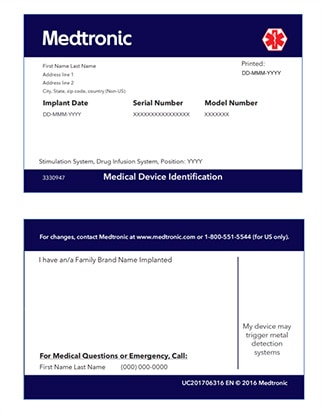
This is the front and back of a sample Medtronic patient ID card that identifies a patient's implanted devices.

This is the front and back of a sample Medtronic patient ID card that identifies a patient's implanted devices.

Identification card

Always carry a patient identification card indicating the presence of an implanted device. The clinician will provide Medtronic with the necessary information to issue this card. This information is also used to track the implanted device in accordance with regulatory requirements.

Patients are responsible for ensuring their contact and physician details remain current, and for updating Medtronic if there are any changes to address, phone number, or managing clinician.


Understand your programmer 

See how to work with your programmer.

Get the details

What is DBS therapy

Learn how DBS therapy may help reduce troublesome movement disorder symptoms and support everyday activities.¹

Learn more

Information contained herein is not medical advice and should not be used as an alternative to speaking with your doctor. Discuss indications, contraindications, warnings, precautions, adverse events and any further information with your health care professional. Please refer to the product insert or Instructions for Use for a complete list of indications, contraindications, warnings, precautions and other important medical information. Always follow the Instructions for Use.

1 Medtronic DBS therapy for Parkinson's disease and essential tremor clinical summary, 2015.

  • Open share options
  • Print
  • Email
  • Copy Link
  • Close share options
LinkedIn Facebook

Patients & Caregivers

  • Overview
  • Conditions & Treatments
  • Patient Services
  • Update Device Registration
  • Order Diabetes Supplies

Healthcare Professionals

  • Login & Registration
  • Therapies & Procedures
  • Products
  • Product Manuals
  • Education & Training

Our Company

  • Who We Are
  • Mission
  • Leadership
  • Key Facts
  • History
  • Locations
  • News
  • Medtronic in ANZ
  • Voice Your Concern
  • Governance
  • Careers

Our Impact

  • Our Impact
  • Impact Reporting
  • Health Equity
  • Inclusion, Diversity & Equity
  • Planet
  • Communities
Medtronic logo with tagline Engineering the extraordinary
  • Privacy Policy
  • Terms of Use
  • Terms & Conditions of Supply
  • Modern Slavery Statement
  • Contact
AU-NEU-2600052 Last Updated April 2026 © 2026 Medtronic