The content of this website is exclusively reserved for Healthcare Professionals in countries with applicable health authority product registrations, except those practicing in France as some of the content is not in compliance with the French Advertising law N°2011-2012 dated 29th December 2011, article 34.
Click “OK” to confirm you are a Healthcare Professional.
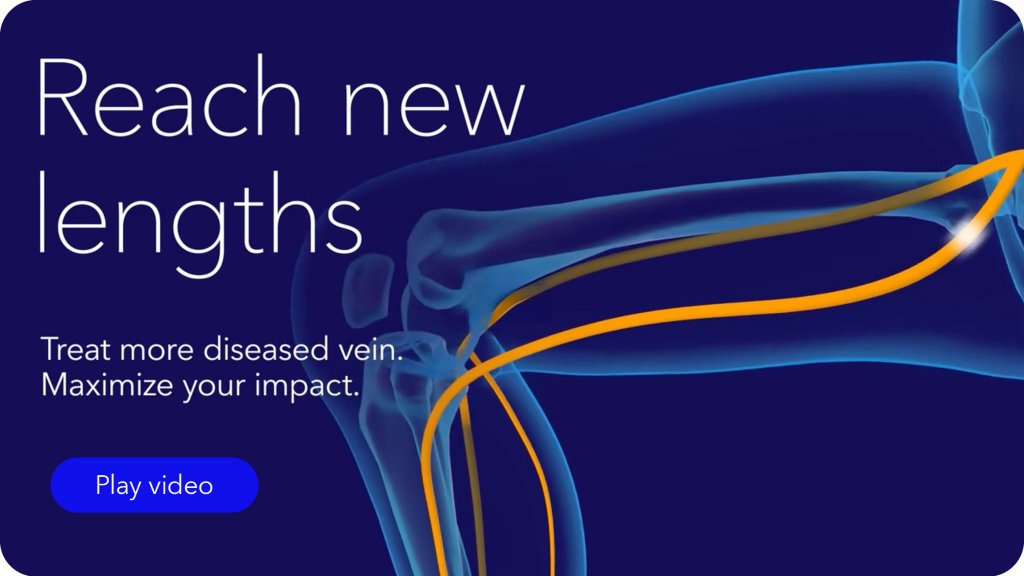
Watch this video to see how VenaSeal™ reaches new lengths in treating more diseased veins and maximizing patient outcomes.
How the VenaSeal™ closure system works
Procedural efficiencies
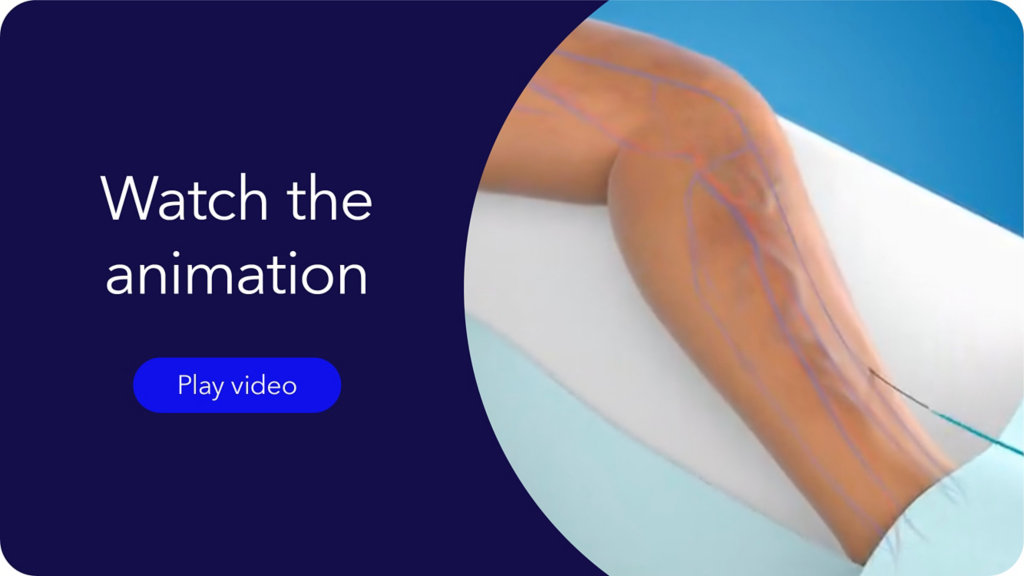
View a VenaSeal™ closure system procedure animation to see how the single, double, and triple segment treatment options work.
Patient impact
Jeanne's story
Hear about Jeanne's experience with the VenaSeal™ closure system.
Anne's story
Hear about Anne's experience with the VenaSeal™ closure system.
The VenaSeal™ closure system procedure offers:
Rapid return to normal activities after treatment1,3
Minimized pain, tenderness, and ecchymosis3
Significant improvements in quality of life6
The VenaSeal™ closure system procedure eliminates2,4:
Tumescent anesthesia
Thermal nerve injury
Post-procedure compression stockings†
Features
Precision
The proprietary catheter is highly visible under ultrasound, allowing precise delivery of the adhesive. The dispensing gun precisely controls the amount of adhesive, delivering 0.10 mL aliquots with each trigger pull.
Polymerization
Upon contact with blood, the adhesive begins to bond with the intima, and compression is applied to close the vein. The adhesive was designed to remain permanently in the diseased vein and is encapsulated by chronic fibrosis.7
Viscosity
The viscosity of the adhesive is specifically designed to minimize migration and embolization.
Flexibility
The adhesive is designed to be soft and flexible and less likely to be felt by the patient.
patients would choose VenaSeal™ procedure again at five years5
75%
improvement in VCSS scores at five years5
94.6%
closure rate at five years5
System components
Adhesive
Plunger
Release button
Trigger
Dispensing tip
Catheter
Kit specifications
VenaSeal™ adhesive
Five mL of the VenaSeal™ adhesive (a specially formulated n-butyl-2-cyanoacrylate) is contained within a screw-capped vial.
Dispenser gun
The dispenser gun consists of a pistol-type ergonomic handle with an integrated barrel and trigger. Each depression of the trigger delivers a controlled 0.10 mL (range: 0.06–0.12 mL) amount of adhesive.
Catheter
The catheter is 5 Fr with an effective length of 91 cm, laser markings at 3 cm and 85 cm from the tip, and high echogenic visibility.
Introducer
The introducer is 7 Fr with an effective length of 80 cm, with 10 mm spaced circumferential markings along its length for measuring retraction length during the VenaSeal™ procedure.
Dilator
The dilator is 5 Fr with an effective length of 87 cm.
Syringe
The 3 mL syringes are graduated Monoject™* luer-lock syringes, each with a standard threaded luer-lock connector.
Dispenser tips
The dispenser tips are each comprised of a stainless steel, 1.5 mm ID, 3.8 cm length hypotube with a luer-lock connector.
Guidewire
The guidewire is a 0.035 in, 180 cm straight floppy-tip guidewire.
Ordering information
VenaSeal™ system
Item number
Description
VS-403
Glass vial with 5 mL adhesive, dispenser gun, 5 Fr x 91 cm catheter, 7 Fr x 80 cm introducer, 5 Fr x 87 cm dilator, (2) 3 mL syringes, (2) 14 ga dispenser tips, guidewire: 0.035 in, (0.89 mm) 180 cm straight floppy-tip
VenaSeal™ system accessories
Item number
Description
CLFKITTP
Full procedure pack with tumescent tubing set
EU-CLF-KITAC-TP
Procedure pack — blue tray, introducer needle, long green needle, blue trolley wrap, ultrasound probe cover, introducer sheath, (3) ultrasound gel, guidewire, tumescent tubing set
TM* Third-party brands are trademarks of their respective owners.
† Demonstrated in C2–C4 patients.
‡ Some patients may benefit from the use of compression stockings post-procedure.
TM* Third-party brands are trademarks of their respective owners.
† Demonstrated in C2–C4 patients.
‡ Based on multi-center retrospective cohort study of 119 patients with CEAP class 6 venous ulcers.
§ Some patients may benefit from the use of compression stockings post-procedure.
Morrison N, Gibson K, McEnroe S, et al. Randomized trial comparing cyanoacrylate embolization and radiofrequency ablation for incompetent great saphenous veins (VeClose). J Vasc Surg. 2015;61(4):985–994.
Proebstle T, Alm J, Dimitri S, et al. Three-year follow-up results of the prospective European Multicenter Cohort Study on cyanoacrylate embolization for treatment of refluxing great saphenous veins. J Vasc Surg Venous Lymphat Disord. 2021;9(2):329–334.
Gibson K, Ferris B. Cyanoacrylate closure of incompetent great, small and accessory saphenous veins without the use of post-procedure compression: Initial outcomes of a post-market evaluation of the VenaSeal system (the WAVES Study). Vascular. 2017;25(2):149–156.
Almeida JI, Javier JJ, Mackay EG, Bautista C, Cher DJ, Proebstle TM. Thirty-sixth month follow-up of first-in-human use of cyanoacrylate adhesive for treatment of saphenous vein incompetence. J Vasc Surg Venous Lymphat Disord. 2017;5(5):658–666.
Morrison N, Gibson K, Vasquez M, Weiss R, Jones A. Five-year extension study of patients from a randomized clinical trial (VeClose) comparing cyanoacrylate closure versus radiofrequency ablation for the treatment of incompetent great saphenous veins. J Vasc Surg Venous Lymphat Disord. 2020;8(6):978–989.
Morrison N, Gibson, Vasquez M, et al. VeClose trial 12-month outcomes of cyanoacrylate closure versus radiofrequency ablation for incompetent great saphenous veins. J Vasc Surg. 2017;5(3):321–330.
Morrison, N. VenaSeal closure system vs. radiofrequency ablation for incompetent great saphenous veins (VeClose). 36-month results presented at: IVC; April 20, 2017; Miami, FL.
Proebstle TM, Alm BJ, Gockeritz O, et al. Five-year results from the prospective European multicentre cohort study on radiofrequency segmental thermal ablation for incompetent great saphenous veins. Br J Surg. 2015;102(3):212–218.
Gibson K, Glorieux K. VenaSeal versus ablation with endothermal laser or radiofrequency for saphenous vein incompetence: a comparison of utilization of adjunctive phlebectomy (VenaSeal value). Presented at AVLS 2019. Abstract available at: journals.sagepub.com/doi/full/10.1177/0268355519893876. Accessed November 5, 2021.
Morrison N, Gibson K, Vasquez M, et al. VeClose trial 12-month outcomes of cyanoacrylate closure versus radiofrequency ablation for incompetent great saphenous veins. J Vasc Surg. 2017;5(3):321–330.
Morrison N, Gibson, Vasquez M, et al. VeClose trial 12-month outcomes of cyanoacrylate closure versus radiofrequency ablation for incompetent great saphenous veins. J Vasc Surg. 2017;5(3):321–330. doi:10.1016/j.jvsv.2016.12.005.
Morrison N. VenaSeal closure system vs. radiofrequency ablation for incompetent great saphenous veins (VeClose). 36-month results presented at: IVC; April 20, 2017; Miami, FL.
Proebstle TM, Alm BJ, Gockeritz O, et al. Five-year results from the prospective European multicentre cohort study on radiofrequency segmental thermal ablation for incompetent great saphenous veins. Br J Surg. 2015;102(3):212–218. doi:10.1002/bjs.9679.
Gibson K, Glorieux K. VenaSeal versus ablation with endothermal laser or radiofrequency for saphenous vein incompetence: a comparison of utilization of adjunctive phlebectomy (VenaSeal value). Presented at: AVLS 2019; November 2019; Phoenix, AZ. Abstract available at: journals.sagepub.com/doi/full/10.1177/0268355519893876. Accessed August 28, 2025.
You are about to visit a website that is not operated by Medtronic.
We do not review or control the content of external sites and are not responsible for any interactions or transactions that may occur there. Any product availability and regulatory requirements on the destination site may differ depending on your location. When you continue, the terms of use and privacy statement of the external site will apply.
Product availability and regulatory requirements may differ depending on your location. The destination website is governed by the laws and regulations of the country in which it operates, which may be different from those in your country. When you continue, the terms of use and privacy statement of the destination Medtronic site will apply.