Find all the order information for the V-Loc™ wound closure device from page 152 onwards.


Barbed sutures
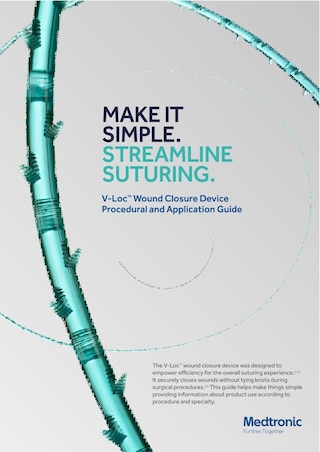
V-Loc™ wound closure device
<p>The V-Loc™ wound closure device is an innovative barbed suture technology that closes wounds without the need to tie knots.</p>
Features
V-Loc™ barbed suture at its best
V-Loc™ wound closure device portfolio
| Product | Image | Package | Description | Absorption time |
|---|---|---|---|---|
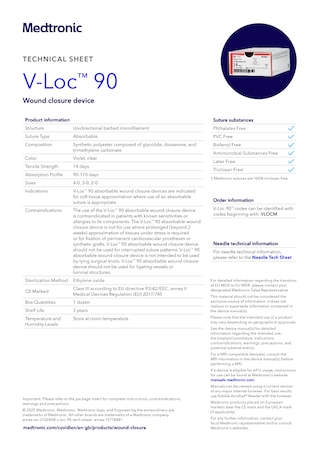
| V-Loc™ 90 device |
 |
 |
Short-term absorbable | 90 days |
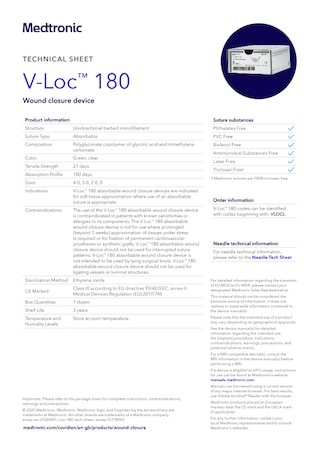
| V-Loc™ 180 device |
 |
 |
Long-term absorbable | 180 days |
| V-Loc™ PBT device |
 |
 |
Non-absorbable polybutester | Permanent |
Resources
Related links
Related products
-
 Endo Stitch™ suturing device
The Endo Stitch™ suturing device is used in endoscopic surgery for the placement of interrupted or running stitches in soft tissues.
-
 VersaOne™ bladed trocar
The VersaOne™ bladed trocar is intended for use in a variety of endoscopic procedures to create and maintain a port of entry.
-
 VersaOne™ bladeless trocar
The VersaOne™ bladeless trocar is intended for use in a variety of endoscopic procedures to create and maintain a port of entry.
-
 VersaOne™ blunt trocar
The VersaOne™ blunt trocar is designed for use in laparoscopic procedures and other minimally invasive surgical procedures.
-
 VersaOne™ fascial closure system
The VersaOne™ fascial closure system is a port-site closure device designed for use during laparoscopic procedures.
-
 VersaOne™ optical trocar
The VersaOne™ optical trocar is intended for use in a variety of gynecologic, general, thoracic and urologic endoscopic procedures.
-
 VersaOne™ universal cannula
The VersaOne™ is intended for use in gynecologic, general, thoracic, urologic endoscopic procedures to create and maintain a port of entry into a body cavity.
TM* Third-party brands are trademarks of their respective owners.
† As compared to conventional sutures.
‡ Based on gynecology study.
§ V-Loc™ device launched in 2009.
◊ Animal data may not correlate with human clinical outcomes.
- Fouda UM, Elsetohy KA, Elshaer HS. Barbed versus conventional suture: A randomized trial for suturing the endometrioma bed after laparoscopic excision of ovarian endometrioma. J Minim Invasive Gynecol. 2016;23(6):962–968.
- Cong L, Li C, Wei B, Zhan L, Wang W, Xu Y. V-Loc™ 180 suture in total laparoscopic hysterectomy: a retrospective study comparing Polysorb™ to barbed suture used for vaginal cuff closure. Eur J Obstet Gynecol Reprod Biol. 2016;207:18–22
- Alessandri F, Remorgida V, Venturini PL, Ferrero S. Unidirectional barbed suture versus continuous suture with intracorporeal knots in laparoscopic myomectomy: a randomized study. J Minim Invasive Gynecol. 2010;17(6):725–729.
- Zaruby J, Gingras K, Taylor J, Maul D. An in vivo comparison of barbed suture devices and conventional monofilament sutures for cosmetic skin closure: biomechanical wound strength and histology. Aesthet Surg J. 2011;31(2):232–240.
- Krishnamoorthy B, Shepherd N, Critchley WR, et al. A randomized study comparing traditional monofilament knotted sutures with barbed knotless sutures for donor leg wound closure in coronary artery bypass surgery. Interact Cardiovasc Thorac Surg. 2016;22(2):161–167.