
Therapies and procedures
Symplicity™ blood pressure procedure
Lifestyle changes and medications have defined hypertension care — until now. Learn how the Symplicity™ procedure complements existing treatments to lower blood pressure.

Renal denervation is recommended in the 2025 hypertension guidelines.
These latest hypertension guidelines were published by the American College of Cardiology (ACC) and American Heart Association (AHA)†,1
Medicare now covers renal denervation for uncontrolled hypertension.
The Centers for Medicare & Medicaid Services (CMS) issued a positive national coverage determination (NCD), which includes the Symplicity™ procedure.‡,2
Current hypertension care strategies are not always enough to help patients achieve blood pressure control. The Symplicity™ procedure is the only interventional approach using a single catheter and radiofrequency (RF) energy to help lower blood pressure.3
Seventy-five percent of hypertension patients in the United States do not have their blood pressure under control,4 yet reducing blood pressure can significantly impact the risk for cardiovascular events.
A 10 mmHg reduction in office systolic blood pressure decreases risk for5:
- Major cardiovascular events by 20%
- Stroke by 27%
- Heart failure by 28%
The Symplicity™ procedure, which uses the Symplicity Spyral™ renal denervation system, may be able to help. Continue reading to understand:
Watch one interventional cardiologist’s perspective.

Safety and efficacy data in patients both on and off hypertension medication
The Symplicity Spyral™ system is proven to achieve significant, safe, and sustained blood pressure reductions in the presence and absence of medications in multiple clinical trials and a real-world patient registry.6–9
Results may vary.
)
How the system works
The Symplicity Spyral™ system is comprised of the Symplicity Spyral™ multi-electrode renal denervation catheter and the Symplicity G3™ renal denervation RF generator.
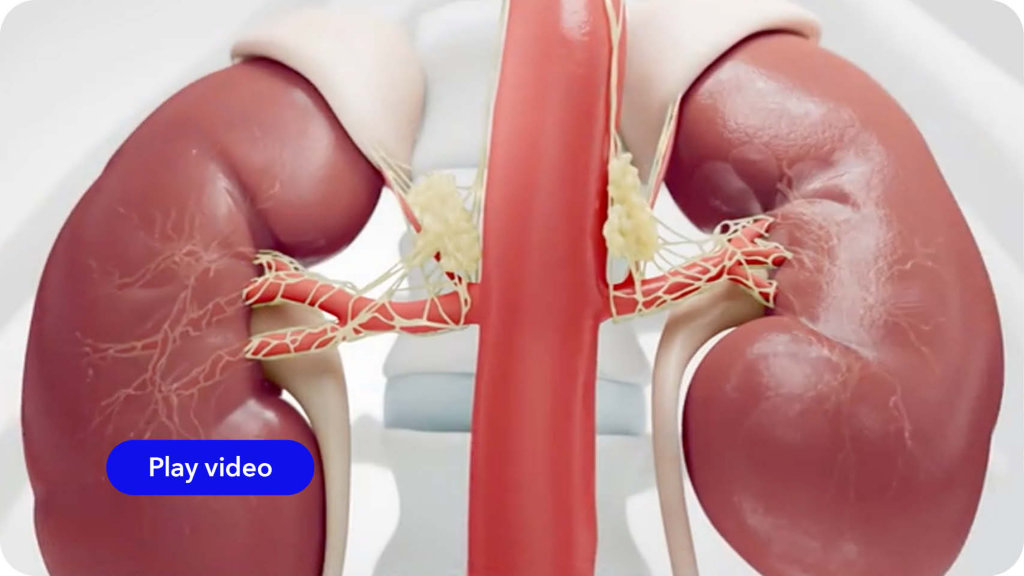
Patients whose blood pressure is difficult to control may have an overactive sympathetic nervous system. The Symplicity™ procedure aims to suppress this inappropriately elevated sympathetic drive. The Symplicity Spyral™ system offers a versatile, simple, and minimally invasive method to perform renal denervation.§,3

Patient selection considerations
Your patients may benefit from the Symplicity™ procedure if they have uncontrolled hypertension and are willing to undergo an interventional procedure following shared decision-making and an attempt at lifestyle modifications and medical therapy.3
View detailed patient selection considerations and a summary of societal recommendations published by AHA, ACC, and the Society for Cardiovascular Angiography & Interventions (SCAI).
We‘re here for you at every turn.
Our goal is to support you and your practice as you become familiar with this therapy. We‘ve thought through everything you‘ll need to establish a Symplicity™ renal denervation program and successfully incorporate the procedure into your practice. Our support includes:
- In-depth training and education
- Detailed resources for patient selection and education
- Expert team providing one-on-one support

Sign up for email to stay up to date.
We want to provide you with the most useful resources as you acquaint yourself with this procedure.
Sign up so we can send relevant information and resources directly to your inbox.
Find a Symplicity™ proceduralist.
Connect your patients with a proceduralist in your area.
Establish a Symplicity™ RDN program.
Understand the suggested framework needed to incorporate the procedure into your practice.
Connect with a representative.
Fill out a short form if you’d like your local Medtronic rep or market development specialist to contact you.
Products
† See ACC/AHA hypertension guidelines for specific patient selection recommendations.
‡ Refer to the national coverage determination for full coverage criteria, including patient, physician, and facility requirements.
§ One catheter size treats vessels 3–8 mm.
- Jones DW, Ferdinand KC, Taler SJ, et al. 2025 AHA/ACC/AANP/AAPA/ABC/ACCP/ACPM/AGS/AMA/ASPC/NMA/PCNA/SGIM Guideline for the Prevention, Detection, Evaluation, and Management of High Blood Pressure in Adults: A Report of the American College of Cardiology/American Heart Association Joint Committee on Clinical Practice Guidelines. J Am Coll Cardiol. 2025;86(18):1567–1678. doi:10.1016/j.jacc.2025.05.007.
- Centers for Medicare and Medicaid Services. Renal denervation for uncontrolled hypertension. Final Decision Memo. Accessed October 28, 2025.
- Symplicity Spyral™ multi-electrode renal denervation catheter instructions for use. Medtronic; November 18, 2023.
- U.S. Department of Health and Human Services. The Surgeon General’s Call to Action to Control Hypertension. Washington, DC: U.S. Department of Health and Human Services, Office of the Surgeon General; 2020.
- Ettehad D, Emdin CA, Kiran A, et al. Blood pressure lowering for prevention of cardiovascular disease and death: a systematic review and meta-analysis. Lancet. 2016;387(10022):957–967. doi:10.1016/S0140-6736(15)01225-8.
- Böhm M, Kario K, Kandzari DE, et al. Efficacy of catheter-based renal denervation in the absence of antihypertensive medications (SPYRAL HTN-OFF MED Pivotal): a multicentre, randomised, sham-controlled trial. Lancet. 2020;395(10234):1444–1451. doi:10.1016/S0140-6736(20)30554-7.
- Kandzari DE, Townsend RR, Kario K, et al. Safety and efficacy of renal denervation in patients taking antihypertensive medication. J Am Coll Cardiol. 2023;82(19):1809–1823. doi:10.1016/j.jacc.2023.08.045.
- Kandzari D, Mahfoud F, Townsend R, et al. Durable safety and efficacy of renal denervation using the Symplicity Spyral catheter in patients taking antihypertensive drugs: final, 3-year results from the SPYRAL HTN-ON MED randomized study. Presented at: TCT 2025; October 25–28, 2025; San Francisco, CA.
- Mahfoud F, Schlaich M, Schmieder RE, et al. Long-term outcomes in ESC guideline-recommended patients for RDN from Global SYMPLICITY Registry DEFINE. Presented at: EuroPCR; May 20–23, 2025; Paris, France.