Deep brain stimulation
BrainSense™ Adaptive DBS technology
The world’s first closed-loop DBS system for Parkinson's disease
The world’s first closed-loop DBS system for Parkinson's disease
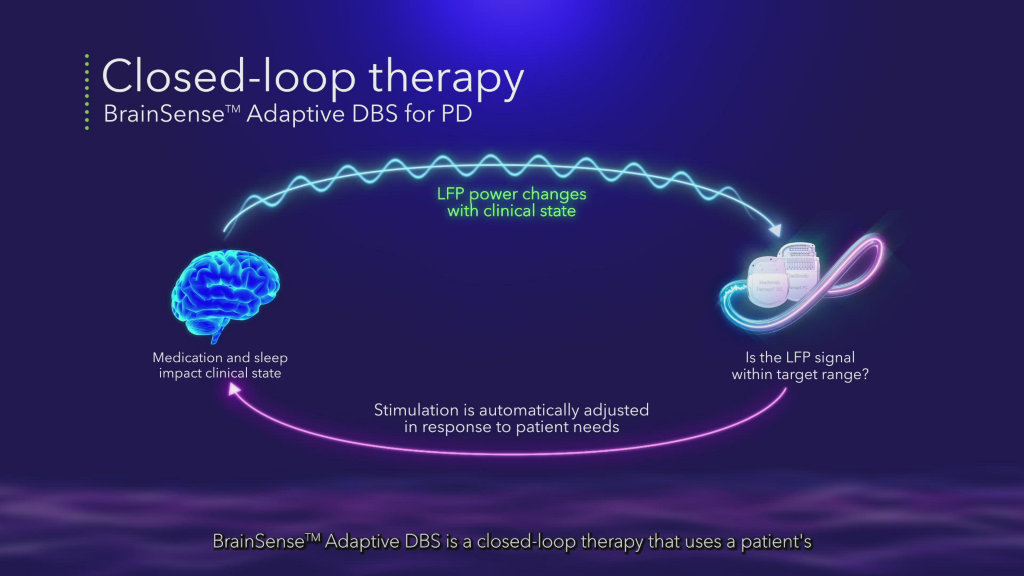
For patients living with Parkinson's disease, symptoms fluctuate throughout the day and night. To meet these needs, BrainSense™ aDBS automatically adjusts the level of therapeutic stimulation based on patient neurophysiology data in real time†, providing more personalized therapy compared to traditional cDBS.

©2026 FIERCE. All right reserved.
©2025 TIME USA LLC. All rights reserved. Used under license.
Many of our Parkinson’s patients fluctuate all day long. They have to use their patient programmer to increase or decrease the stimulation. The idea of having this closed-loop DBS system doing the work is very exciting.”— Monica Volz, Nurse Practitioner

may increase “On” time, on average, compared to traditional DBS (cDBS)‡
see results below from the ADAPT-PD clinical trial

hours/day§

“On” time hours
with BrainSense™ aDBS§

with good “On” time§,◊

of patients with Parkinson's say adaptive DBS (aDBS) technology sounds appealing.¶
of patients with Parkinson’s disease preferred BrainSense™ aDBS over traditional DBS after using for 30 days.#
There are risks and benefits of DBS: Risks include surgical complications, infection, failure to deliver therapy as needed and/or worsening of some symptoms.
The safety profile observed for aDBS is consistent with the safety profile for traditional DBS (cDBS). Stimulation-related side effects are expected during initial aDBS setup, such as worsening of Parkinson’s disease symptoms and dyskinesias, and are expected to resolve with reprogramming. It’s important to ensure patients have regular follow up visits to monitor response to therapy, optimize programming, and manage any stimulation-related side effects promptly, especially within aDBS adjustment and set up periods (at least within the first few months of aDBS programming). aDBS is an optional programming feature and may not work for everyone.
Access on-demand resources — videos, webinars, and more — to deepen your knowledge and uncover the innovations transforming movement disorder care.
Adaptive deep brain stimulation (aDBS) is a form of DBS therapy that automatically adjusts stimulation based on a patient's brain signals. Unlike conventional DBS, which delivers stimulation continuously, aDBS uses BrainSense™ technology to detect changes in neural activity and adapt therapy throughout the day.
Conventional DBS delivers stimulation at a fixed setting, regardless of changes in a patient's symptoms or clinical state. Adaptive DBS (aDBS) continuously monitors specific brain signals and automatically adjusts stimulation to help address motor symptom fluctuations associated with Parkinson's disease.
aDBS is designed for people with Parkinson's disease who experience changes in symptom severity throughout the day. By responding to a patient's unique neural activity, aDBS aims to provide a more personalized therapy experience that adapts as symptoms change.
BrainSense™ technology captures and analyzes brain signals associated with Parkinson's disease. These insights allow the aDBS system to automatically adjust stimulation when changes in neural activity are detected, creating a therapy that responds to the patient's needs in real time.
Motor symptom fluctuations occur when symptoms such as tremor, rigidity, or slowness of movement vary throughout the day. These fluctuations may be influenced by factors such as medication timing, sleep, or disease progression, making consistent symptom management challenging.
Adaptive DBS continuously monitors brain activity, but stimulation adjustments occur only when clinically relevant changes in neural signals are detected. This allows therapy to respond dynamically while remaining personalized to each patient's unique needs.
No. Adaptive DBS is designed to complement, not replace, clinical expertise. Clinicians remain responsible for programming therapy, evaluating outcomes, and making treatment decisions, while aDBS automatically adjusts stimulation based on real-time brain activity.
Medtronic BrainSense™ aDBS combines sensing and stimulation within a closed-loop DBS system, allowing therapy to automatically adapt based on a patient's own brain signals. This personalized approach helps move beyond a one-size-fits-all model of stimulation and supports therapy that can evolve as patient needs change.

The Percept™ PC is a recharge free neurostimulator with sensing, directionality, and advanced programming capabilities for deep brain stimulation (DBS).

Percept™ RC is a rechargeable neurostimulator with sensing, directionality, and advanced programming capabilities for deep brain stimulation (DBS).

The SenSight™ directional DBS lead system combines the benefits of directionality with the power of sensing.
Medtronic MR Conditional∆ systems are backed by more than 14 years of MRI research and testing history.
Access on-demand resources — videos, webinars, and more — to deepen your knowledge and uncover the innovations transforming movement disorder care.
See reimbursement codes and information for Medtronic DBS.
† The sensing feature of the Percept™ PC system and Percept™ RC system is intended for use in patients receiving DBS where chronically-recorded bioelectric data may provide useful, objective information regarding patient clinical status. Signal may not be present or measurable in all patients.
‡ Improved motor symptom control results were based on post hoc analysis averaging overall patient aDBS on time results compared to cDBS. Results presented for dual threshold aDBS. N=40. Based on results from an open-label comparison.
§ Study data with 40 patients evaluated on Dual Threshold mode. ◊ 16 hours.
¶ Based on a Medtronic sponsored opt in survey of n=200 people living with Parkinson's disease in the US and UK conducted in April, 2026. Results reflect self-reported perceptions and experiences.
# Clinical summary. Data from 45 patients who were previously stable on traditional DBS (cDBS).
∆ Medtronic DBS Systems are MR Conditional. Refer to product labeling for full list of conditions. https:manuals.medtronic.com/manuals/mri/region