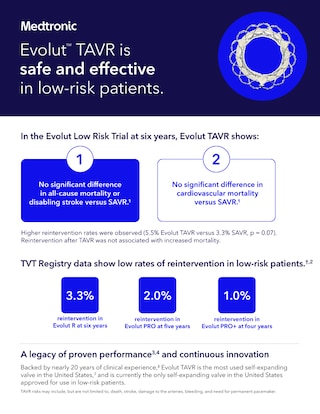
With its supra-annular, self-expanding valve frame, Evolut™ TAVR is built on the original CoreValve™ platform which has consistently shown strong effective orifice areas (EOAs) and low gradients over time.1–3
How did we design for durability?
More height
By decoupling the native annular plane where the sealing occurs, from the working portion of the prosthetic leaflets, you can facilitate circularity and maximize leaflet coaptation.
More surface
Taller leaflet mounting allows for a greater distance between the commissure and the edge of the leaflet, distributing stress over a greater distance.
More room
The tall valve keeps the working portion above and unconstrained by the native annulus (supra-annular), allowing for a large EOA.
More contact
External tissue wrap increases surface contact with native anatomy to reduce the risk of paravalvular leak (PVL).4
Supra-annular design benefits
Large EOAs mean less restriction of blood flow through the valve.5
Large EOAsmean less workload for the ventricle.6
Large EOAs have been correlated to less prosthesis-patient mismatch (PPM).5
Less PPM and low gradients after aortic valve replacement have been linked to:
Better survival7,8
Less heart failure rehospitalization8,9
TAVR risks may include, but are not limited to, death, stroke, damage to the arteries, bleeding, and need for permanent pacemaker.
Explore the evidence.
The CoreValve™/Evolut™ platform has demonstrated excellent hemodynamic results compared with balloon-expandable valves and SAVR across clinical trials.
Forrest JK, Yakuboc SJ, Deeb M, et al. 5-year outcomes after transcatheter or surgical aortic valve replacement in low-risk patients with aortic stenosis. J Am Coll Cardiol. 2025;85(15):1523–1532. doi:10.1016/j.jacc.2025.03.004.
Van Mieghem NM, Deeb GM, Søndergaard L, et al. Self-expanding transcatheter vs. surgical aortic valve replacement in intermediate-risk patients: 5-year outcomes of the SURTAVI randomized clinical trial. JAMA Cardiol. 2022;7(10):1000–1008. doi:10.1001/jamacardio.2022.2695.
Gleason TG, Reardon MJ, Popma JJ, et al. 5-year outcomes of self-expanding transcatheter vs surgical aortic valve replacement in high-risk patients. J Am Coll Cardiol. 2018;72:2687–2696. doi:10.1016/j.jacc.2018.08.2146.
90-day porcine GLP Evolut R study. Results may not be indicative of clinical performance. Medtronic data on file.
Rahimtoola SH. The problem of valve prosthesis-patient mismatch. Circulation. 1978;58(1):20–24. doi:10.1161/01.cir.58.1.20.
Dahou A, Mahjoub H, Pibarot P. Prosthesis-patient mismatch after aortic valve replacement. Curr Treat Options Cardiovasc Med. 2016;18(11):67. doi:10.1007/s11936-016-0488-0.
Playford D, Stewart S, Celermajer D, et al. Poor survival with impaired valvular hemodynamics after aortic valve replacement: The national echo database Australia study. J Am Soc Echocardiogr. 2020;33(9):1077–1086.e1. doi:10.1016/j.echo.2020.04.024.
Herrmann HC, Daneshvar SA, Fonarow GC, et al. Prosthesis-patient mismatch in patients undergoing transcatheter aortic valve replacement: from the STS/ACC TVT Registry. J Am Coll Cardiol. 2018;72(22):2701–2711. doi:10.1016/j.jacc.2018.09.001.
Anand V, Ali MA, Naser J, et al. Incidence, mechanisms, and predictors of mean systolic gradients ≥20 mmHg after transcatheter aortic valve implantation. Am J Cardiol. 2020;125(6):941–947. doi:10.1016/j.amjcard.2019.12.023.