people in the United States are diagnosed annually with ssAS.1–9
48%
of those patients are undertreated nationally.1–10
More than 120,000
remain untreated.8
Women are
up to 35%
less likely than men to be treated for aortic valve replacement (AVR).11
Medical management isn’t enough.
If left untreated, average patient survival is just 50% at two years.12
Symptomatic severeaortic stenosis can be fatal.
Aortic stenosis is among the most common of all valvular heart diseases and continues to increase as our population ages.13 ssAS can be fatal if left untreated.
Once symptoms begin, survival is cut short.12
Aortic valve replacement greatly improves the rate of survival.
“Mortality difference for people with symptoms of aortic stenosis treated with aortic valve replacement versus those not undergoing this procedure is one of the most striking in medicine.“13
For women, the difference in survival is even starker.
If women do receive treatment, they have a lower mortality rate,14 excellent outcomes compared to SAVR,15 and superior valve performance to the SAPIEN™* platform.16
Patients with ssAS: operated versus unoperated ssAS survival rates13,17
Urgency is everything for ssAS patients.
Detect the murmur.
You can help save more lives by recognizing the symptoms of ssAS early on.
Remember to:
Listen for the murmur.
Order an echocardiogram.
Refer patients to a heart valve team without delay.
Learn about determining the severity of aortic stenosis and when to refer patients to the heart team.
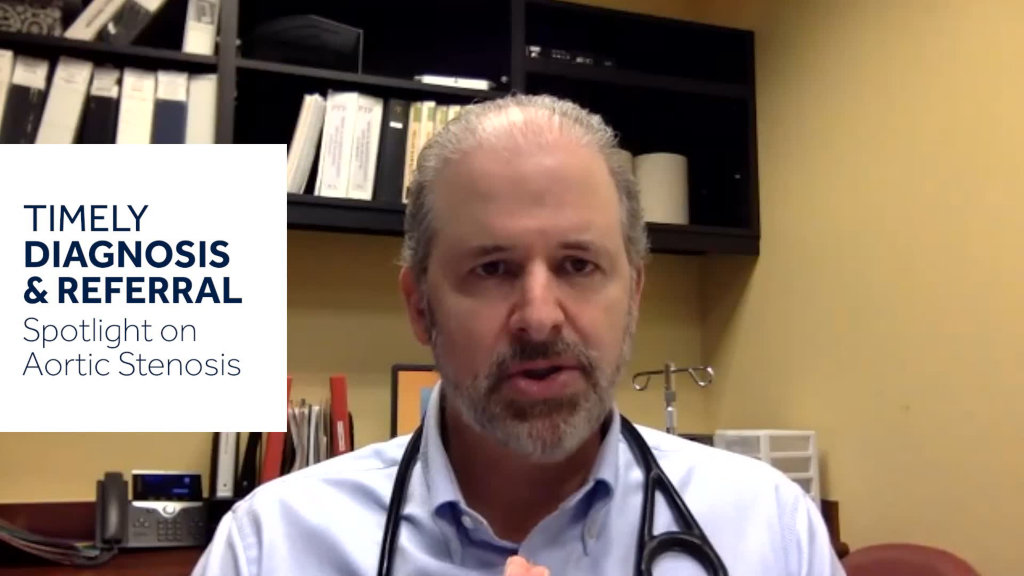
Experts share their experiences assessing and treating patients with severe aortic stenosis.
Refer your ssAS patients to the heart valve team.
Follow updated ACC/AHA guidelines.
“Patients with severe valvular heart disease (VHD) should be evaluated by a multidisciplinary heart valve team when intervention is considered.”
Understanding severe symptomatic aortic stenosis from a patient point of view
90%
of patients with heart valve disease are influenced by conversations with their doctor when making ssAS treatment decisions.18
It’s easier to help patients when you know what they’re thinking. The insights gathered from a national survey conducted by heart-valve-surgery.com, with support from Medtronic, can help you better understand the heart valve patient experience.
Share this resource with your patients and help them learn more about their condition and find a supportive community of other patients diagnosed with ssAS.
Additional information
Inquiries about referring patients or becoming a study site?
Based on STS adult cardiac database. 2010; Harvest, Isolated AVR.
Bach DS, Cimino N, Deeb GM. Unoperated patients with severe aortic stenosis. J Am Coll Cardiol. 2007;50(20):2018–2019. doi: 10.1016/j.jacc.2007.08.011.
Pellikka PA, Sarano ME, Nishimura RA, et al. Outcome of 622 adults with asymptomatic, hemodynamically significant aortic stenosis during prolonged follow-up. Circulation. 2005;111(24):3290–3295. doi: 10.1161/CIRCULATIONAHA.104.495903.
Charlson E, Legedza AT, Hamel MB. Decision-making and outcomes in severe symptomatic aortic stenosis. J Heart Valve Dis. 2006;15(3):312–321.
Nkomo VT, Gardin JM, Skelton TN, Gottdiener JS, Scott CG, Enriquez-Sarano M. Burden of valvular heart diseases: a population-based study. Lancet. 2006;368(9540):1005–1011. doi: 10.1016/S0140-6736(06)69208-8.
Lindroos M, Kupari M, Heikkilä J, Tilvis R. Prevalence of aortic valve abnormalities in the elderly: an echocardiographic study of a random population sample. J Am Coll Cardiol. 1993;21(5):1220–1225. doi: 10.1016/0735-1097(93)90249-z.
Mack MJ, Brennan JM, Brindis R, et al. Outcomes following transcatheter aortic valve replacement in the United States. JAMA. 2013;310(19):2069–2077. doi: 10.1001/jama.2013.282043.
Medtronic data on file.
Lung B, Baron G, Butchart EG, et al. A prospective survey of patients with valvular heart disease in Europe: The Euro heart survey on valvular heart disease. Eur Heart J. 2003;24(13):1231–1243. doi: 10.1016/s0195-668x(03)00201-x.
Bavaria JE. TAVR update: New insights and perspectives from the U.S. National STS/ACC TVT Registry. Available from STS National Database.
Rice CT, Barnett S, O'Connell SP, et al. Impact of gender, ethnicity and social deprivation on access to surgical or transcatheter aortic valve replacement in aortic stenosis: a retrospective database study in England. Open Heart. September 2023;10(2):e002373. doi: 10.1136/openhrt-2023-002373.
Ross J Jr, Braunwald E. Aortic stenosis. Circulation. 1968;38(1 Suppl):61–67. doi: 10.1161/01.cir.38.1s5.v-61.
Carabello BA, Paulus WJ. Aortic stenosis. Lancet. 2009;373(9667):956–966. doi: 10.1016/S0140-6736(09)60211-7.
Williams M, Kodali SK, Hahn RT, et al. Sex-related differences in outcomes after transcatheter or surgical aortic valve replacement in patients with severe aortic stenosis: Insights from the PARTNER Trial (Placement of Aortic Transcatheter Valve). J Am Coll Cardiol. 2014;63(15):1522–1528. doi: 10.1016/j.jacc.2014.01.036.
Reardon M, et al. Transcatheter versus surgical aortic valve replacement in aortic stenosis patients at low surgical risk: 4-year outcomes from the Evolut Low Risk Trial. October 2023.
Herrmann HC, Mehran R, Blackman DJ, Bailey S, et al. Self-expanding or balloon-expandable TAVR in patients with a small aortic annulus. N Engl J Med. 2024;390(21):1959–1971. doi: 10.1056/NEJMoa2312573.
Schwarz F, Baumann P, Manthey J, et al. The effect of aortic valve replacement on survival. Circulation. 1982;66(5):1105-1110. doi: 10.1161/01.cir.66.5.1105.