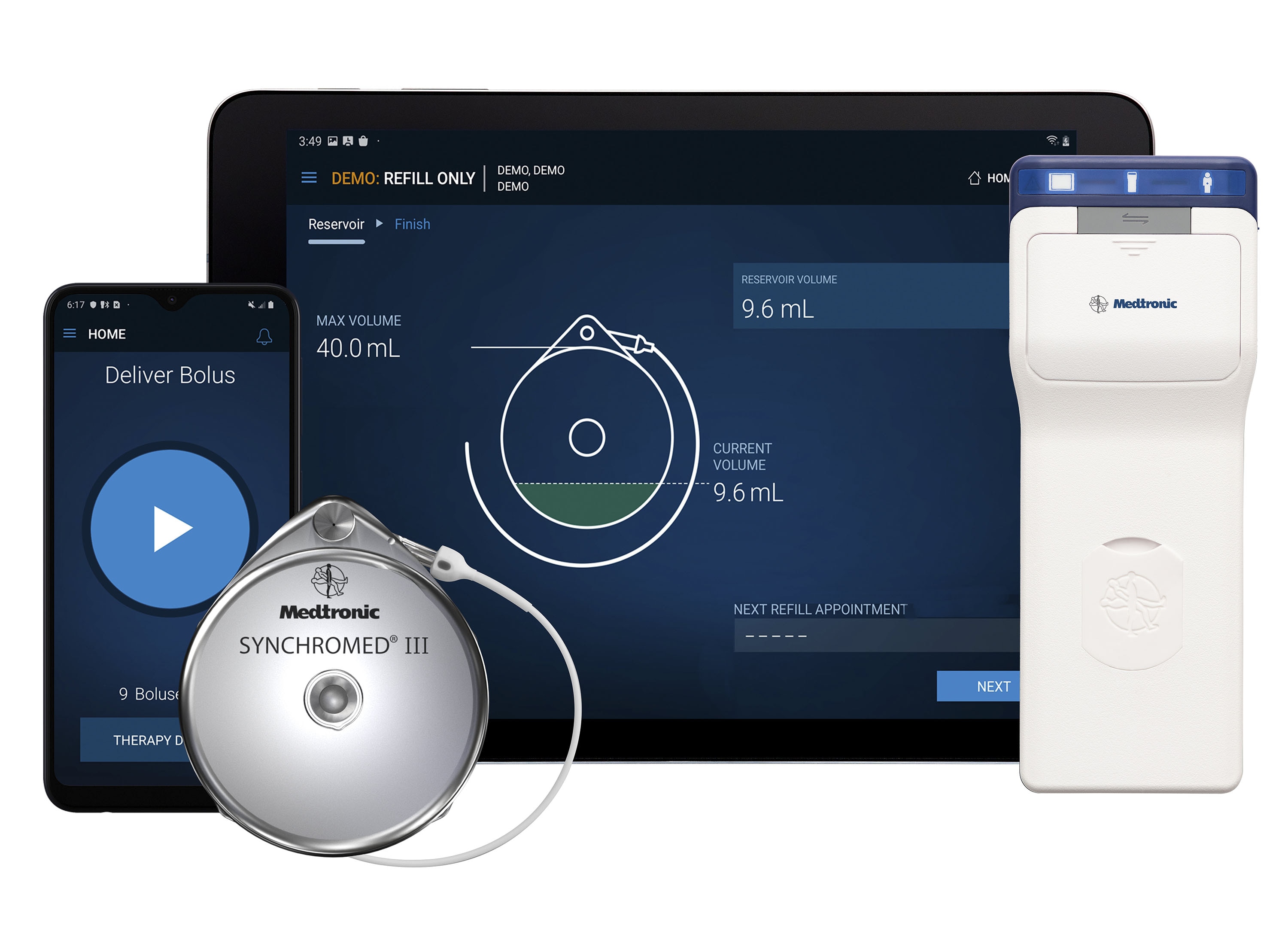
Helping patients reduce severe spasticity with Targeted Drug Delivery (TDD)
Using Targeted Drug Delivery can significantly decrease severe spasticity2,9,12 and spasms.3,7–9 TDD provides provides long-term relief of severe spasticity symptoms with far less baclofen than oral doses.3–5,10 Less medication may help minimize some of the possible side effects that may accompany oral baclofen.3–5,10
SynchroMed™ III implantable infusion system
The SynchroMed™ III implantable infusion system delivers baclofen directly into the intrathecal space, thereby bypassing the blood-brain barrier. As a result, only a fraction of the oral dose is needed to produce efficacy while minimizing systemic side effects.11
In clinical studies, the test dose of TDD for severe spasticity was effective for:
Effectiveness
97%
Patients with spasticity of spinal origin12
Effectiveness
94%
Patients with spasticity of cerebral origin5
Pump Replacement
99.1%
of severe spasticity patients choose to replace the pump13
Patient selection: Targeted Drug Delivery for severe spasticity
The 2005 SPASM consortium defined severe spasticity as troublesome, problematic spasticity for patients and caregivers.12 TDD for severe spasticity should be considered for:
Patients who are unresponsive to oral baclofen or who experience intolerable central nervous system (CNS) side effects from oral baclofen
Spasticity that interferes with function or daily activities14
Spasticity that interferes with care or positioning14
Spasticity-related pain14
Key considerations for patient selection14
TDD for severe spasticity can be an effective tool in improving ambulatory function in certain patients. Rehabilitative therapy should be applied concomitantly in ambulatory patients.
TDD for severe spasticity is a highly effective tool for spasticity reduction in the pediatric population. The unique characteristics of this group require specialized attention, including baseline evaluations for scoliosis, hip status, hydrocephalus, and urodynamic status.
While not a directly disease-modifying treatment, TDD for severe spasticity should be considered early to potentially avoid or delay musculoskeletal and functional consequences of spasticity.
Safety and effectiveness in pediatric patients below the age of four has not been established.
This therapy is not for everyone. Results vary. Not every individual will receive the same benefits or experience the same complications.
TDD for severe spasticity must always be considered in the context of other factors affecting patients with spasticity, with cognitive ability being of paramount significance.
Therapy education and treatment goals for severe spasticity patients14
Patient/family/caregiver education is a crucial process in TDD for severe spasticity. Centers must create a supportive instructive environment that uses all available resources to accomplish the education goals effectively.
Goal setting is necessary for patients and clinicians to approach the usage of TDD for severe spasticity in a meaningful and effective way.
Clinicians must consider the absolute and relative contraindications for TDD for severe spasticity and, if needed, develop appropriate strategies for addressing these issues.
Relative contraindications include unrealistic goals, unmanageable mental health issues, psychosocial factors affecting compliance, and financial burden.
Discover SychroMed™ III
See how the SynchroMed™ III pump works to help alleviate pain.
Penn RD. Intrathecal baclofen for spasticity of spinal origin: seven years of experiences. Neurosurg. 1992;77(s):236–240.
Francisco GC, Boake C. Improvement in walking speed in poststroke spastic hemiplegia after intrathecal baclofen therapy: a preliminary study. Arch Phys Med Rehabil. 2003:84(8):1194–1199.
Meythale r JM, Guin Renfroe S, Brunner RC, Hadley MN. Intrathecal baclofen for spastic hypertonia from stroke. Stroke. 2001;32(9):2099 2109.
Ivanhoe CB, Francisco GE, McGuire JR, Subramanian T, Grissom SP. Intrathecal baclofen management of poststroke spastic hypertonia: implications for function and quality of life. Arch Phys Med Rehabil. 2006;87(11):1509–1515.
Gilmartin R, Bruce D, Storrs BB, et al. Intrathecal baclofen for management of spastic cerebral palsy: Multicenter trial. J Child Neurol. 2000;15(2):71–77.
Hoving MA, van Raak EP, Spincemaille GH, Palmans LJ, Becher JG, Vles JS; Dutch Study Group on Child Spasticity. Efficacy of intrathecal baclofen therapy in children with intractable spastic cerebral palsy: a randomised controlled trial. Eur J Paediatr Neurol. 2009;13:240–246.
Albright AL, Gilmartin R, Swift D, Krach LE, Ivanhoe CB, McLaughlin JF. Long-term intrathecal baclofen therapy for severe spasticity of cerebral origin. J Neurosurg. 2003;98(2):291–295.
Coffey RJ, Cahill D, Steers W. Intrathecal baclofen for intractable spasticity of spinal origin: results of a long-term multicenter study. J Neurosurg. 1993;78(6):226–232.
Ordia JI, Fischer E, Adamski E, Chagnon KG, Spatz EL. Continuous intrathecal baclofen infusion by a programmable pump in 131 consecutive patients with severe spasticity of spinal origin. Neuromodulation. 2002;5(1):16–24.
Meythaler JM, DeVivo MJ, Hadley M. Prospective study on the use of bolus intrathecal baclofen for spastic hypertonia due to acquired brain injury. Arch Phys Med Rehabil. 1996;77(5): 461–466.
Penn RD, Savoy SM, Corcos D, et al. Intrathecal baclofen for severe spinal spasticity. N Engl J Med. 1989; 320: 1517–1521.
Pandyan AD, et al. Spasticity: clinical perceptions, neurological realities and meaningful measurement. Disabil Rehabil. 2005;27:2–6.
Schiess et al, Intrathecal Baclofen for Severe Spasticity: Longitudinal Data From the Product Surveillance Registry. Neuromodulation. 2020; 23(7):996–1002
Saulino M., Ivanhoe CB., McGuire J.R., Ridley B., Shilt J.S., Boster A.L. Best Practices for Intrathecal Baclofen Therapy: Patient Selection. Neuromodulation 2016; 19:607–615.
Pandyan AD, Gregoric M, Barnes MP et al. Spasticity: clinical perceptions, neurological realities and meaningful measurement. Disabil Rehabil 2005;27:2–6
Best Practices for Intrathecal Baclofen Therapy: Patient Selection. Neuromodulation. 2016;19: 607- 615. Saulino M, Ivanhoe CB, McGuire JR, Ridley B, Shilt JS, Boster AL.